
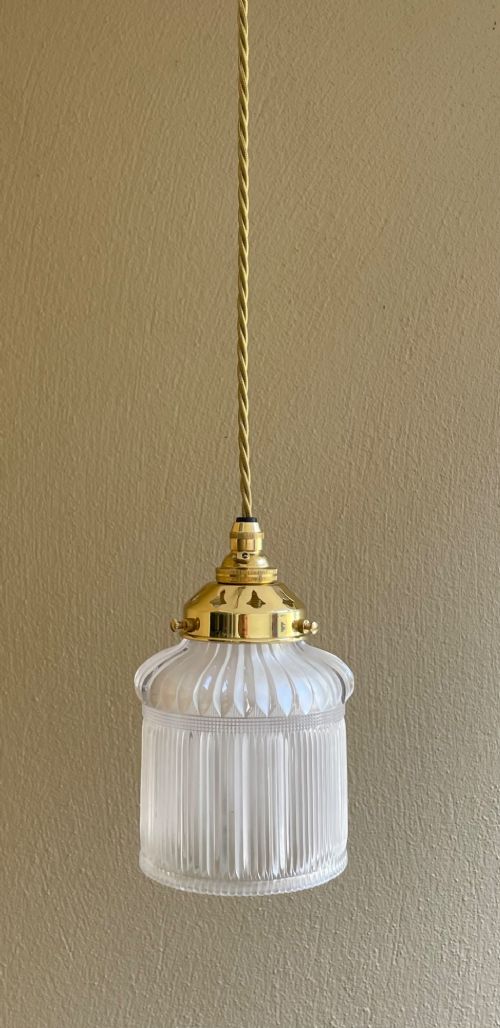


Prismatic Glass Pendant
These prismatic glass pendant lights combine industrial utility with exceptional refractive qualities, offering a brilliant centrepiece for period and contemporary interiors alike.
Prismatic Glass Pendant
When you search for prismatic glass pendant, you are looking at utilitarian lighting fixtures designed to diffuse and redirect strong artificial illumination across large spaces. The pieces gathered here span from the 19th Century through the Edwardian era up to 1940, capturing decades of functional design. Most examples on this page date from the 1920 period, alongside Edwardian and 1910 variations.
The primary form represented is the pendant light, frequently featuring the distinct Holophane shade. These range in size from nine-inch models to larger bell pendants and double prismatic configurations. Originally utilised in factories, shops, and public buildings, they now provide robust character in domestic settings.
How they were made
The defining physical attribute of these lights is the moulded prismatic glass shade, engineered with precise ridges to control and spread light efficiently. This glass is paired with robust metal mountings, including brass and chrome galleries, as well as cast iron components.
Makers utilised these durable materials to withstand demanding commercial and industrial environments. The combination of heavy pressed glass and secure metal fittings ensured longevity and reliable suspension over extended periods of use.
Listings feature pendant lights spanning the 19th Century, Edwardian era, 1910, 1920, and 1940 periods, incorporating brass, chrome, and cast iron.
What varies in quality
Quality in these pendant lights lies in the clarity and weight of the glass, alongside the integrity of the metal gallery. Finer examples display crisp, uniform prismatic ribs that refract light cleanly without distortion.
The transition between the glass shade and the supporting metalwork also reveals distinction. Superior pieces feature well-matched galleries in brass or chrome that hold the glass firmly while maintaining period-appropriate proportion.
The Prismatic Glass Pendant Glossary
- Prismatic glass
- Pressed glass moulded with specific geometric ribs or prisms designed to refract and diffuse light efficiently. This technique reduces glare while maximising illumination.
- Holophane
- A prominent manufacturer and style associated with scientific light distribution through prismatic glass shades. The name became synonymous with this specific type of industrial glassware.
- Gallery
- The metal collar or mount that grips the upper rim of a glass shade and connects it to the suspension rod or chain. Galleries are commonly cast in brass, chrome, or iron.
- Bell pendant
- A lighting fixture featuring a shade shaped like a conventional bell, directing the majority of light downwards. This form is typical in industrial and commercial interiors.
- Double prismatic
- A shade construction utilising two layers of prismatic glass to achieve enhanced optical control. This configuration provides superior diffusion for intense light sources.
Prismatic Glass Pendant: Frequently Asked Questions
Where were these pendant lights originally used?
These lights were primarily installed in 19th Century and early 20th Century factories, workshops, and commercial premises where efficient task lighting was essential.
Their robust construction and scientific glass design made them ideal for large spaces requiring bright, glare-free illumination over extended working hours.
How do I identify an Edwardian prismatic pendant?
Edwardian examples typically feature specific proportioning and mounting styles associated with the early 1900s, often paired with brass galleries.
Examining the weight of the glass and the design of the metal fittings helps distinguish these pieces from later 1920 or 1940 productions.
What is the difference between single and double prismatic glass?
Single prismatic shades utilise one layer of moulded glass ribs to redirect light, while double prismatic versions incorporate a secondary optical layer.
This extra layer provides finer control over light diffusion, often found in more complex industrial applications.
Can these industrial lights suit modern homes?
These pendants adapt readily to contemporary domestic interiors, bringing an authentic industrial aesthetic to kitchens, hallways, and dining areas.
Their neutral glass and metal construction allows them to sit comfortably alongside both modern and traditional furnishings.