


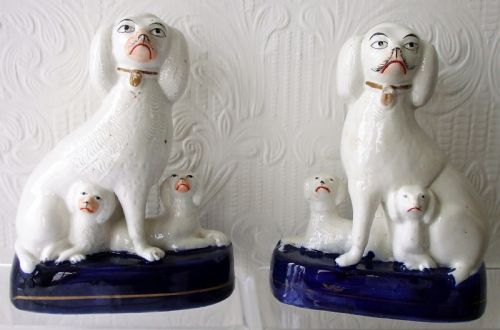


Pottery Hearth Spaniels
Pottery hearth spaniels bring unmistakable nineteenth century character to a mantelpiece, offering the traditional charm of Victorian Staffordshire figures.
Pottery Hearth Spaniels
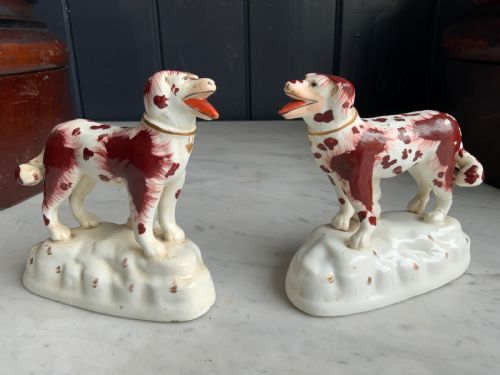
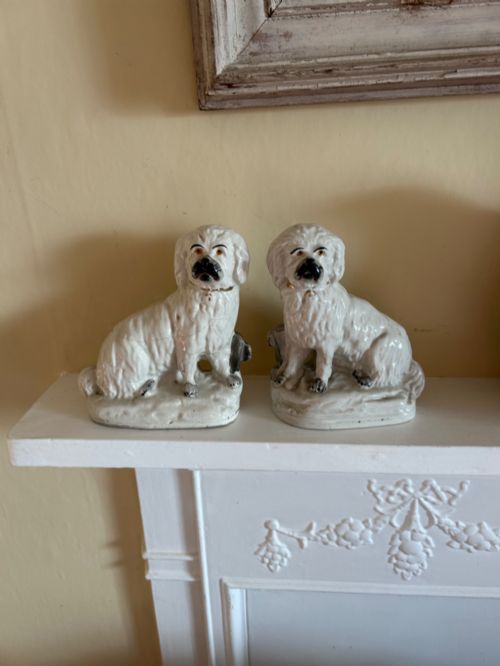
Pottery hearth spaniels comprise decorative ceramic figures modelled as seated dogs, commonly found in pairs that were traditionally placed on mantelpieces in nineteenth century homes. These figures represent iconic English traditional subjects, particularly spaniels, poodles with pups, and Maltese terriers.
The selections seen here span the Victorian era, with dates stretching from the Regency period through to the late nineteenth century. Most examples take the form of symmetrical pairs intended to sit facing one another on either side of a fireplace.
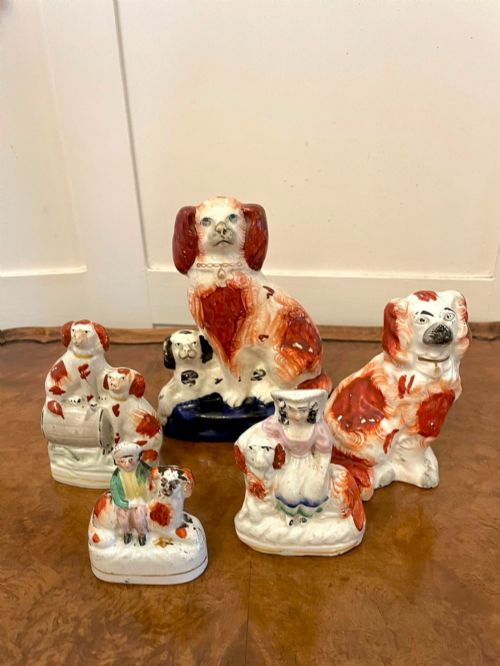
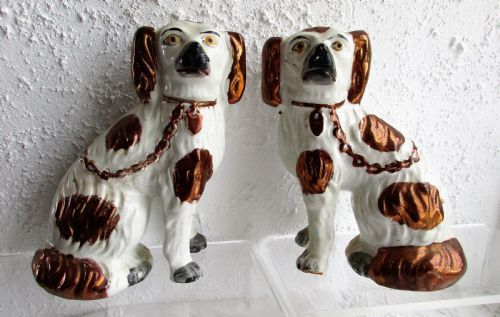
Makers and decorators produced these ornamental dogs in various sizes, ranging from grand pairs down to smaller collections. Collectors encounter white glazed bodies, red and white markings, and pieces finished with copper lustre or gold leaf accents.
How they were made
Pottery hearth spaniels are constructed from earthenware and ceramic, shaped into figures using traditional moulding techniques. Potters then applied glazes to seal the clay body before adding surface details.
Decoration relied on hand painted enamel colours, copper lustre accents, and touches of gold leaf or gilt. Some pieces incorporate textured elements such as encrusting to represent fur or cushions.
Pottery Hearth Spaniels Retail Price Guide 2026
Typical asking prices for pottery hearth spaniels among the pieces listed under this phrase on Sellingantiques today, from the lower quarter to the upper quarter. They describe what is for sale here now, not the wider market.
Some spaniels sit proudly on blue cushions adorned with textured clay encrusting.
What varies in quality
Consistency in the glazing and the depth of copper lustre or gold leaf application mark out superior examples. Weight, scale, and the balanced modeling of paired figures further influence the character of each piece.
Beswick
The Pottery Hearth Spaniels Glossary
- Earthenware
- A porous type of pottery fired at lower temperatures, commonly used for nineteenth century Staffordshire figures. It forms the ceramic body beneath the surface glaze.
- Copper lustre
- A metallic glaze finish producing a reflective, copper-hued sheen on pottery surfaces. Potters applied this technique to add rich ornamentation to figurine details.
- Enamel
- Vitreous coloured paints applied over the glazed ceramic body and fired again to fix the design. These pigments provide the distinct red, white, and black markings on the dogs.
- Encrusting
- Applied ceramic clay particles or slip used to create textured surface effects resembling curly fur or fabric trim. This technique appears on specialised decorative models.
Pottery Hearth Spaniels: Frequently Asked Questions
What are pottery hearth spaniels?
Pottery hearth spaniels are decorative ceramic figures modelled as dogs, historically produced in Staffordshire during the nineteenth century. Households placed them on mantelpieces as traditional ornaments.
These figures often depict seated spaniels, poodles, or terriers, frequently created as symmetrical pairs to anchor either end of a fireplace.
How were they used in homes?
Victorian families placed these ceramic dogs on mantelpieces above hearths to serve as domestic ornaments. They sat in matching pairs facing inwards toward the centre of the fireplace.
Beyond mantelpieces, collectors gathered them in groups on tables or sideboards as part of standard Victorian interior decoration.
How do you date these figures?
Dating pottery hearth spaniels relies on stylistic traits, glazing methods, and manufacturing characteristics associated with the nineteenth century. Figures from the Regency period exhibit distinct modeling compared to later Victorian iterations.
Details such as copper lustre finishes, gold leaf application, and specific ceramic bodies help connect individual pieces to eras spanning from 1845 to 1900.
Are they always found in pairs?
Many examples survive as pairs designed to sit symmetrically on a mantelpiece, reflecting how potters originally manufactured and sold them. Left and right facing dogs formed standard sets for fireplace display.
At the same time, collectors also encounter larger collections of four, five, or six individual figures that were gathered together over time.