
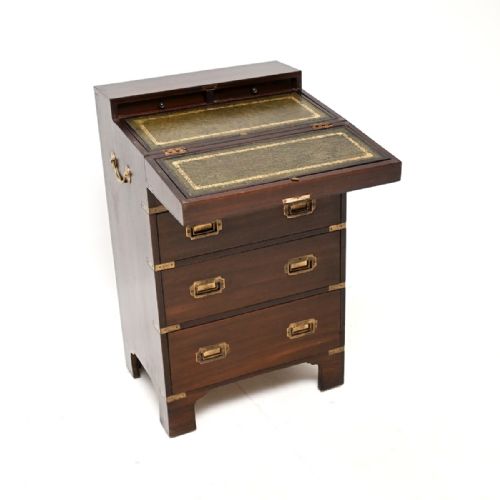
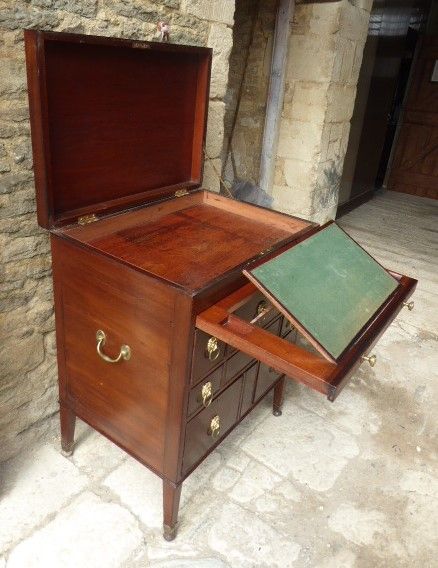


Portable Military Chest
A portable military chest brings the clever ingenuity of campaign design into the home.
Portable Military Chest
A portable military chest encompasses a versatile array of furniture designed for travel, including chests of drawers, writing slopes, washstands, and apothecary boxes. These pieces belong primarily to the Georgian and 19th Century periods, reflecting the practical needs of officers on the move.
Mahogany and teak dominate the selection on this page, often paired with brass fittings and leather details to withstand the rigours of transit. Forms range from compact lap desks to large camphor trunks and secretaire chests.
Makers such as A W Insall produced specialised travelling items, while Anglo-Indian examples showcase regional variations in rosewood. Buyers frequently encounter George III designs alongside later Victorian military and colonial iterations.
How they were made
Cabinet makers utilised dense timbers like mahogany, teak, and rosewood to ensure structural integrity during military campaigns. These woods were often built in sections, allowing heavy pieces of furniture to separate easily for transport.
Brass corners, flush-fitting handles, and strapwork were integrated to protect vulnerable edges from knocks and heavy handling on voyages. Internal fittings frequently included baize linings, ceramic compartments, and clever metamorphic mechanisms for writing or washing.
Listings feature mahogany, teak, and rosewood across Georgian and 19th Century periods.
What varies in quality
The sophistication of the internal mechanism separates standard travel boxes from finer commissioned pieces. Elaborate metamorphic desks and secretaire drawers require precise joinery that operates smoothly after decades of use.
The choice of timber and the integration of quality brass hardware dictate the calibre of the chest. Finer examples retain their original fitted interiors, leather surfaces, and structural stability across their sectional parts.
A W Insall
The Portable Military Chest Glossary
- Campaign
- Furniture specifically engineered to dismantle or fold for military travel, usually fitted with recessed brass handles to prevent catching.
- Secretaire
- A cabinet or chest featuring a pull-out drawer with a fitted writing surface and small compartments for stationery.
- Metamorphic
- Describing furniture that transforms from one form into another, such as a lap desk converting into a reading stand.
- Baize
- A coarse woolen material resembling felt, traditionally used to line writing slopes and gaming surfaces.
- Apothecary box
- A specialised portable case fitted with small glass bottles and jars for storing medicines and chemical compounds.
Portable Military Chest: Frequently Asked Questions
What is a portable military chest?
A portable military chest is a piece of collapsible furniture designed for officers and travellers on the move. These items were built to split into sections or fold away compactly for transit.
Examples on this page span chests of drawers, writing desks, and washstands from the Georgian and 19th Century eras.
How were campaign chests transported?
These chests were constructed in two or more stacking sections equipped with sturdy carrying handles. This modular design allowed them to be packed onto animals or wagons during military expeditions.
Recessed brass hardware ensured that handles and fittings did not snag on ropes or canvas covers.
What materials are used in campaign furniture?
Cabinet makers relied on durable hardwoods such as mahogany, teak, and rosewood to resist warping and damage. Brass was universally employed for corner brackets, hinges, and flush handles.
Internal compartments often incorporated secondary materials like leather, baize, and ceramic fittings.
How do I care for a campaign chest?
Keep these pieces away from direct heat sources and dramatic humidity changes to protect the solid hardwood construction. Regular dusting with a dry cloth helps preserve the polished timber finish.
Avoid placing damp items directly onto antique leather or wooden writing surfaces.