


Polished Brass Ceiling Lantern
A polished brass ceiling lantern brings warm metallic lustre and focused downward illumination to a hallway or entrance.
Polished Brass Ceiling Lantern
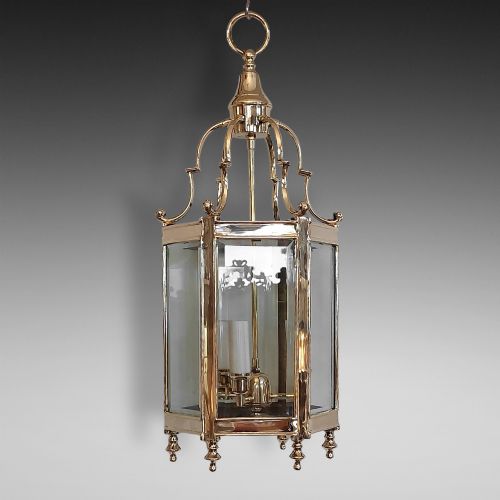
A polished brass ceiling lantern forms a striking focal point in corridors, entrance halls, and stairwells where overhead lighting requires both presence and clarity. These hanging light fixtures span the Edwardian era through the nineteen thirties, encompassing English and French workshop traditions.
The selections range from compact hexagonal and simple single-bulb designs to substantial multi-light configurations suitable for high ceilings. Buyers encountering these fixtures will find both restrained Arts and Crafts interpretations and more ornate French Chateau or classical silhouettes.
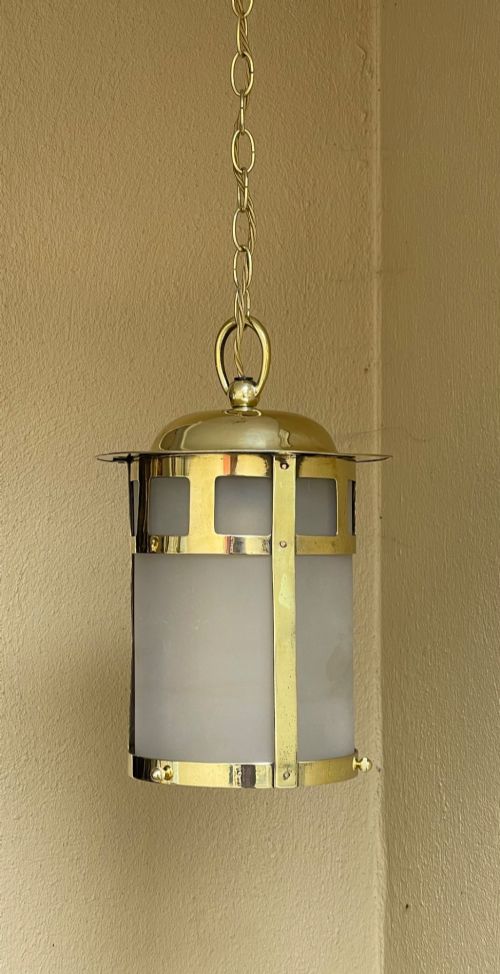
Earlier examples lean towards Edwardian proportions and Arts and Crafts simplicity, while later nineteen thirties pieces often incorporate steel elements alongside brass frameworks. Most pieces function as pendant lights suspended by chains or rods, distributing light through clear or frosted glass panes.
Materials and construction methods
Construction relies heavily on sheet and cast brass frameworks soldered or screwed together to house glass panels securely. Many pieces combine brass with copper or steel components, particularly in larger multi-light configurations dating from the nineteen thirties.
Glazing typically involves clear, frosted, or occasionally stained glass held within metal framing channels or secured by internal glazing bars. Metal surfaces are polished to a bright finish, accentuating the natural metallic sheen of the brass and copper elements.
Early twentieth-century makers ensured hallways received proper illumination long before the invention of the dimmer switch.
Distinctions in manufacture and finish
Quality rests upon the gauge of the metal framework and the precision of the joints holding the glass panels in place. Heavier brass castings and robust structural framing indicate superior original manufacture compared to lighter, more utilitarian alternatives.
The integrity of the glass panels and the refinement of decorative details, such as cast brass mounts or period-appropriate suspension hardware, separate standard production items from more ambitious architectural commissions.
The Polished Brass Ceiling Lantern Glossary
- Hexagonal lantern
- A hanging light fixture defined by a six-sided glazed body. This geometry allows light to project evenly in multiple directions.
- Pendant light
- A luminaire suspended from the ceiling by a chain, cord, or metal rod. It positions the light source lower in the room space.
- Frosted glass
- Translucent glass treated by acid-etching or sandblasting to diffuse illumination. It softens the glare from internal bulbs.
- Arts and Crafts
- A design movement prioritising honest construction and simple functional forms. Ornate ornamentation is largely absent in these pieces.
Polished Brass Ceiling Lantern: Frequently Asked Questions
Where should I hang a brass lantern?
These fixtures suit hallways, entrance foyers, and stairwells where overhead clearance allows for a hanging pendant. Their downward and lateral illumination defines circulation spaces effectively.
Ensure the ceiling height accommodates the specific drop of the chain or rod suspension to maintain proper clearance below.
How do I date a brass lantern?
Dating relies on stylistic markers and material combinations visible in the framework. Edwardian and early twentieth-century pieces often display simpler geometric or Arts and Crafts lines.
Later nineteen thirties examples frequently introduce steel structural elements alongside brass, accommodating larger multi-light cluster fittings.
Are these lanterns wired for modern use?
Most surviving fixtures require professional rewiring or electrical safety checks to meet current domestic standards. Restoration work often retains the original metal body while updating internal lamp holders.
Buyers should consult a qualified electrician regarding safe installation and compatible bulb wattage for antique metal fittings.
What is the difference between French and English styles?
English examples from the early twentieth century tend to follow restrained Edwardian or Arts and Crafts principles. They frequently feature clean geometric brass frames.
French pieces from the nineteen thirties often present larger proportions, heavier steel and brass construction, and multi-light capacities designed for grander interior volumes.