
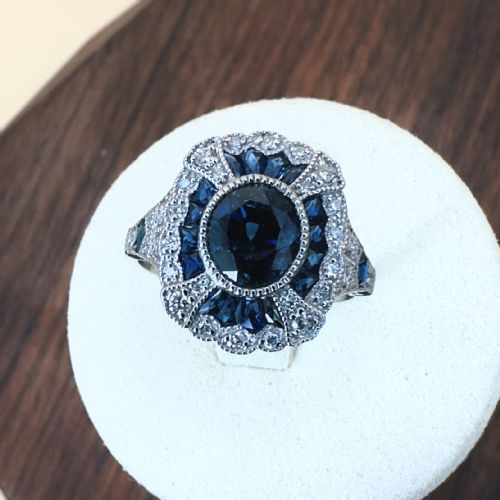


Platinum Sapphire Target Ring
A platinum sapphire target ring draws the eye with its precise concentric circles of stones, channelling the geometric focus of the interwar period.
Platinum Sapphire Target Ring
A platinum sapphire target ring centres on a vibrant blue stone encircled by concentric rows of diamonds, creating the distinctive concentric pattern of the target motif.
Most pieces encountered here originate from the Art Deco period of the 1920s and 1930s, alongside Edwardian and mid-century examples spanning 1940 to 1960.
The form functions primarily as a dress ring or cocktail ring, occasionally serving as an engagement ring for those drawn to geometric antique jewellery.
How they were made
Goldsmiths utilised durable platinum to construct intricate settings that could support numerous small diamonds without heavy metal bulk.
Yellow gold, white gold, and rose gold appear frequently as secondary metals, often combined with platinum tops to showcase the stones effectively.
Cut types vary from old cut and rose cut diamonds to calibré cut and baguette sapphires, shaped specifically to fit strict geometric borders.
Listings feature rings from the Edwardian era through the 1920s, 1930s, 1940s, 1950s, and 1960s, utilising platinum, yellow gold, white gold, and rose gold.
What varies in quality
The precision of the concentric stone arrangement dictates visual harmony, where uniform spacing separates exceptional examples from ordinary compositions.
The origin and saturation of the sapphire influence value, with natural unheated stones commanding greater attention than synthetic alternatives.
The Platinum Sapphire Target Ring Glossary
- Target ring
- A ring featuring concentric circles of contrasting gemstones around a central stone. This layout creates a concentrated focal point reminiscent of a shooting target.
- Calibré cut
- Gemstones specifically shaped and cut to fit tight geometric channels in a mounting. This technique requires expert stone cutting to maintain continuous lines.
- Old cut
- A diamond cut style predating the modern brilliant cut, characterised by a smaller table and larger culet. These stones display a softer, candlelit sparkle.
- Pave setting
- A surface closely set with small gems held by minimal shared beads of metal. The technique creates a continuous pavement of brilliance.
- Baguette
- A rectangular step-cut gemstone shape with straight parallel sides. It provides linear contrast to round stones in vintage cluster designs.
Platinum Sapphire Target Ring: Frequently Asked Questions
How do I wear a target ring daily?
Wear the ring with care during physical activities to protect the intricate stone settings from knocks and potential gemstone loss.
Store the piece in a dedicated jewellery box separately from harder items to prevent scratching the platinum and gold surfaces.
Are synthetic sapphires common in vintage rings?
Synthetic sapphires appear in several period pieces from the early twentieth century alongside natural stones. Laboratory-grown gems offered uniform colour and clarity during the manufacturing eras.
Independent certification or professional appraisal helps determine whether a sapphire formed naturally in the earth or in a laboratory.
What is the difference between Edwardian and Art Deco rings?
Edwardian rings emphasise delicate lace-like platinum work, floral motifs, and softer yellow gold elements. They often feature romantic daisy cluster designs.
Art Deco rings embrace bold geometric symmetry, sharp angles, and strict concentric target patterns, utilising white metals almost exclusively.
Can I resize a platinum and gold ring?
Jewellers can resize most rings of this construction by adding or removing a small section of the metal shank. The presence of delicate shoulder stones requires cautious evaluation by an experienced specialist.
Consult a skilled antique specialist to ensure the structural integrity of the concentric setting remains undisturbed during the resizing process.