


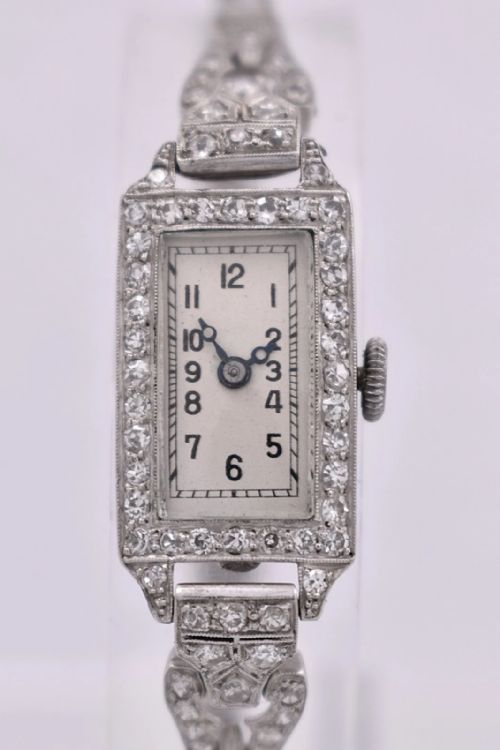


Platinum Diamond Cocktail Watch
A platinum diamond cocktail watch brings together period precision and evening glamour through intricate metalwork and sparkling stones.
Platinum Diamond Cocktail Watch
A platinum diamond cocktail watch is a sophisticated timepiece designed primarily as evening jewellery rather than a purely utilitarian object. These watches span several decades from the 1920s through to the 1960s, with the Art Deco aesthetic heavily represented across the pieces.
The objects take the form of ladies wristwatches, fob watches, and bracelet watches. Most examples combine dense diamond settings with geometric or asymmetrical metal designs.
Materials and construction methods
The primary metal utilised is platinum, often paired with 18ct white gold for bracelets, mesh bands, or case backs. Diamond carat weights vary substantially, with stones hand-set to maximise brilliance around the dial.
Movements are driven by manual wind mechanisms, frequently incorporating Swiss jewelled lever technology. Glass covers protect the watch faces, while straps include integrated metal mesh, fabric, or full platinum bracelet links.
Platinum Diamond Cocktail Watch Retail Price Guide 2026
Typical asking prices for platinum diamond cocktail watch among the pieces listed under this phrase on Sellingantiques today, from the lower quarter to the upper quarter. They describe what is for sale here now, not the wider market.
Listings span the 1920s to the 1960s, featuring platinum, white gold, fabric, and glass.
Assessing quality and craftsmanship
Quality rests upon the intricacy of the metal fabrication and the scale of the diamond weight. Pieces featuring named makers or complex asymmetrical cases demonstrate higher levels of period design ambition.
The integration of the bracelet with the watch head distinguishes standard models from superior examples. Hand-finished platinum work and higher diamond carat totals elevate individual pieces within the range.
Asprey·Vertex·Longines·Omega·Bensons of London·Movado·Tissot·Arsa
The Platinum Diamond Cocktail Watch Glossary
- Art Deco
- A design style dominant in the 1920s and 1930s characterised by geometric symmetry, clean lines, and stylised motifs. It heavily influences the architecture of these watch cases.
- Manual wind
- A mechanical movement requiring the wearer to manually turn the crown to tension the mainspring. This traditional winding method is standard in vintage timepieces.
- Swiss jewelled lever
- An escapement mechanism utilising small synthetic rubies to reduce friction in the gear train. This inclusion indicates a higher grade of watchmaking precision.
- Mesh bracelet
- A flexible strap woven from fine metal wire, providing a supple and comfortable fit around the wrist. It is frequently cast in white gold or platinum to match the watch head.
Platinum Diamond Cocktail Watch: Frequently Asked Questions
What is a platinum diamond cocktail watch?
A platinum diamond cocktail watch is a vintage timepiece created to serve as both jewellery and a functional accessory for evening wear. These pieces are defined by precious platinum mountings and sparkling diamond settings.
Most examples date from the Art Deco period through to the mid-century decades. They prioritise artistic expression and intricate metalwork over simple timekeeping.
How do I wind a manual watch?
Manual wind watches require you to gently turn the crown between your thumb and forefinger until you feel resistance. Do not force the crown once tension builds, as this can damage the mainspring.
Wind the watch at a consistent time each day if you wear it regularly. This habit keeps the mechanical movement operating smoothly.
Can I wear my cocktail watch daily?
While these watches were built with durable platinum and quality movements, their delicate bracelets and intricate stone settings make them better suited for special occasions. Treating them as fine jewellery ensures the small components remain secure.
Store the watch in a lined box when not in use to protect the delicate mesh bands and glass crystals from accidental knocks.
How do I date these watches?
Dating relies on stylistic clues such as geometric Art Deco motifs from the 1920s and 1930s, or cleaner mid-century lines from the 1950s and 1960s. Maker signatures and movement engravings also help establish the decade of production.
Comparing the case shape, such as asymmetrical wave or hooded designs, provides further context for the manufacturing period.