
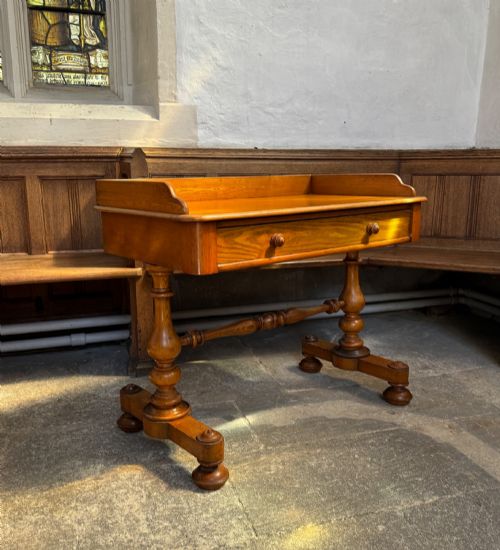
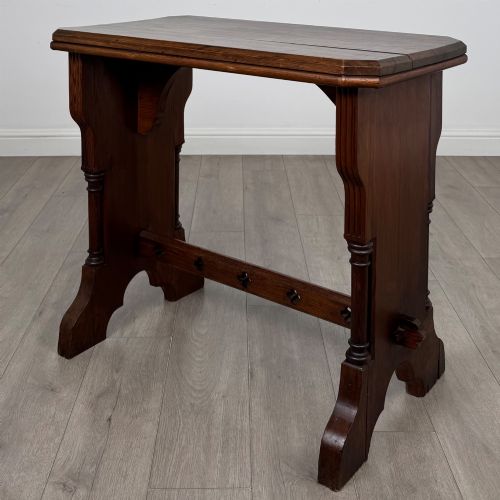
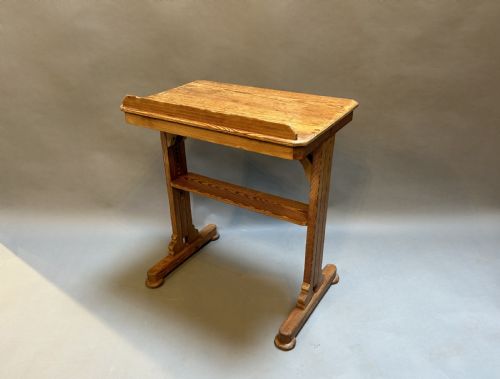


Pine Trestle Desk
A pine trestle desk offers a sturdy working surface supported by braced trestle ends, combining utility with rustic charm.
Pine Trestle Desk
When buyers search for a pine trestle desk, they encounter working tables, writing desks, and lecterns constructed primarily from timber. The selection spans the nineteenth century and early twentieth century, taking in Victorian, Edwardian, and regional European styles.
The pieces appearing here include pitch pine writing desks, ecclesiastical writing tables, and industrial work tables with iron components. These utilitarian objects served in offices, institutions, and domestic settings, bringing straightforward utility to modern spaces.
Originating from English, French, Swedish, and Welsh workshops, the variations demonstrate regional preferences in construction. Plain pine boards and pitch pine timber dominate the forms, often retaining traces of original paint or natural patination.
How they were made
Makers utilised pine and denser pitch pine for tops and framework, occasionally combining timber with iron bases or brass fittings. Structural support relied upon trestle frames and X-frame bracing to bear heavy loads without wobble.
Surfaces were left bare, waxed, or finished with traditional paint applications such as Swedish Falu red paint. Joinery prioritized durability for practical use in taverns, workshops, and ecclesiastical interiors.
Some nineteenth-century work tables retain splashes of foundry paint and tavern spills, carrying the honest scars of centuries past.
What varies in quality
Quality rests in the selection of the timber, particularly the tighter grain and durability found in pitch pine examples. The integrity of the trestle bracing and the retention of original surface treatments, including early paint layers, elevate a piece.
Proportion and scale distinguish standard utility tables from finer architectural or ecclesiastical writing desks. Refined edge moulding and solid iron or brass hardware separate utilitarian workshop items from more considered domestic furniture.
The Pine Trestle Desk Glossary
- Trestle
- A structural support consisting of a horizontal beam fixed to two splayed legs at each end. This form provides robust stability for tables and desks without requiring corner legs.
- Pitch pine
- A resinous North American pine species prized for its density and distinct grain pattern. Cabinet makers favoured it for durable furniture requiring strength.
- Falu red
- A deep red paint originating from copper mines in Sweden, traditionally used to protect timber exteriors and furniture. It imparts a matte finish that weathers distinctly over time.
- Ecclesiastical
- Pertaining to the Christian church and its clergy, often describing furnishings made for chapels, vestries, or schools. These pieces frequently display Gothic Revival design details.
- X-frame
- A furniture base constructed from crossed timber members forming an X shape for added structural rigidity. This configuration appears commonly on tavern and work tables.
Pine Trestle Desk: Frequently Asked Questions
What is a pine trestle desk?
A pine trestle desk is a practical working surface supported by trestle ends rather than standard corner legs. These pieces draw on nineteenth-century and early twentieth-century utilitarian designs.
Constructed from pine or pitch pine, they range from simple workshop benches to Gothic-influenced writing tables. Their sturdy build makes them well-suited for modern study spaces.
How do I date a pine desk?
Dating relies on examining construction methods, timber selection, and stylistic cues like Gothic Revival moulding or Edwardian utility markers. Tool marks and fastener types offer further clues to the period.
Nineteenth-century examples often feature dense pitch pine and hand-planed surfaces. Later pieces from the twentieth century show different milling standards and simpler framing.
Where were these desks used?
Original contexts included domestic farmhouse kitchens, trade workshops, taverns, and ecclesiastical institutions. Writing tables and lecterns served clerical or administrative functions in schools and churches.
Their robust construction allowed them to withstand heavy daily use in demanding environments. Today, they transition easily into home offices and living areas.
Are these desks sturdy for daily work?
The trestle construction provides inherent stability, making these tables reliable for writing and computer work. The diagonal bracing prevents lateral movement.
Solid timber tops handle daily wear well, developing a rich patina over the years. Regular maintenance with soft wax helps preserve the wood surface.