

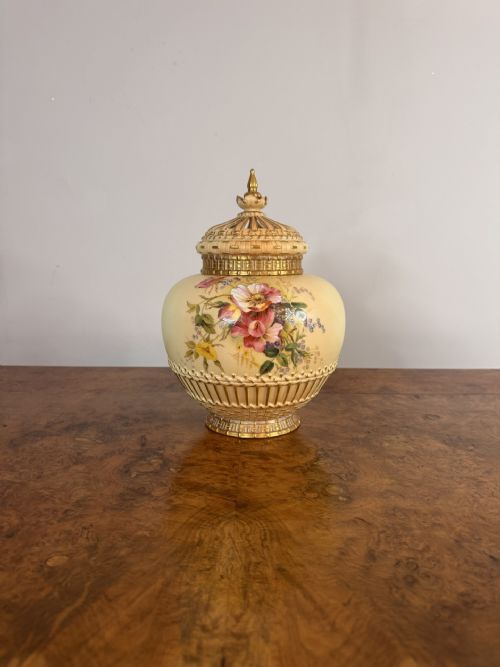


Pierced Porcelain Urn
These pierced porcelain urn pieces are decorative vessels combining delicate ceramic openwork and glaze, offering collectors classical form and fine craftsmanship.
Pierced Porcelain Urn
A pierced porcelain urn is a decorative vessel, often configured as a lidded pot pourri jar or pedestal vase, designed to display fine ceramic work and scent a room. When searching for a pierced porcelain urn, buyers encounter pieces ranging from eighteenth century Derby frill vases and Georgian Mason's ironstone to late nineteenth and early twentieth century Royal Worcester blush ivory creations.
The selection here centres heavily on Victorian and Edwardian Royal Worcester productions, alongside continental examples from Sitzendorf and Herend. Forms typically include ovoid bodies with crown covers, pierced gilt handles, and reticulated collars intended to release fragrance from dried botanicals held within.
Dated specimens span the eighteenth century through to the mid twentieth century, encompassing traditional English styles and flamboyant Rococo revivals. The most frequent iteration on this page is the Royal Worcester pot pourri jar, often featuring hand painted florals or fruit alongside intricate piercing.
Materials and production methods
Makers utilised fine porcelain, bone china, and ironstone as the primary ceramic bodies for these vessels, providing a dense, smooth substrate for subsequent decoration. Potters shaped these materials into ovoid jars, pedestal urns, and vases before applying intricate surface treatments.
Decoration relied heavily on hand painting, particularly floral motifs, chrysanthemums, and fruit, executed alongside extensive gilding, gold leaf, and enamel work. Artisans also employed reticulation and piercing techniques to cut openwork patterns through the wet clay body prior to firing, creating delicate fretwork on necks, handles, and covers.
Pierced Porcelain Urn Retail Price Guide 2026
Typical asking prices for pierced porcelain urn among the pieces listed under this phrase on Sellingantiques today, from the lower quarter to the upper quarter. They describe what is for sale here now, not the wider market.
Listings feature porcelain, ironstone, and bone china pieces spanning the eighteenth century through to the mid twentieth century, with a strong concentration of Victorian and Edwardian Royal Worcester.
Assessing quality in the collection
Quality in these vessels rests on the precision of the reticulation and the skill of the brushwork. Master hands achieved crisp, uniform piercing through fragile porcelain without distortion, whereas lesser work shows uneven cell spacing and clumsy perforation.
Painted decoration further separates ordinary production from exceptional pieces. Standard floral transfers or hurried brushwork yield to detailed hand painted botanical and fruit studies by known artists, accompanied by crisp, raised gilding that elevates the entire vessel.
Royal Worcester·Samuel Alcock·Sitzendorf·Herend·Derby·Mason's Ironstone
The Pierced Porcelain Urn Glossary
- Reticulation
- The technique of cutting geometric or lattice patterns into the clay body before firing to create openwork panels. This delicate process requires immense skill to avoid collapsing the ceramic wall.
- Pot pourri
- A vessel designed to hold dried aromatic plant material, featuring a pierced lid or cover to diffuse scent into a room. These jars often combine decorative urn forms with functional aeration.
- Blush Ivory
- A specialised porcelain body finish developed by Royal Worcester in the late nineteenth century, mimicking the soft, warm tone of human skin. It typically serves as a muted ground for pastel floral painting and gilt highlights.
- Frill Vase
- A ceramic vessel featuring ruffled or fluted clay applications around the rim or body edges. Eighteenth century examples from Derby demonstrate this tactile modelling style.
- Imari
- A decorative style imitating Japanese export porcelain, characterised by a palette of underglaze blue, iron red, and abundant gold leaf. Mason's ironstone pieces frequently adopt this vibrant scheme.
Pierced Porcelain Urn: Frequently Asked Questions
What is a pot pourri jar?
A pot pourri jar is a lidded ceramic vessel engineered to hold dried flowers and spices. The pierced cover allows the contained fragrance to permeate interior spaces.
Historically placed in reception rooms and parlours, these vessels combined practical domestic freshening with high status ornamental display.
How do I date a piece?
Dating relies on maker marks stamped or painted on the underside, stylistic cues like blush ivory finishes, and historical period attributes. Victorian and Edwardian examples often display registration numbers or specific factory ciphers.
Comparing the painting style and the complexity of the reticulation against documented factory timelines helps narrow the decade of production.
How were these urns used?
These urns served primarily as decorative mantelpiece ornaments and functional scent diffusers in wealthy homes. The internal cavity held botanical mixtures that released perfumes through the perforated lids.
Over time, many transitioned purely into cabinet pieces and focal display objects for collectors of fine ceramics.
What is blush ivory?
Blush ivory is a matte cream porcelain body developed during the Victorian era, particularly associated with Royal Worcester. It provides a subdued, warm background designed to accentuate hand painted floral subjects.
Pieces utilising this finish frequently incorporate raised gold gilding to frame the painted panels and highlight the pierced collars.