




Pie Crust Snap Table
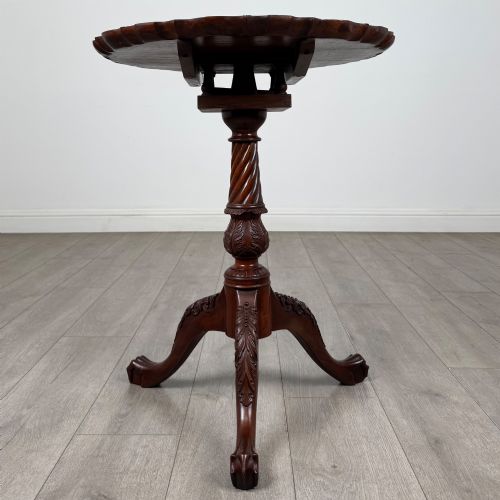
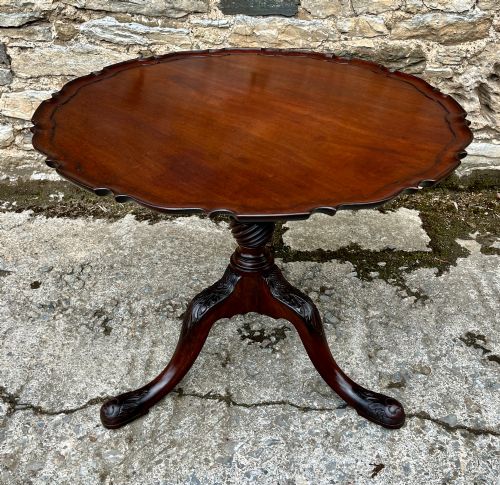
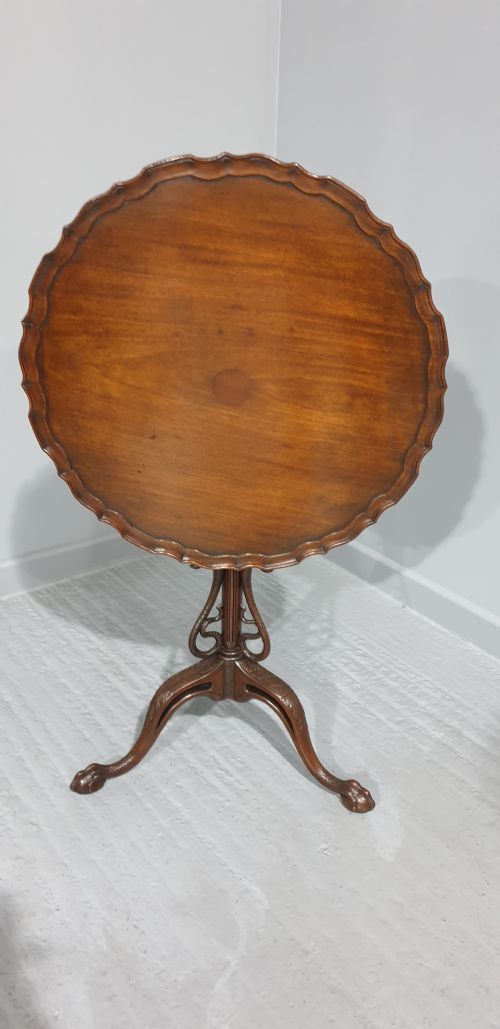
A pie crust snap table brings together timber and ingenuity, offering a tilt-top surface shaped with raised scalloped edges.
Pie Crust Snap Table
A pie crust snap table is a form of occasional table, often designated as a tea table, side table, or supper table, designed for versatility in historic interiors. These pieces appear across Georgian, George III, and nineteenth-century periods, alongside later revival styles.
The defining characteristic is the shaped top with raised moulding reminiscent of pastry crust, paired with a tilting mechanism that allows the surface to be folded upright when not in use. Tripod bases dominate the evidence, supporting the pillar and top with three legs.
Materials and construction
Mahogany serves as the sole material recorded across these pieces, providing a dense and durable timber suited to carved edges and slender tripod supports. Artisans shaped the characteristic scalloped rims directly from solid wood or applied moulded profiles.
The tilting action relies on a clever snap mechanism or catch integrated into the central pillar and block, allowing the table top to pivot and lock securely into a horizontal position.
Judging quality and character
Quality rests in the crispness of the carved edge and the proportional balance between the top, the central turned pillar, and the splayed legs of the tripod base. Earlier Georgian and George III examples display sharper detail in the timber moulding and turning compared to later nineteenth-century interpretations.
The integration of the tilt mechanism also dictates the calibre of the piece, where smooth movement and a snug lock reflect thoughtful historic carpentry rather than loose or clumsy fittings.
The Pie Crust Snap Table Glossary
- Pie crust edge
- A raised, scalloped perimeter carved or moulded onto a round table top to resemble pastry work. This decorative border prevents items from sliding off.
- Snap top
- A mechanism allowing the table top to tilt vertically and lock into place horizontally via a catch. It saves space when the table is pushed against a wall.
- Tilt top table
- A table designed with a hinged top that pivots for easy storage. They frequently double as tea or occasional tables.
- Tripod table
- A piece supported by a single central pillar resting on three legs. This configuration ensures stability on uneven floors.
- Supper table
- A historic term for a small dining or occasional table used for evening meals. These often feature the tilt mechanism for convenient clearing.
Pie Crust Snap Table: Frequently Asked Questions
What is a pie crust snap table?
A pie crust snap table is a small occasional or tea table featuring a round top with a raised, scalloped edge and a tilting mechanism on a tripod base.
The tilting function allows the top to fold flat against the pedestal, enabling the table to be stored compactly against a wall when not in use.
How were these tables used historically?
These tables served primarily for taking tea, playing games, or partaking in light suppers in eighteenth and nineteenth-century parlours.
Because the tops could be tilted upright, they freed up floor space in domestic rooms when entertaining finished for the evening.
What timber are they made from?
The pieces recorded on this page are constructed entirely from mahogany, a dense and reliable hardwood favoured by historic cabinet makers.
Mahogany accepted fine carving on the raised edges and slender turned pillars without splitting or splintering.
How do I distinguish eighteenth-century pieces?
Eighteenth-century and George III examples often exhibit finer hand-carved mouldings on the edges and more refined proportions in the tripod legs.
Later nineteenth-century and revival pieces follow the same traditional forms but tend to display different handling of the timber and turning details.
How do I live with a tilt top table?
Living with these tables involves appreciating their dual nature as both functional surfaces and compact sculptural objects when folded.
Place them beside a chair or in a corner where the tilting mechanism can be admired or utilised when space is required.