
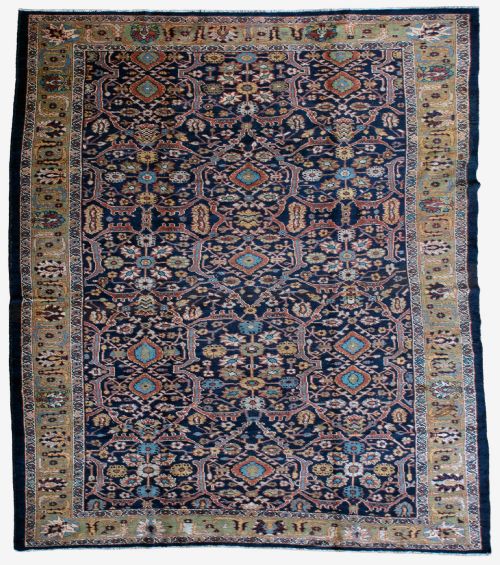
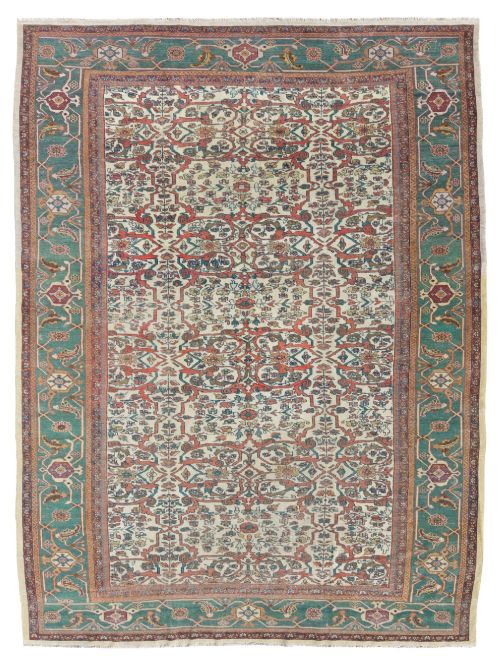
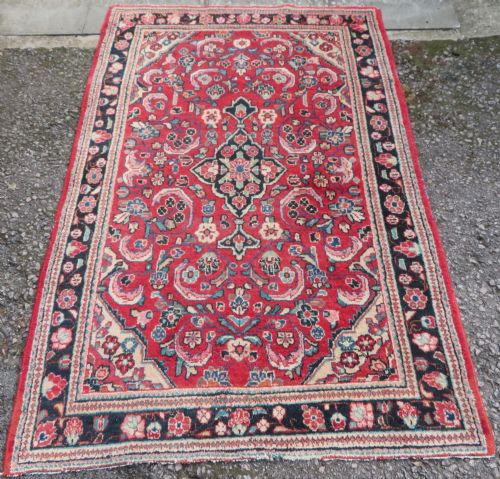
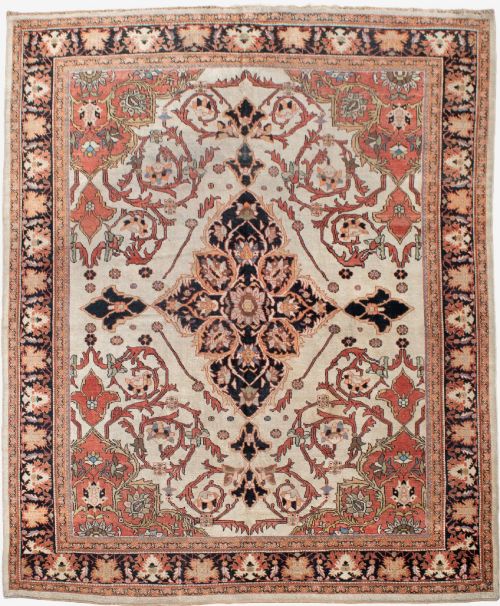


Persian Sultanabad Rug
A Persian sultanabad rug brings grand room-scale pattern and muted vegetable dyes into a modern interior.
Persian Sultanabad Rug
When you search for a persian sultanabad rug, you are looking at large-scale woven floor coverings originating from Western Persia during the nineteenth and early twentieth centuries. These pieces encompass related regional weaving traditions including Mahal and Ziegler production from the same Sultanabad district. You will most frequently meet room-sized carpets and smaller area rugs bearing grand floral motifs and characteristic softened palettes.
The objects on this page span several decades of production from the late nineteenth century through to the interwar period. The forms vary from intimate village rugs to expansive carpets designed for grand reception rooms. West Persian weaving centres during this era produced both commercial carpets for Western export and traditional village pieces for local use.
The design vocabulary relies heavily on oversized palmettes, scrolling vines, and large-scale Herati or all-over patterns. Artisans adapted traditional Persian compositions to suit European and American interior tastes by expanding the scale of the design. This creates a balanced, spacious aesthetic that anchors a contemporary room without overwhelming the floor.
How they were made
The construction of these floor coverings relies on durable natural fibres rotated through traditional hand-knotting techniques on vertical looms. Artisans utilised sturdy cotton for the foundational warps and wefts to ensure structural stability across large formats. Soft wool forms the pile, providing resilience and a deep lustre that mellows gracefully over generations of use.
Dyeing methods combined traditional botanical extracts with precise colorimetric standards demanded by Western merchants operating in Persia. Natural mordants fixed rich madder reds, indigo blues, and soft ivory tones into the fleece before weaving began. This chemical interaction ensures the wool patinates with a soft, uniform fading rather than harsh colour loss.
Early weavers occasionally worked under dim natural light, leaving charming irregularities in the symmetry of the grand floral palmettes.
What varies in quality
The distinction between standard commercial output and superior workshop pieces rests on the handling of the wool and the precision of the knotting. Finer examples display a denser pile that holds crisp drawing within the scrolling floral motifs. Lesser pieces might show coarser fibre selection that obscures the fine curves of the palmettes.
Colour harmony and dye saturation separate the exceptional weaves from ordinary examples. Master weavers achieved depth through nuanced shading within individual motifs, whereas standard pieces rely on flat, uniform tones. The crispness of the secondary scrolling defines the overall architectural discipline of the design.
The Persian Sultanabad Rug Glossary
- Mahal
- A category of carpet woven in the same West Persian district as Sultanabad pieces, often featuring similar large-scale floral designs. These rugs generally display slightly more relaxed drawing compared to urban workshops.
- Ziegler
- A designation originating from the Swiss firm Ziegler and Co., which commissioned carpets in Persia for the Western market using specific subdued palettes. These pieces are prized for their grand scale and softened coloration.
- Warp
- The vertical threads stretched tightly on the loom that form the structural skeleton of the rug. Cotton is the standard material found in these West Persian pieces.
- Weft
- The horizontal threads passed through the warps after each row of knots to bind the structure together. Multiple weft shots create the characteristic handle and flexibility of the carpet.
- Palmette
- A stylized floral motif resembling a symmetrical fan shape, commonly found dominating the field of these large carpets. Artisans rendered them in oversized proportions for decorative impact.
Persian Sultanabad Rug: Frequently Asked Questions
How do I date a carpet?
Dating relies on stylistic shifts, palette changes, and structural evidence recorded across the weaving centres. Nineteenth-century examples often feature deeper natural dyes and finer hand-spun wool.
Later pieces moving into the twentieth century frequently adopt broader borders and slightly brighter vegetal hues. Comparing the knot density and border geometry against verified period pieces provides the clearest chronological anchor.
Where were these rugs made?
These pieces originated in the district surrounding Sultanabad, now known as Arak, in Western Persia. This region functioned as a major hub for commercial carpet production aimed at European and American markets.
Local workshops and surrounding villages coordinated large-scale weaving operations under the supervision of international trading houses. This infrastructure combined traditional Persian motifs with Western interior design preferences.
How do I care for my rug?
Regular gentle vacuuming without a rotating power head prevents dust accumulation in the wool pile. Professional specialist cleaning remains essential every few years to protect the natural fibres and organic dyes.
Keep the piece out of direct, harsh sunlight to prevent uneven fading across the vegetable-dyed wool. Rotating the carpet periodically ensures even wear patterns from heavy foot traffic or furniture placement.
What is the difference between Mahal and Sultanabad?
Sultanabad and Mahal rugs both hail from the same West Persian district and share a similar decorative vocabulary. Sultanabad pieces often denote higher-grade commercial output with finer knotting and more elaborate designs.
Mahal carpets can display slightly looser drawing and are frequently attributed to surrounding village production. Both categories deliver the signature grand scale and muted palette valued by collectors.