

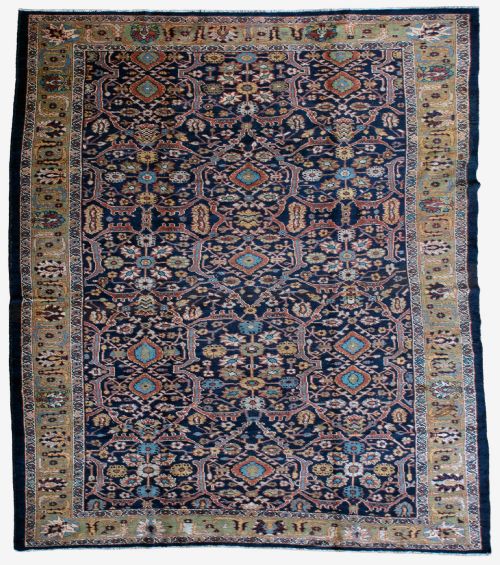
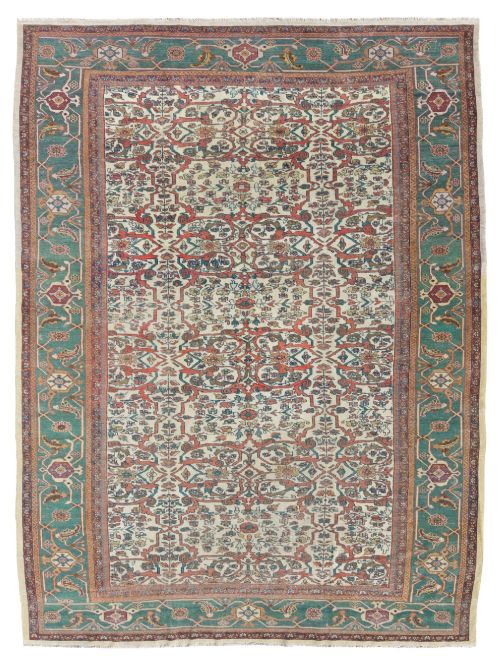
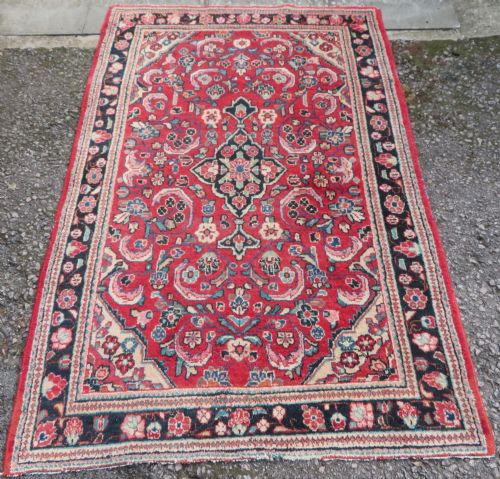
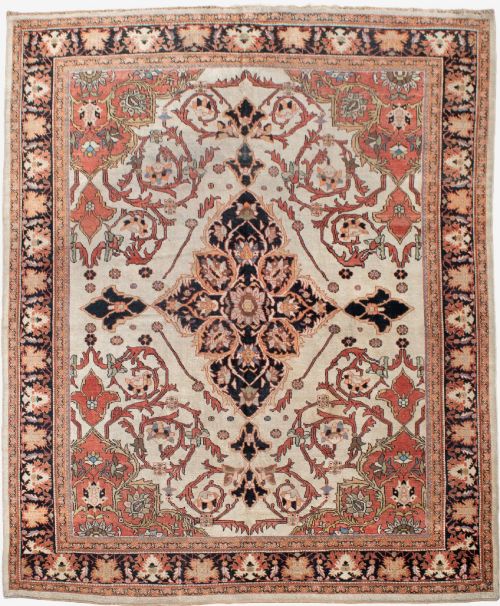
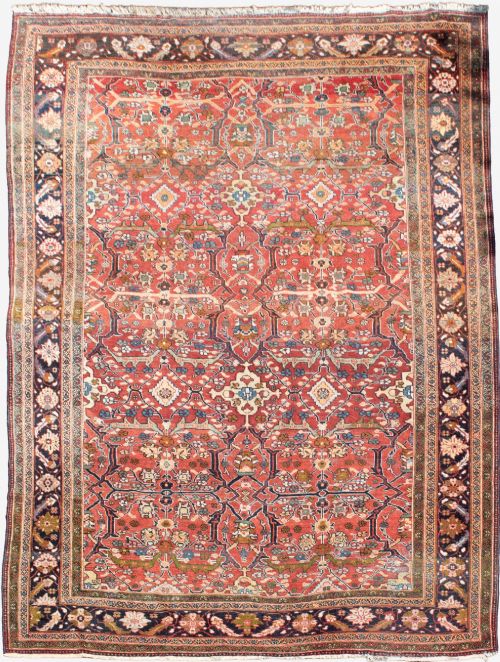


Persian Mahal Area Rug
These persian mahal area rug examples bring grand nineteenth and early twentieth century West Persian artistry straight to your floor.
Persian Mahal Area Rug
When you search for a persian mahal area rug, you are looking at substantial woven floor coverings originating from West Persia during the nineteenth and early twentieth centuries. These pieces encompass village rugs, room-size carpets, and expansive oversize formats carrying traditional Persian designs.
The specimens you meet on this page span from the 1870s through to the 1930s, featuring related regional styles such as Sultanabad, Fereghan, and Ziegler carpets. They serve primarily as heavy floor coverings designed to anchor large rooms with muted or terracotta grounds.
How they were made
Makers constructed these carpets using natural wool piles knotted onto sturdy cotton foundations. This pairing provided the structural durability required for large room-size and oversize formats.
Weavers employed traditional Persian techniques to build dense, resilient surfaces capable of enduring decades of heavy domestic use. The resulting textiles combined local dyeing traditions with robust structural weaving methods.
Listings span from the 1870s through the 1930s, utilising wool and cotton across multiple regional styles including Sultanabad and Ziegler.
What varies in quality
The distinction between standard examples and finer pieces rests in the complexity of the design execution and the crispness of the weave. Tighter knotting allows for sharper delineation of traditional motifs across the wool surface.
Scale and proportion also define the upper tier, particularly in room-size and oversize formats where maintaining geometric harmony across large dimensions requires superior planning by the weaver.
The Persian Mahal Area Rug Glossary
- Mahal
- A West Persian carpet style known for large-scale floral and Herati patterns, produced largely for Western export during the nineteenth and early twentieth centuries.
- Ziegler
- A specific commercial classification of Persian carpet often associated with softer palettes and grand room sizes, produced under European direction.
- Sultanabad
- A nineteenth-century Persian carpet style originating from the same region as Mahal weaves, noted for bold botanical motifs.
- Fereghan
- A designation for fine nineteenth-century Persian carpets recognised for intricate field designs and dense wool construction.
Persian Mahal Area Rug: Frequently Asked Questions
How do I clean a mahal rug?
Gentle surface vacuuming without the rotating brush roll helps remove loose dirt from the wool pile. Professional specialist cleaning remains essential for deep maintenance.
Water and harsh chemical detergents should be avoided to protect the natural fibres and dyes. Periodic inspection by a textile conservator ensures the cotton foundation stays sound.
Where were mahal rugs made?
These carpets originated in the West Persian region, particularly around the village and valley areas associated with Mahal and Sultanabad production. Local workshops and village weavers created them for both domestic use and export markets.
Many examples reflect traditional designs tied to specific valleys and towns in Persia. The output spans a period from the nineteenth century into the early twentieth century.
Are these rugs suitable for high traffic?
The robust wool pile and cotton foundation make these carpets durable enough for everyday living areas. Their historical construction was intended to withstand heavy domestic use over generations.
Placement in moderate to high traffic rooms is common, provided a suitable underlay is used to reduce friction. Regular rotation helps distribute wear evenly across the surface.
How do I date an antique carpet?
Dating relies on examining the materials, colour palettes, weave structure, and stylistic markers characteristic of specific decades. Pieces from the nineteenth century often display distinct natural dye variations compared to later twentieth-century work.
Comparative analysis with documented examples from periods like 1880 or 1900 helps narrow the origin. Structural analysis of the cotton warp and woof provides further clues.