

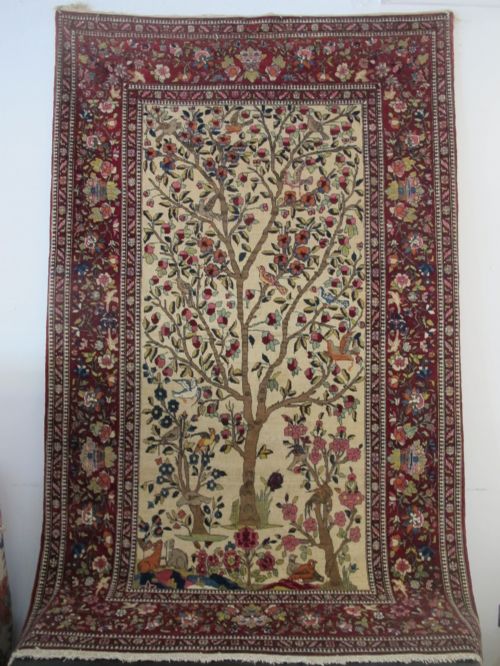


Persian Isfahan Rug
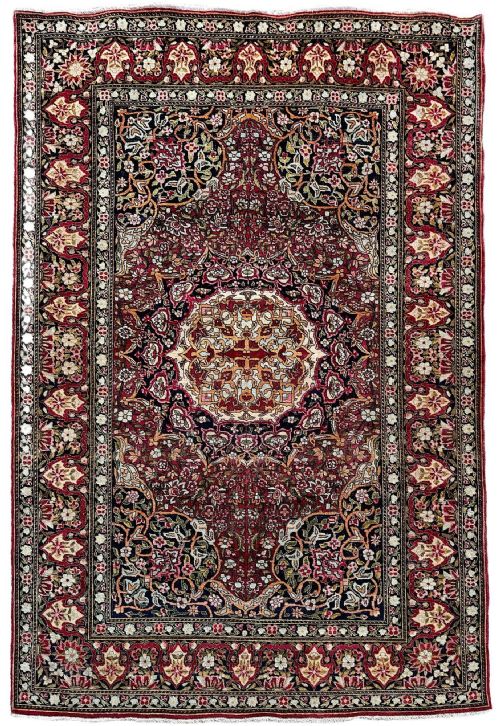
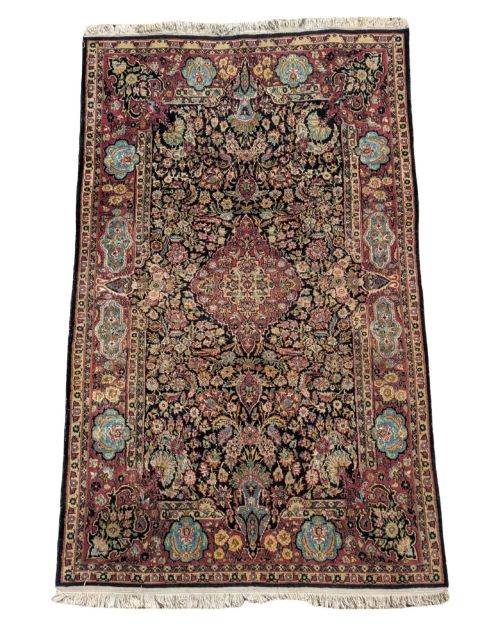
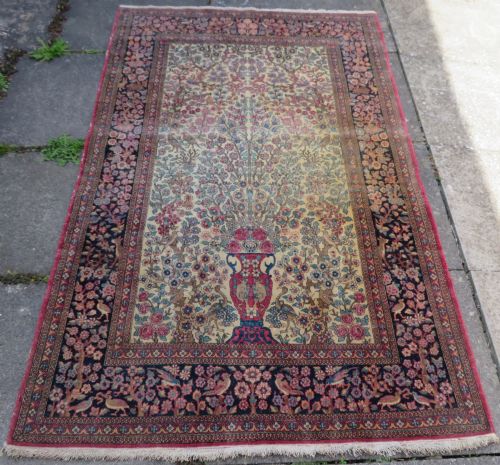
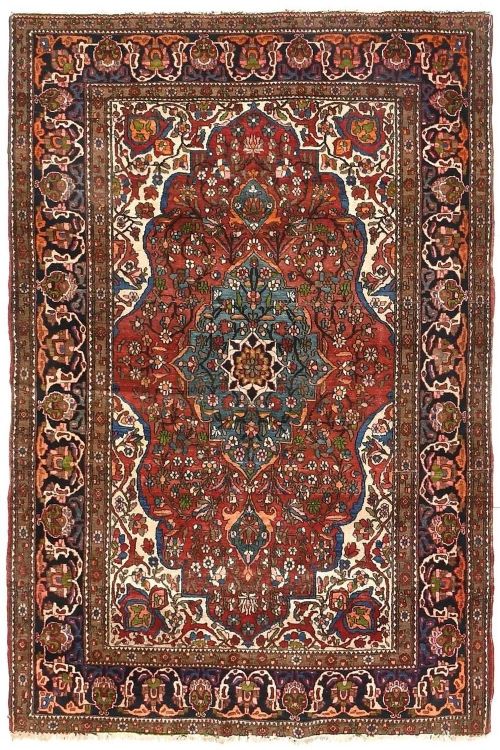
A persian isfahan rug brings the refined knotting of central Persia into a room through intricate medallion or tree of life designs.
Persian Isfahan Rug
A persian isfahan rug originates from central Persia and represents a tradition of fine urban weaving dating from the late nineteenth and early twentieth centuries. Buyers search for these floor coverings to secure pieces that display balanced composition, classical medallion layouts, or pictorial detail.
The versions most commonly met on this page span several decades from the eighteen nineties through the nineteen thirties. These range from standard area rugs to large carpets suitable for principal rooms, often carrying traditional Persian or Qajar stylistic influences.
How they were made
Weavers constructed these pieces using a combination of wool, lambswool, and silk foundations to achieve structural stability alongside soft pile texture. Silk highlights frequently accentuate specific motifs within the field, contrasting against the primary wool ground.
Craftsmen executed the intricate designs with a very fine weave, which allowed for precise curves in medallions, floral scrolls, and pictorial elements. The integrity of the structure relies on sturdy cotton or silk warp and weft threads supporting the knotted pile.
Persian Isfahan Rug Retail Price Guide 2026
Typical asking prices for persian isfahan rug among the pieces listed under this phrase on Sellingantiques today, from the lower quarter to the upper quarter. They describe what is for sale here now, not the wider market.
Current listings feature Persian Isfahan rugs and carpets produced across multiple decades from eighteen ninety to nineteen thirty, utilising wool, cotton, and silk.
What varies in quality
The standard of execution depends primarily on knot density and the precision of the drawing within the central field. A finer weave allows complex floral curves and medallions to appear crisp and well-defined.
Material selection also dictates overall grade, particularly the incorporation of silk highlights or a fine lambswool pile on a silk foundation. Pieces that retain their structural density and rich palette demonstrate superior workshop origin.
Ahmadi
The Persian Isfahan Rug Glossary
- Medallion
- A symmetrical ornamental motif placed at the centre of the rug field. This central design anchors the surrounding floral scrolls and corner pieces.
- Tree of Life
- A pictorial motif representing growth and eternal life, populated by branches, flowers, and animals. It forms a distinct narrative structure within the pile.
- Foundation
- The underlying structure of warp and weft threads that holds the knots in place. Silk foundations provide exceptional strength and enable a finer weave.
- Pile
- The upright yarn surface of the rug formed by individual knots. Lambswool and standard wool create a resilient texture across the field.
- Prayer Rug
- A format featuring a mihrab or arch design at one end, historically oriented towards Mecca during worship. These pieces often display specific devotional symbolism.
Persian Isfahan Rug: Frequently Asked Questions
Where were these rugs made?
These pieces originated in Isfahan, a major historical centre for textile production in central Persia. Local workshops produced them for both domestic use and export.
Master weavers in the region drew upon classical Safavid design traditions, adapting historical motifs into finely knotted carpets and rugs during the late nineteenth and early twentieth centuries.
How do I identify an Isfahan rug?
Look for a high knot density that permits intricate floral curves and precise medallion layouts. Central Persian pieces often utilise a balanced palette with silk highlights.
Styles frequently incorporate classical medallion designs, tree of life motifs, or pictorial elements set against a fine wool or silk foundation.
Are these rugs suitable for high traffic?
Many examples utilise durable wool pile and sturdy construction that withstands everyday placement in domestic spaces. Regular rotation helps distribute wear evenly across the surface.
Pieces featuring delicate silk foundations or fine lambswool require careful placement away from heavy foot traffic to preserve their structural integrity.
How should I care for a vintage carpet?
Vacuum gently using a suction-only attachment without a rotating brush roll to protect the pile. Professional cleaning suited to antique textiles maintains the fibres.
Keep the carpet out of direct sunlight to prevent fading of the natural dyes used in the wool and silk elements.