

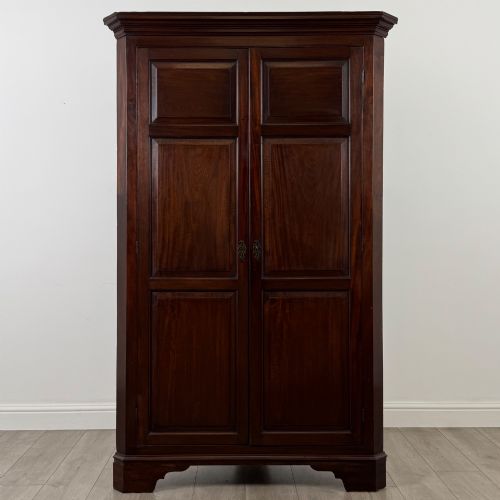
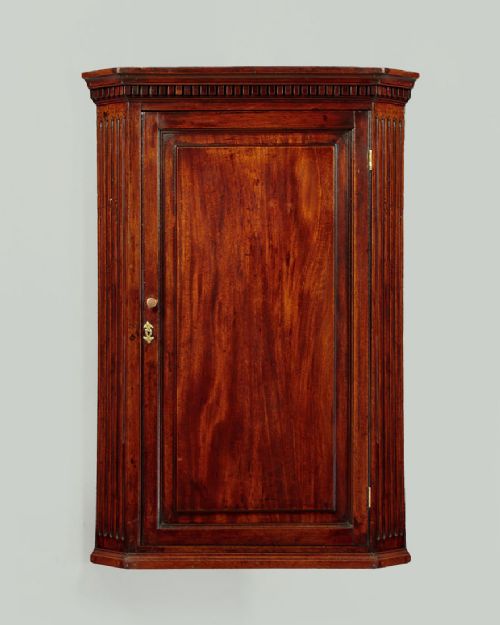

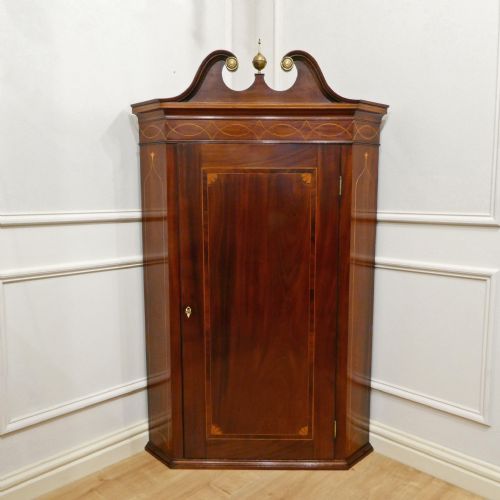


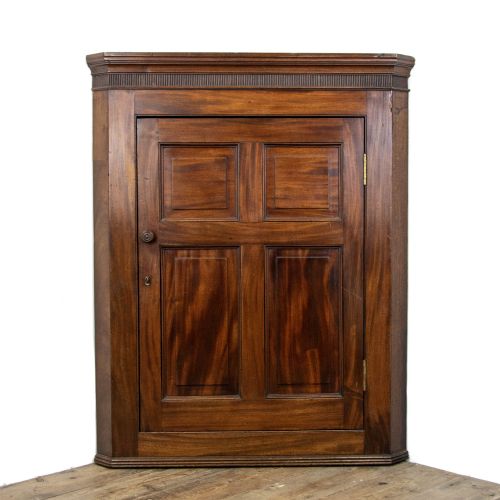
Period Mahogany Corner Cabinet
A period mahogany corner cabinet brings an architectural line to an awkward angle while holding your china or glassware.
Period Mahogany Corner Cabinet
A period mahogany corner cabinet is a fitted storage piece designed to occupy the meeting of two walls in a room, turning dead space into a display or storage area. You will most frequently encounter Georgian examples, often executed in solid mahogany or with oak secondary woods, built to hang on the wall or stand on the floor.
The surviving selection includes wall-hanging corner cupboards, bow front variants, and pieces featuring single or double doors. Some incorporate glazed upper sections for display or delicate satinwood inlay work along the frieze.
Makers of these cupboards utilised the dense grain of mahogany to create clean sightlines that fit snugly into ninety-degree angles. They served domestic interiors across the eighteenth and nineteenth centuries, holding tableware, spirits, or books.
Materials and construction
Cabinet makers built these pieces using solid mahogany timbers, frequently supported by oak for internal shelving and backboards to ensure structural stability. The primary wood was selected for rich figure and depth of tone, then finished with hand-applied polish.
Decorative detailing relies on precision woodworking and contrasting timber veneers, notably satinwood inlay on later Georgian pieces. Brass hardware, including H-hinges and key escutcheons, secures the doors while complementing the dark reddish-brown grain of the mahogany.
Period Mahogany Corner Cabinet Retail Price Guide 2026
Typical asking prices for period mahogany corner cabinet among the pieces listed under this phrase on Sellingantiques today, from the lower quarter to the upper quarter. They describe what is for sale here now, not the wider market.
The documented pieces span the Georgian period, the nineteenth century, and later Edwardian revival work, executed primarily in mahogany with oak and satinwood.
What separates the grades
Quality in a corner cabinet rests upon the choice of timber and the crispness of any carved or inlaid details. Cabinets constructed with finely figured mahogany veneers or subtle satinwood stringing demonstrate greater workshop ambition than plain utilitarian boxes.
The integrity of the internal shelving, original brass hinges, and the precise fit of the doors within the frame dictate the standing of the piece. Surviving glazing bars on display variants also reflect the joiner's skill, where thinner divisions indicate superior craftsmanship.
The Period Mahogany Corner Cabinet Glossary
- Bow front
- A convex curved cabinet face that projects outward from the corner. This curved profile requires skilled joinery to shape the solid wood or veneer correctly.
- Astragal glazed
- A door fitted with small wooden strips that hold individual panes of glass in a lattice pattern. These glazed doors turned a simple cupboard into a display piece for valuable ceramics.
- Satinwood inlay
- A decorative technique using contrasting light-yellow wood inserted into recesses in the darker mahogany surface. It appears on finer eighteenth-century and later revival pieces.
- Hanging corner cupboard
- A wall-mounted cabinet designed to be secured directly to wall studs. These pieces leave the floor space beneath them open.
- Fiddle back
- A descriptive term for mahogany grain showing undulating ripples resembling the wood used for violins. This highly figured timber marks a more costly selection of raw material.
Period Mahogany Corner Cabinet: Frequently Asked Questions
Were these cabinets meant for dining rooms?
Dining rooms and parlours were the primary locations for these cupboards, where they held porcelain, glassware, and bottled spirits. Their triangular footprint made efficient use of corners in crowded Georgian reception rooms.
Over time, owners also placed them in hallways and bedrooms for additional storage. They remained practical household furniture across multiple design periods.
How do I distinguish Georgian from later Edwardian cabinets?
Georgian pieces display older construction methods, such as hand-cut dovetails, thicker oak secondary woods, and simpler hand-forged iron or brass fixings. The timber often shows a deeper, drier patina acquired over centuries.
Edwardian Sheraton Revival pieces often feature brighter, highly polished mahogany, lighter construction, and machine-cut elements beneath the decorative satinwood inlay.
What is the difference between a cabinet and a cupboard here?
In historical listings, these terms often overlap to describe triangular storage furniture with doors. A cupboard typically implies simpler internal shelving enclosed by a single wooden door.
Cabinets frequently denote glazed display sections, finer timber selection, or pieces standing on dedicated bases or stands. Both share the same fundamental corner-fitting geometry.