






Period Etagere Stand
A period etagere stand brings tiered shelving and display to a room, offering multiple open surfaces for books and ornaments.
Period Etagere Stand
A period etagere stand functions primarily as an open tiered shelving unit or whatnot, designed for displaying objects and holding small possessions within domestic spaces. Buyers searching for a period etagere stand encounter multi-tiered designs spanning the Georgian, Regency, and Victorian eras, often taking the form of distinct open stands or combined cabinet forms.
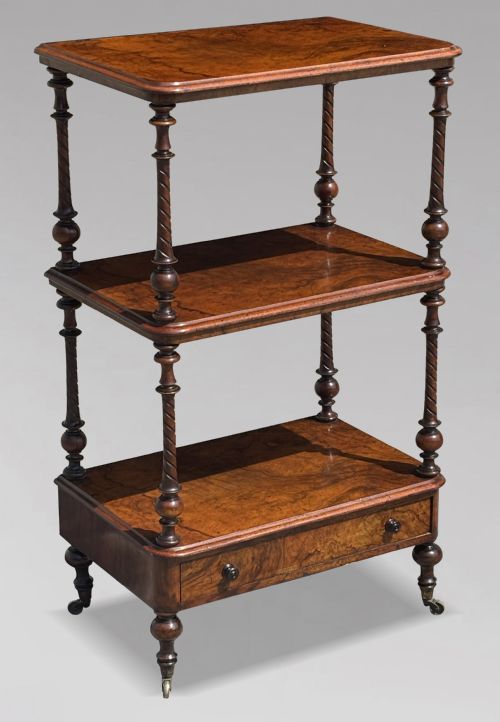
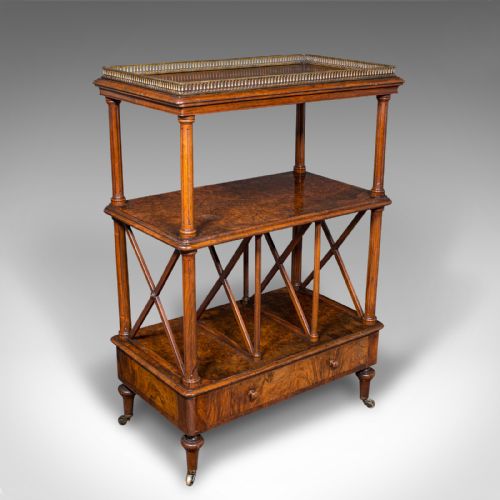
The most common examples on this page date from the Regency and George III periods, executed in timber with multiple ascending tiers supported by turned columns or uprights. These pieces include specific variants such as the Canterbury with its lower partitions, the revolving dumb waiter, and compact corner or octagonal configurations.
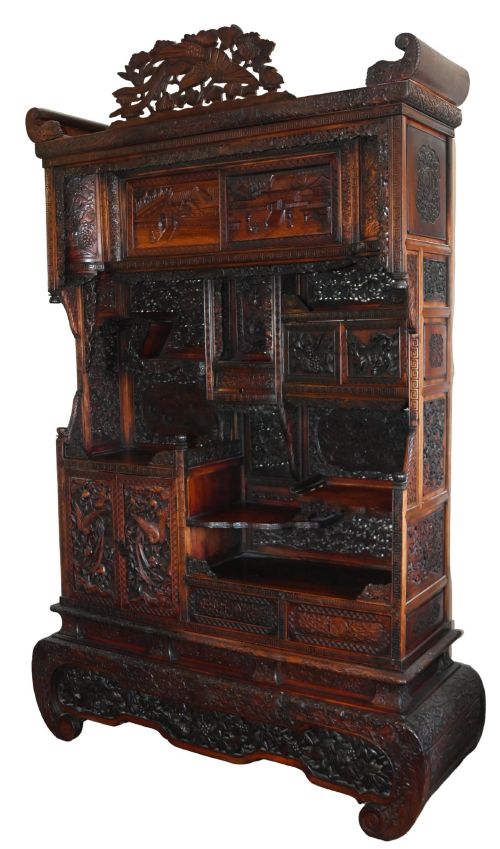
Origins stretch across English workshops of the late eighteenth and nineteenth centuries, alongside nineteenth-century Japanese Meiji period bamboo and carved display cabinets. The unifying characteristic across these disparate pieces remains the stacked platform structure intended for portable display rather than heavy storage.
How they were made
Makers constructed these stands using dense timbers such as mahogany, rosewood, walnut, and oak, frequently selecting figured veneers for top surfaces and upright supports. Joinery relied on traditional framing methods to secure the horizontal tiers to vertical uprights without sacrificing the open profile.
Alternative materials appear in the record, including bamboo for Aesthetic period cabinets and brass for casters, gallery rails, or structural mounts. Surface finishing involved polishing to accentuate the natural grain of the hardwood, while Meiji period pieces incorporated intricate carved wooden details.
Period Etagere Stand Retail Price Guide 2026
Typical asking prices for period etagere stand among the pieces listed under this phrase on Sellingantiques today, from the lower quarter to the upper quarter. They describe what is for sale here now, not the wider market.
Listings feature etagere stands executed in mahogany, rosewood, walnut, oak, and bamboo across Georgian, Regency, and Victorian periods.
What varies in quality
Construction rigidity separates sturdier stands from those compromised by loose joints between the tiers and upright supports. The choice of timber grain and the crispness of turned columns or carved decoration dictate the visual refinement of the piece.
Proportion and scale influence desirability, as compact formats and unusual configurations command attention for their utility in smaller spaces. Original brass hardware, castors, and gallery rails contribute to the integrity of a stand.
Gillows
The Period Etagere Stand Glossary
- Etagere
- A piece of furniture consisting of a set of open shelves for displaying small objects or ornaments. It originated in France during the eighteenth century.
- Whatnot
- A nineteenth-century British term for an open set of tiered shelves used for books or ornaments. The name reflects its versatile utility for whatever one wished to place upon it.
- Canterbury
- A low stand with partitioned vertical sections, frequently incorporated into the lower tier of a whatnot for holding sheet music or folios. It emerged in the late eighteenth century.
- Dumb waiter
- A tiered serving table with rotating or stationary circular trays, used in dining rooms for holding dishes without servants present. George III examples often feature graduated tiers.
- Meiji Period
- The era in Japanese history lasting from 1868 to 1912, characterised by the opening of trade and the export of carved cabinets and decorative stands to Europe.
Period Etagere Stand: Frequently Asked Questions
What is an etagere stand used for?
These tiered stands provide open surface area for displaying ceramics, books, and decorative objects in a drawing room or study. Their stacked platform design allows multiple items to be seen at once without cluttering table surfaces.
Historically, they served as versatile furniture for the display of portable possessions, shifting function according to the room they occupied. Today, they suit corners or wall spaces where vertical display is preferred over enclosed cabinetry.
How do I date a wooden whatnot?
Dating relies on timber selection, structural joinery, and stylistic markers associated with specific periods like the Regency or George III eras. Earlier pieces often employ solid mahogany or figured veneers with fine turning on the upright supports.
Later Victorian examples introduce heavier walnut timbers and machine-turned components, while Meiji period Japanese cabinets use distinct carved motifs and bamboo framing. Comparing the proportions and edge profiles helps place the piece within its historical decade.
Where should I place an etagere in a room?
An open tiered stand works best against a solid wall or within a corner where its multi-level profile can be appreciated from multiple angles. Because the shelves are open on all sides, positioning them away from heavy foot traffic protects delicate items placed on the lower tiers.
They function effectively beside seating areas to hold reading materials or small lamps, or as standalone display units in entrance halls and drawing rooms.
What is the difference between an etagere and a whatnot?
The terms are frequently used interchangeably in the antiques trade to describe multi-tiered open shelving units. Etagere derives from the French tradition of decorative tiered stands, while whatnot is the traditional English term recorded from the late eighteenth century onward.
Both forms share the essential characteristic of stacked horizontal platforms supported by upright columns, though individual examples may incorporate drawers, cabinets, or music partitions.