
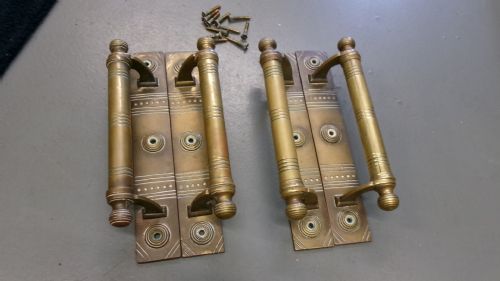


Period Door Pull
A period door pull brings tangible history to an entryway, offering tactile weight and historic design that modern hardware simply cannot match.
Period Door Pull
A period door pull covers functional entryway hardware spanning several centuries, including Victorian, Georgian, Regency, Edwardian, and seventeenth-century eras. The selection on this page leans heavily toward Victorian and Georgian pieces, reflecting standard domestic upgrades of those times.
Buyers encounter distinct forms ranging from centre door knobs and handle pairs to lever sets, letter boxes with integrated pulls, and mechanical bell pulls. Brass dominates the selection, appearing alongside bronze, iron, steel, nickel, and ceramic variants.
Stylistic variations stretch from austere seventeenth-century baroque ironwork through ornate Victorian beehive profiles to flowing Art Nouveau and Arts and Crafts designs. These pieces served grand townhouses and modest country dwellings alike, leaving a diverse legacy for modern restoration projects.
Materials and construction
Foundry work defined much of this hardware, utilising cast brass, cast bronze, and wrought iron shaped in moulds or hammered by hand. Early examples relied on heavier forged metals and simple pinned assemblies, whereas later nineteenth-century manufacturing introduced precise turning and stamping.
Complementary materials enhance the metalwork, incorporating black china, blue glass, amber glass, horn, and ebony wood inserts into handles and knobs. These mixed-media pieces required skilled joinery between metal collars and ceramic or glass barrels.
Listings span multiple centuries, uniting seventeenth-century wrought iron with Georgian brass and late-Victorian glass designs.
Judging quality in period hardware
Quality rests in the crispness of the casting, the depth of hand-chased ornamentation, and the substantial weight of the raw metal. Finer examples retain sharp architectural details on backplates and mounts rather than the softened contours of worn-down production moulds.
The integrity of mechanical action and the preservation of original patination separate superior specimens from lesser items. Intact porcelain insets, original mounting screws, and smooth-turning spindles indicate careful survival through centuries of daily use.
The Period Door Pull Glossary
- Centre door knob
- A large, stationary knob mounted in the middle of a front door rather than at the edge, traditionally paired with a heavy latch or mortice lock. These often doubled as pulling handles for closing heavy timber doors.
- Bell pull
- A mechanical lever or handle mounted on the exterior wall or doorframe, connected by wires or cranks to a household bell inside. Georgian and Victorian examples frequently combined brass handles with decorative backplates.
- Beehive knob
- A turned wooden or brass knob characterised by concentric stepped rings resembling a traditional skep beehive. This profile was exceptionally popular across Victorian domestic architecture.
- Backplate
- The decorative flat metal plate attached behind a door handle, knob, or pull to protect the wood and distribute stress. Ornate versions display cast floral, geometric, or baroque motifs.
- Art Nouveau
- A decorative style prevalent around nineteen hundred, defined by asymmetric, organic whip-like lines and stylized floral motifs. Door hardware in this taste breaks away from rigid classical geometry.
Period Door Pull: Frequently Asked Questions
How do I date a brass door pull?
Dating relies on stylistic clues, manufacturing marks, and assembly methods. Georgian pieces tend toward restrained geometry, while Victorian hardware often displays heavier ornamentation and distinct screw placement.
Material choices also offer hints, as nickel plating and certain glass insets became prevalent toward the late nineteenth century.
Can antique door pulls be fitted to modern doors?
Most period door pulls can be adapted to modern doors with minor adjustments to spindle lengths and fixing holes. Centre knobs and pull handles require simple surface mounting through existing or new bolt paths.
Buyers should check spindle thicknesses and backplate dimensions against their specific door thickness before installation.
What is the difference between a door handle and a centre knob?
A door handle operates a latch mechanism to open a door, whereas a centre knob is typically a stationary grip used for pulling a heavy door shut. Centre knobs often accompanied thumb latches or separate rim locks placed lower on the timber.
On this page, centre knobs appear frequently alongside matched lever pairs and bell pulls.
How should I clean antique brass and bronze?
Preserving the historic patina is generally preferred over aggressive polishing to bare metal. Gentle washing with warm soapy water removes accumulated grime without stripping centuries of oxidation.
Avoid harsh chemical abrasives that can permanently damage delicate cast details and hand-chased surfaces.