

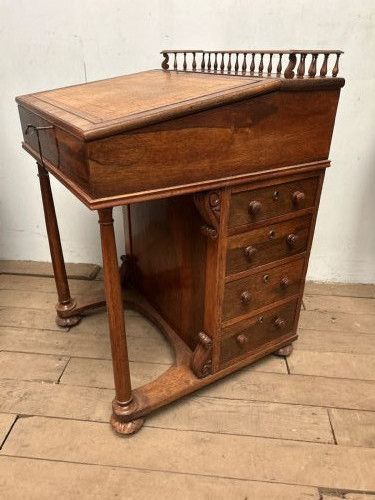


Period Davenport Desk
A period davenport desk offers compact writing storage with refined craftsmanship, making it an essential piece for traditional study spaces.
Period Davenport Desk
A period davenport desk is a compact form of writing furniture that emerged during the Regency era and continued through the Victorian period. These pieces combine a sloping, leather-inset writing surface with a set of side drawers, designed specifically for efficient correspondence in smaller rooms.
The versions most commonly met on this page date from the Regency and Victorian eras, including examples from around eighteen-twenty and eighteen-sixty. They appear in forms such as sliding top desks, diminutive proportions, and lady's writing desks.
Originating primarily in English workshops, these desks showcase the refined proportions characteristic of the late Georgian period and the subsequent Aesthetic movement. Each piece reflects the functional requirements of nineteenth-century writers who needed storage integrated directly into the writing slope.
Construction and Materials
Makers utilised rich hardwoods such as rosewood, mahogany, burr walnut, walnut, burr elm, satinwood, and coromandel to construct the primary bodies of these desks. These timbers were selected for their striking grain patterns and finished with polished surfaces that highlighted the natural figure of the wood.
Insects, ink, and daily wear necessitated durable writing surfaces, which were typically lined with fitted leather. Metal hardware, including brass fittings, secured the drawers and supported the mobility of the desk components.
Joinery techniques focused on creating sturdy carcasses that could house multiple side drawers whilst maintaining the delicate silhouette expected of a lady's writing desk. Specialised mechanisms, such as sliding tops, were engineered to allow the writing slope to adjust forward for comfort.
Period Davenport Desk Retail Price Guide 2026
Typical asking prices for period davenport desk among the pieces listed under this phrase on Sellingantiques today, from the lower quarter to the upper quarter. They describe what is for sale here now, not the wider market.
Listings feature woods such as rosewood, mahogany, burr walnut, satinwood, and coromandel, alongside brass and leather.
Distinctions in Quality
Gillows·Gillow
The Period Davenport Desk Glossary
- Davenport desk
- A compact writing desk featuring a sloping top above a pedestal of drawers. The form became popular in the nineteenth century for its space-saving design.
- Sliding top
- A writing surface that moves forward to overhang the drawer pedestal. This mechanism allows the writer to adjust their seating position.
- Burr walnut
- A highly figured wood veneer taken from the growth excrescences of walnut trees. It creates intricate, swirling patterns across the desk surface.
- Pedestal of drawers
- A stack of small drawers built into the side of the desk carcass. They typically open to one side while dummy drawers balance the opposite elevation.
Period Davenport Desk: Frequently Asked Questions
What is a period davenport desk?
A period davenport desk is a nineteenth-century compact writing station featuring a sloping, leather-lined top built over a pedestal of side drawers.
These pieces were designed for domestic correspondence, offering integrated storage whilst occupying minimal floor space in studies or drawing rooms.
How were davenport desks used?
Owners sat at the sloping desk to write letters, utilising the integrated drawers to store stationery, inkwells, and correspondence.
The compact footprint allowed the desk to be placed in tight corners or windowsills where larger writing tables would not fit.
How do I identify a Regency davenport?
Regency examples typically date from around eighteen-twenty and feature timbers such as rosewood, mahogany, or satinwood.
They often display clean classical lines, brass accents, and occasionally specialised mechanisms like sliding tops or diminutive proportions.
What woods were used for davenports?
Cabinetmakers utilised dense hardwoods including mahogany, rosewood, walnut, and coromandel for the structural carcass and exterior surfaces.
Decorative veneers such as burr walnut and satinwood were frequently applied to create striking visual patterns across the writing slope and drawer fronts.