





Penwork Wooden Box
A penwork wooden box brings intricate monochrome ink decoration to small Georgian and Regency receptacles, prized for detailed miniature scenes.
Penwork Wooden Box
A penwork wooden box covers a range of small lidded containers finished with fine ink drawing on a prepared ground. The selection includes tea caddies, games boxes, jewellery boxes, sewing boxes, and small snuff boxes.
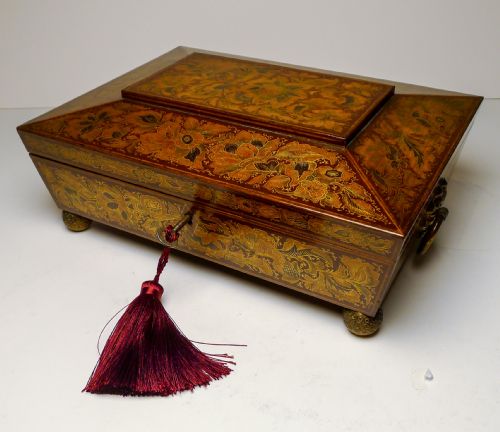
Most examples hail from the Regency and Georgian eras, typically constructed from wood and embellished with painted or inked details. Buyers encounter various forms such as double-compartment tea caddies and decorative boxes featuring chinoiserie motifs or architectural subjects like the Brighton Chain Pier.
These items serve as both functional receptacles and decorative objects, demonstrating the meticulous hand of early nineteenth-century artisans. The surface ornament relies heavily on penwork and pokerwork techniques applied directly to the wooden substrate.
How they were made
Maker construction relies on timber shaped into boxes, caddies, and baskets, often finished with varnish, paint, or lacquer to create a smooth pale ground. Artisans then use ink and fine pens to draw intricate motifs, sometimes incorporating bone or brass hinges and escutcheons.
Decoration often combines penwork with pokerwork, using heated metal points to burn designs into the wood before applying dark ink to define the outlines. Protective layers of varnish seal the delicate ink drawings against wear.
Penwork Wooden Box Retail Price Guide 2026
Typical asking prices for penwork wooden box among the pieces listed under this phrase on Sellingantiques today, from the lower quarter to the upper quarter. They describe what is for sale here now, not the wider market.
Current listings span the Georgian and Regency periods, featuring wood, ink, brass, bone, and lacquer.
What varies in quality
Quality rests primarily on the finesse and complexity of the ink drawing, where finely rendered architectural scenes or figures elevate a piece above simpler geometric borders. The crispness of the pokerwork and the preservation of the original varnish surface also dictate overall desirability.
The sophistication of the box form itself plays a role, with compartmentalised tea caddies and fitted games boxes showing greater joinery skill than plain receptacles. Preservation of the delicate monochrome ornament without excessive fading or surface disruption separates standard examples from finer works.
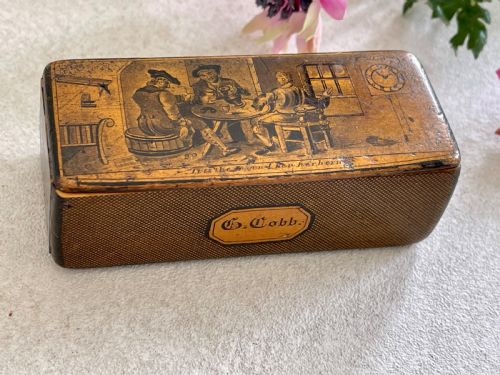
G Cobb
The Penwork Wooden Box Glossary
- Penwork
- A decorative technique using fine ink lines on a painted or lacquered wooden surface to simulate inlaid ivory or engraving. It defines the intricate surface imagery characteristic of Regency small boxes.
- Pokerwork
- The art of burning designs into wood using heated metal implements. This method provides deep shading and bold outlines beneath or alongside ink details.
- Tea caddy
- A lidded container originally designed to store loose tea leaves securely. Regency examples often feature internal divisions and fine penwork exteriors.
- Chinoiserie
- A European artistic style reflecting Chinese motifs and landscapes. It frequently appears on penwork boxes depicting imaginary pavilions and figures.
- Regency
- An English stylistic period spanning the early nineteenth century. Pieces from this era display classical restraint combined with decorative surface detail.
Penwork Wooden Box: Frequently Asked Questions
How do you clean penwork?
Cleaning requires only gentle dusting with a soft, dry cloth because moisture can damage the historic varnish and ink layers.
Harsh commercial polishes and water must be avoided to protect the delicate monochrome drawings from fading or lifting off the wood.
When were these boxes made?
The available evidence dates these pieces primarily to the Georgian and Regency periods, around the late eighteenth and early nineteenth centuries.
Many specific items on record cluster around eighteen twenty, reflecting the height of popularity for detailed ink-decorated treen.
How were tea caddies used?
Tea caddies stored valuable loose tea leaves under lock and key in wealthy households during the Georgian period. Their internal compartments kept different tea varieties separated.
Because tea was an expensive commodity, the caddy itself received elaborate decoration such as penwork to display status in the parlour.