
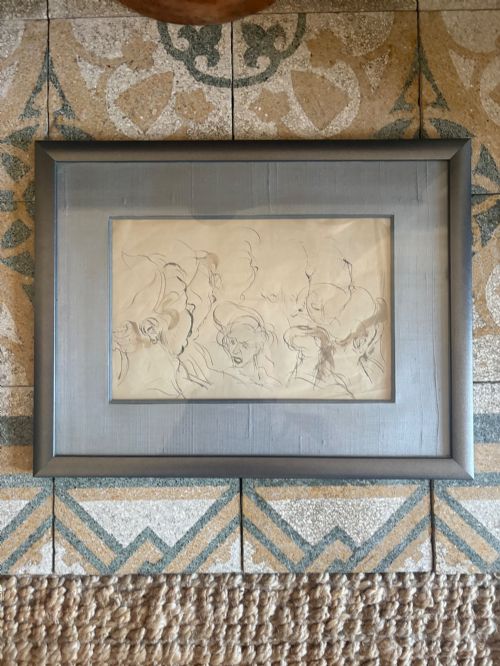
![Pen and Ink Sketch - Female Nudes by William Edward Frost [1810-1877]](https://www.sellingantiques.co.uk/photosnew/dealer_kendallhouse/dealer_kendallhouse_full_1758970795762-8493507346.jpg)


Pen and Ink Study
These pen and ink study pieces capture direct draughtsmanship on paper, offering buyers a window into an artist's working process.
Pen and Ink Study
A pen and ink study represents original graphic artwork executed on paper surfaces, capturing subjects ranging from architectural forms to figure drawings. You will frequently encounter nineteenth century examples, alongside works from the eighteenth century, nineteen-ten, nineteen-sixty, and later periods.
The material forms vary from framed artwork and architectural drawings to wall art and original drawings. Styles span Georgian, Victorian Gothic, French Romanticism, nineteenth century realism, and mid-century modern British traditions.
Pieces often incorporate wash, gouache, watercolour, pastel, and pencil alongside the primary ink medium. Many arrive ready to hang within wood and glass frames.
What varies in quality
The distinction between tiers rests upon the sureness of the draughtsmanship and the expressiveness of the line work. Preparatory sketches by documented hands command attention through their compositional confidence.
Condition of the paper support and the clarity of the ink dictate the visual impact. Works retaining crisp contrasts between ink lines and wash demonstrate superior preservation.
Listings feature paper, ink, wood, glass, gouache, watercolour, and wash across eighteenth-century to post-nineteen-sixty periods.
William Marshall Craig·Alfred Dehodencq·William Edward Frost·Lucien Freud·Lawrence Stephen Lowry·Luigi Sabatelli
The Pen and Ink Study Glossary
- Wash
- A thin layer of diluted ink or watercolour applied to paper to create tonal gradients and shadow. This technique adds depth behind crisp pen lines.
- Gouache
- An opaque water-based pigment used to highlight details and add body to graphic works. It provides solid areas of colour distinct from translucent washes.
- Preparatory study
- A preliminary drawing executed by an artist to plan a larger composition or explore a subject. These sheets reveal the direct working method behind finished paintings.
- Architectural drawing
- A precise technical or artistic rendering of buildings and structures. Examples record historical facades with meticulous detail.
- Blind stamp
- An embossed seal impressed directly into the paper without ink. It often marks an institutional collection or paper maker.
Pen and Ink Study: Frequently Asked Questions
What is a pen and ink study?
A pen and ink study is an original graphic work on paper where an artist investigates a subject through line and tone. These drawings often serve as preparatory pieces for larger compositions or stand as finished artistic statements.
Creators utilise various media alongside ink, including wash, gouache, and watercolour, to build atmosphere and depth on the paper support.
How should I frame these drawings?
Framing requires protective glass and acid-free mounts to shield delicate paper and water-soluble inks from light damage and humidity. Wood frames are typical for period pieces.
Keep works away from direct sunlight to prevent the fading of ink and paper over time.
Are these works original art?
Yes, the listings comprise original drawings executed by hand rather than mechanical reproductions. Each sheet bears the distinct marks of the artist's pen.
Variations in ink density and paper texture confirm the hand-drawn nature of every piece.
How do I identify the period?
Periods range from the eighteenth century through the nineteenth century to mid-century examples from nineteen-sixty. Stylistic clues such as Georgian or Victorian Gothic traits help determine the era.
Signatures, inscriptions, and paper characteristics often provide further context for dating an artwork.