
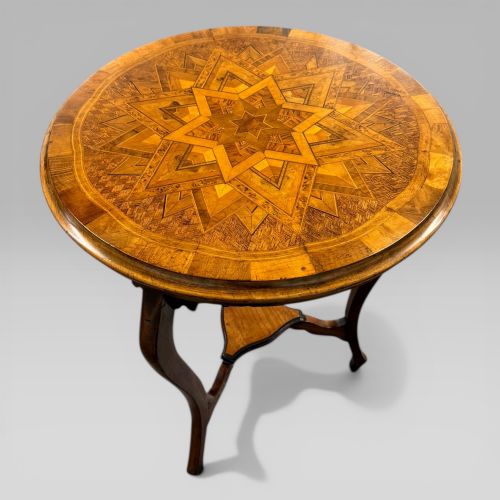


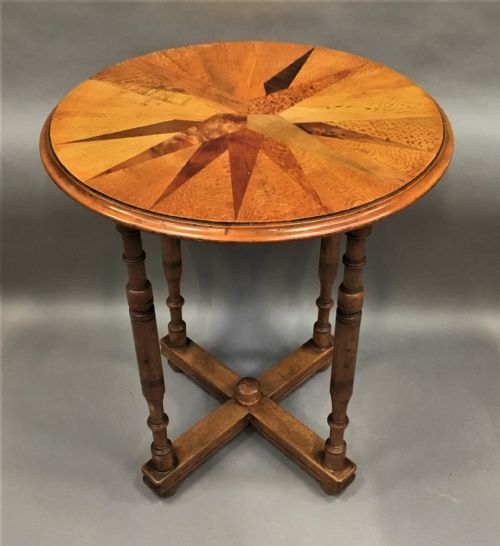
Parquetry Starburst Side Table
A parquetry starburst side table brings geometric precision and rich timber tones into a room, offering a surface with genuine focal depth.
Parquetry Starburst Side Table
When you search for a parquetry starburst side table, you encounter small occasional and centre furniture designed around a radiating geometric centre. These pieces appear across several eras, including the eighteenth and nineteenth centuries, taking the form of wine tables, pedestal tables, and lamp tables.
The construction reaches across different global workshops, with examples recorded from British, French, and colonial traditions such as Ceylonese and New Zealand makers. Walnut, mahogany, and oak form the structural foundations, while intricate veneered patterns create the characteristic optical depth on the surface.
Pedestal formats with circular tops sit alongside snap-top variants and occasional tables resting on native timber or brass mounts. Each piece relies on the contrast of distinct timbers to emphasise the radial design of the tabletop.
Materials and construction methods
Cabinetmakers constructed these tables using solid carcases of walnut, mahogany, oak, or ebony, applying precise sliced veneers to the primary display surfaces. Specimen wood veneers allow artisans to combine contrasting natural tones into complex geometric layouts.
The central starburst motif demands careful hand-cutting of individual wood segments so that grain directions alternate to catch the light differently. Brass elements occasionally reinforce joints or support pedestal mechanisms, while native timbers provide durable structural frames.
Occasional tables and wine tables dominate the structural forms found in the current selection.
Judging the quality of the work
Quality reveals itself in the precision of the veneer joints and the selection of timber contrasts within the starburst pattern. Finer examples maintain absolute symmetry across the radiating segments without gaps or uneven filler in the junctions.
The choice of specimen woods dictates the visual richness, where rarer native timbers and darker ebonised framing elevate the piece beyond standard production. Structural integrity in the pedestal turning and the smoothness of any tilt-top mechanism also separate standard items from superior workshop output.
Cohesion between the decorative top and the supporting base indicates thoughtful design, ensuring the pedestal or leg framing complements the complexity of the parquetry.
Anton Seuffert·William Norrie
The Parquetry Starburst Side Table Glossary
- Parquetry
- A geometric mosaic of wood pieces used for decorative surfaces, similar to masonry in wood. It differs from marquetry by focusing on regular geometric angles rather than pictorial scenes.
- Specimen wood
- Individual timbers selected for their specific colour, grain, or rarity rather than general utility. Makers often gathered these from various regions to highlight natural diversity.
- Snap top
- A tabletop mounted on a hinged mechanism that tilts vertically when not in use. This clever design allowed tables to stand flush against walls to save floor space.
- Pedestal table
- A table supported by a single central column rising from a stable base or feet. This configuration maximises legroom around the surface.
- Centre table
- A freestanding piece finished on all sides intended to sit in the middle of a room. These items command visual interest from every angle.
Parquetry Starburst Side Table: Frequently Asked Questions
How were these tables originally used?
These pieces functioned primarily as moveable stands for lighting, serving drinks, or holding books in principal rooms. Their compact size allowed servants to relocate them easily according to the daily routine of the household.
In reception spaces, they often held decorative objects or served as convenient surfaces next to seating. The tilt-top variants allowed households to clear floor space quickly when rooms needed to transform for other activities.
How do I care for a veneered timber top?
Maintain a stable indoor environment away from direct heat sources and strong sunlight to prevent the delicate veneers from drying or lifting. Regular dusting with a soft, dry cloth preserves the finish without introducing moisture that harms historic glue.
Avoid placing damp items directly onto the polished wood to prevent water rings from penetrating the shellac or wax coating. Applying a suitable quality wax occasionally helps nourish the historic timber surfaces.
What distinguishes Victorian colonial furniture?
Victorian colonial pieces incorporate native timbers indigenous to regions like New Zealand or Ceylon into traditional European furniture forms. Makers utilised local woods to create unique colour variations and grain patterns not found in standard British workshops.
These items reflect the exchange of cabinetmaking techniques and local materials during the nineteenth century. They often feature dense tropical hardwoods combined with intricate geometric parquetry work.
How do I identify an 18th century piece?
Eighteenth-century examples typically display simpler structural engineering paired with rich primary timbers like oak or early mahogany. Joinery techniques from this period rely on hand-cut joints and heavier framing timbers designed for long-term durability.
The patination on these older surfaces exhibits deeper oxidation and softer wear patterns accumulated over generations of use. Hardware elements and turning styles also reflect the prevailing neoclassical or Georgian design preferences of the era.