


Parquetry Dining Table
A parquetry dining table brings geometric timber work to the room, offering a surface made for daily meals and long gatherings.
Parquetry Dining Table
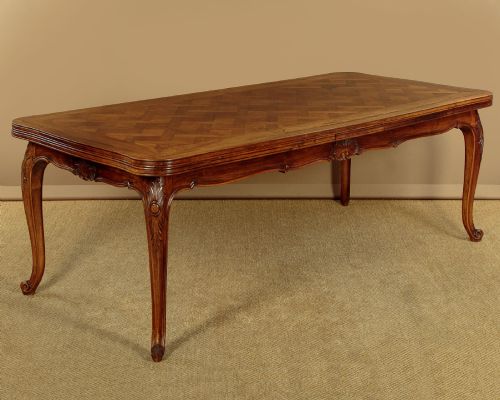
A parquetry dining table displays geometric wood veneer arrangements across the surface, turning the top into a pattern of fitted timber pieces. Buyers searching for a parquetry dining table will find examples ranging from 19th-century designs to pieces from the early decades of the twentieth century.
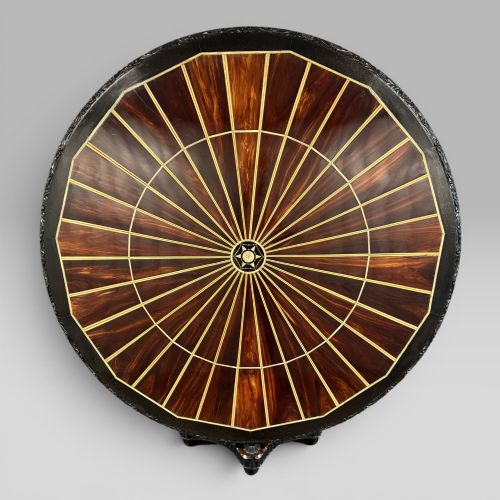
The form appears most frequently as a draw-leaf table or extending refectory style, originating from French provincial and farmhouse traditions. Oak and walnut form the backbone of these pieces, alongside regional variations such as Ceylonese ebony and calamander centre tables.
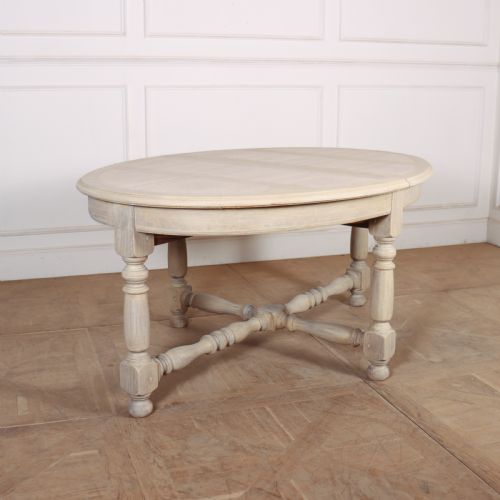
Makers adapted these dining surfaces for practical homes, incorporating extendable leaves and sturdy underframes while maintaining decorative geometric parquetry centres. The selection spans Edwardian items and revival pieces that suit both country interiors and formal dining rooms.
How They Were Made
Craftsmen built these tables using solid foundational timbers such as oak, walnut, and fruitwood, applying geometric veneers to the upper surfaces. The geometric panels required precise cutting of contrasting woods like ebony and calamander to fit tightly together.
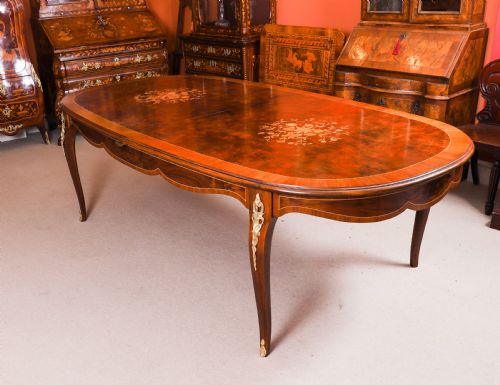
Expansion mechanisms like draw leaves and centre leaves were engineered into the heavy frames to allow the tables to extend smoothly. Metal mounts in ormolu and detailed bone inlay occasionally completed the structural and decorative assembly.
Some tables hide their extension leaves so cleverly that guests search in vain for the joins until dinner is announced.
What Varies in Quality
The precision of the geometric parquetry work sets the finest examples apart from simpler utilitarian builds, showing tight joints and thoughtful grain matching across the entire top. Superior tables balance decorative marquetry inlay and ormolu mounts with robust construction beneath the surface.
The choice of secondary timbers and the complexity of the extension mechanisms, particularly on draw-leaf and refectory formats, indicate the level of craftsmanship invested in the piece.
E Gomme
The Parquetry Dining Table Glossary
- Parquetry
- A geometric mosaic of wood pieces used for decorative surfaces, commonly seen on table tops. It relies on precise woodworking to create repeating patterns.
- Draw-leaf
- A table design featuring leaves stored beneath the main top that pull out to extend the surface length. This mechanism increases seating capacity without removing the central parquetry section.
- Ormolu
- Gilded bronze mounts applied to furniture for decoration, often found on revival pieces from the nineteenth and early twentieth centuries. It adds metallic contrast to the timber surface.
- Refectory
- A long, narrow dining table traditionally used in communal halls and adapted for domestic dining rooms. These sturdy frames often support intricate parquetry tops.
Parquetry Dining Table: Frequently Asked Questions
How do draw-leaf tables work?
Draw-leaf tables use hidden end panels that slide out from beneath the main surface to extend the length for guests.
The central parquetry top remains undisturbed while the leaves pull smoothly from each end on wooden runners.
Are these tables suitable for daily use?
These robust dining surfaces were built for regular family meals and large gatherings, utilising durable hardwoods like oak and walnut.
Routine maintenance involves standard timber care to protect the geometric veneer work from excessive moisture and heat.
What is the difference between parquetry and marquetry?
Parquetry creates geometric patterns and repeating shapes using fitted blocks of wood, whereas marquetry forms pictorial or floral motifs.
Dining tables in this category focus on the angular precision of parquetry rather than curved pictorial designs.
How do I date a parquetry table?
Dating relies on examining the framing methods, timber choices, and extension hardware beneath the top alongside the overall style.
Pieces range from nineteenth-century provincial designs to early twentieth-century revival and Edwardian workshop productions.