
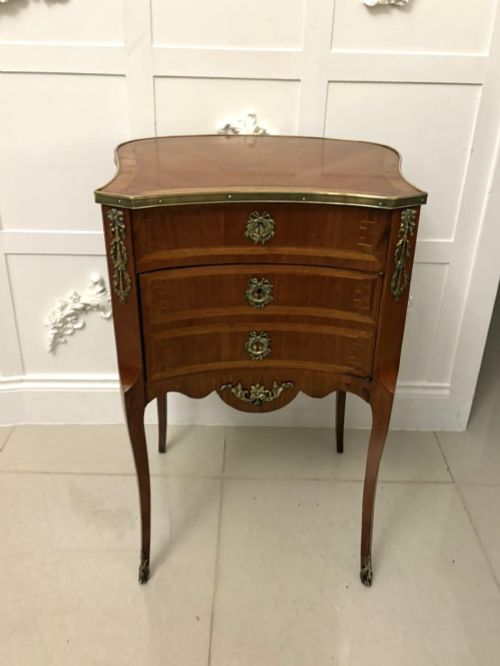
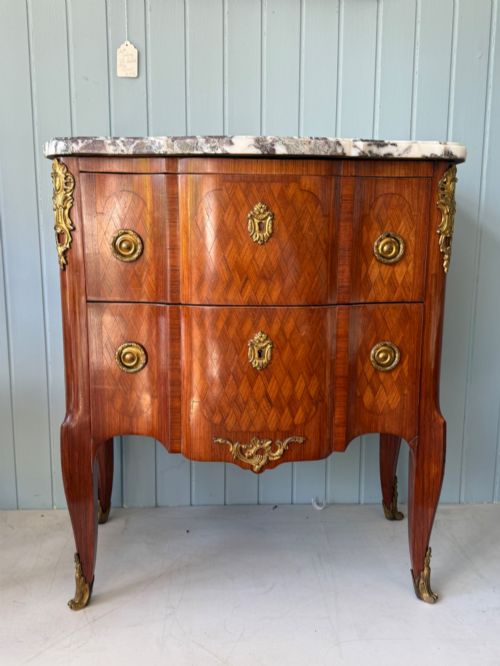
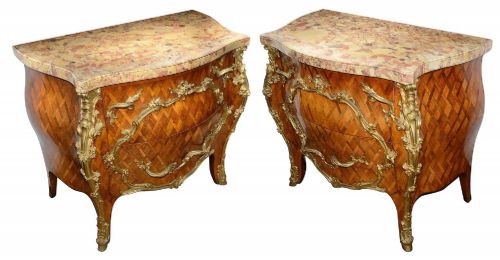
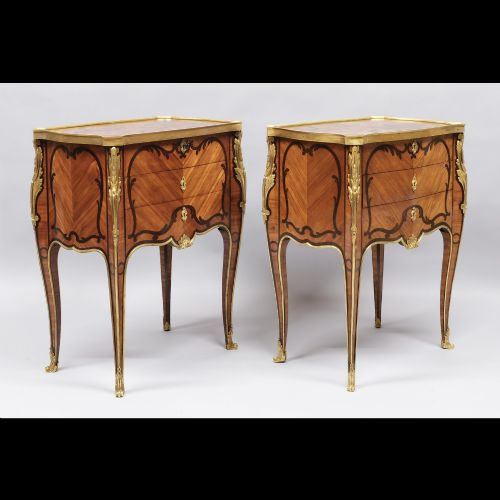


Parquetry Bedside Chests
These parquetry bedside chests bring continental proportion and geometric wood veneers to the bedroom.
Parquetry Bedside Chests
Parquetry bedside chests are small storage pieces designed for the bedroom, often taking the form of miniature commodes or side cabinets. When searching for parquetry bedside chests, buyers encounter French designs from the nineteenth and early twentieth centuries alongside later revivals.
The selection here includes pieces from the eighteenth century through to the art deco period of the 1930s. Common forms feature shaped bodies, bombe profiles, and marble tops paired with small drawers or cupboards.
How they were made
Cabinet makers constructed these pieces using dense timber carcases overlaid with fine veneers of walnut, kingwood, rosewood, and tulipwood. Geometric parquetry patterns were meticulously cut and fitted together by hand across the drawer fronts and sides.
Mounts in brass, ormolu, and gilt bronze were cast and chased to accent the corners and handles. Many examples were finished with fitted slabs of marble, including breche d'alep, placed across the top surface.
Current listings span from the 1800s through the 1930s, featuring walnut, kingwood, rosewood, and tulipwood.
What varies in quality
The precision of the veneer work dictates the standing of a piece, with tighter geometric alignment separating better examples from simpler ones. The crispness of the cast bronze mounts and the weight of the marble top also indicate the standard of production.
Proportion plays a major role in these compact items, where neat dimensions and balanced curves denote more thoughtful workshop design.
Sormani
The Parquetry Bedside Chests Glossary
- Parquetry
- A geometric mosaic of wood veneers arranged in repeating patterns such as cubes, diamonds, or chequers. This technique requires exact cutting to ensure tight joints across curved surfaces.
- Bombe
- A swollen or bulging outline found on the front and sides of furniture bodies. This shape demands advanced veneering skill to follow the convex contours.
- Ormolu
- Gilded bronze mounts applied to furniture edges and feet for decoration. The metal is cast and then finished with gold leaf or mercury gilding.
- Commode
- A low chest of drawers originating in France. These pieces typically stand on slender legs and serve formal reception rooms or bedrooms.
- Breche d'alep
- A specific variety of decorative marble featuring a brecciated pattern of mixed tones. It often tops French cabinets and commodes.
Parquetry Bedside Chests: Frequently Asked Questions
Are these chests suitable for modern bedrooms?
Their compact scale and flat marble tops make them practical surfaces for modern bedside lighting and small items. They provide enclosed drawer storage while maintaining a decorative presence.
Most examples offer enough internal room for night-time essentials without dominating smaller bedroom layouts.
How do I care for the marble tops?
Marble surfaces benefit from regular wiping with a damp cloth and mild soap. Avoid acidic liquids like citrus juice or vinegar, which can etch the polished stone.
Using coasters and mats protects the natural material from staining over years of daily use.
What is the difference between parquetry and marquetry?
Parquetry relies on geometric shapes and repeating wood patterns to form abstract designs. Marquetry uses varied veneers to create pictorial scenes such as flowers, landscapes, or urns.
Both techniques appear frequently on antique French bedside furniture from the eighteenth and nineteenth centuries.
How can I tell the period of a bedside chest?
Dating relies on a combination of construction methods, timber choices, and stylistic cues such as Louis XV or art deco lines. Nineteenth-century pieces often employ traditional oak or pine secondary woods beneath the veneer.
Hardware styles and marble thickness also offer clues to whether a piece originates from the 1800s or a later revival.