

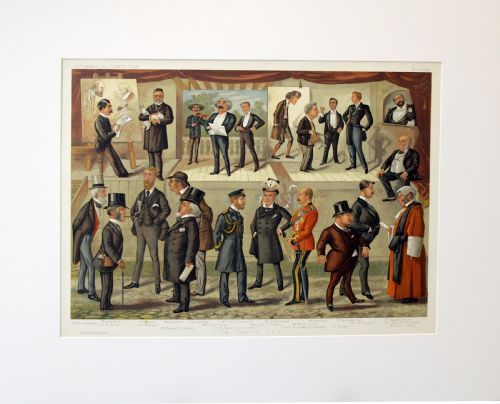


Paper Satirical Print
A paper satirical print is a sharp political or social critique on paper that brings historical wit and artistic ridicule directly into a modern interior.
Paper Satirical Print
A paper satirical print delivers biting commentary through caricature, political cartooning, and social critique across several centuries of production. These works appear in forms ranging from individual copperplate engravings and chromolithographs to framed cartoon watercolours and bound scrapbook pages.
The selections available here span from Georgian portfolios and Victorian periodicals to 1930s illustrations and American political prints. Buyers encounter both hand-coloured stipple engravings after eighteenth-century masters and sequential social satires capturing bygone manners.
Originating primarily from British and American workshops, these pieces document public figures, fashion extremes, and political scandals through the eyes of period satirists. They offer a direct window into historical humour preserved on fragile sheets of paper.
Materials and production
Makers printed these satirical works onto paper substrates using copperplate engraving, etching, and chromolithography techniques. Many sheets received subsequent application of watercolour pigment by hand to heighten the comedic effect of uniforms, dresses, and complex facial expressions.
Framed examples frequently utilise wood mouldings, glass protection, and mount board to preserve the delicate paper beneath. Artisans bound other examples into portfolios or scrapbook pages alongside armorials and descriptive text.
Paper Satirical Print Retail Price Guide 2026
Typical asking prices for paper satirical print among the pieces listed under this phrase on Sellingantiques today, from the lower quarter to the upper quarter. They describe what is for sale here now, not the wider market.
Factors of distinction
The distinction between ordinary and exceptional prints rests on the sharpness of the plate impression and the vibrancy of any hand-applied watercolour pigment. Early strikes from copperplate engravings yield crisp lines, whereas worn plates produce muddy or softened details that dilute the satirist's intent.
Completeness and historical association also elevate certain items, such as intact portfolios by Riepenhausen or original double-page periodical spreads by Vanity Fair. The survival of an unblemished paper sheet alongside clean margins determines the enduring visual authority of the work.
William Hogarth·Gilray·E.L. Riepenhausen·Thomas Worth·Henry William Bunbury
The Paper Satirical Print Glossary
- Chromolithography
- A planographic colour printing technique using multiple limestone blocks to build up rich, vibrant hues on paper. This method produced the brilliant plates seen in nineteenth-century periodicals.
- Copperplate engraving
- An intaglio printmaking process where an artist cuts lines directly into a copper sheet with a burin before inking and pressing onto paper. It yields fine, precise lines suited to detailed caricature.
- Stipple engraving
- A method of dotting the copper plate to create tonal gradations and soft shadows rather than continuous lines. Eighteenth-century publishers favoured this technique for rendering flesh and textiles realistically.
- Scrapbook page
- A bound leaf containing a curated assemblage of pasted prints, engravings, and armorials. These pages preserve historical collections as compiled by contemporary owners.
Paper Satirical Print: Frequently Asked Questions
How should I display paper satirical prints safely?
Keep framed pieces away from direct sunlight to prevent the watercolour pigment and paper from fading over time. Acid-free mount board helps protect the delicate paper from chemical degradation.
Ensure that the glass does not press directly against the surface of the print. Maintaining stable indoor humidity prevents the paper from warping or developing mildew.
What is the difference between an engraving and a chromolithograph?
An engraving relies on incised lines carved into metal plates to transfer sharp, monochromatic images onto paper. Publishers often enhanced these with hand-applied watercolour.
Chromolithography uses multiple stones to print rich, multi-coloured layers directly onto the sheet. This later technique achieved vibrant hues without requiring individual hand colouring.
Are these prints originals or modern reproductions?
The listings comprise period originals produced across the eighteenth, nineteenth, and early twentieth centuries. Many derive from contemporary publications, portfolios, and dedicated print series.
Physical indicators such as plate marks, paper texture, and printing ink confirm their historical origin. Each piece reflects the printing technology of its specific era.
How do I identify the period of a satirical print?
Examine the clothing, hairstyles, and political references depicted in the imagery to establish a contextual timeframe. Typography, paper type, and framing methods also provide reliable clues to the date of production.
Signatures, publisher imprints, and named subjects often point directly to specific historical reigns or decades. Comparing the style to known works by artists like Hogarth or Rowlandson confirms the era.