
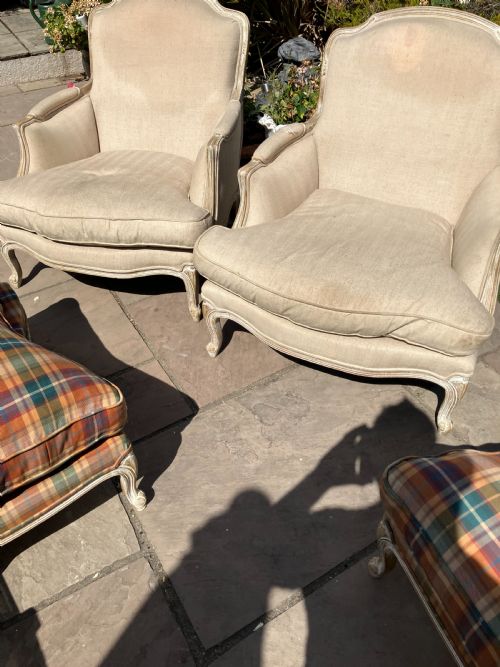
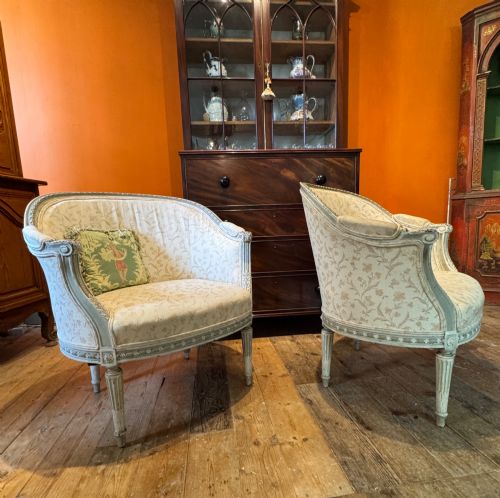
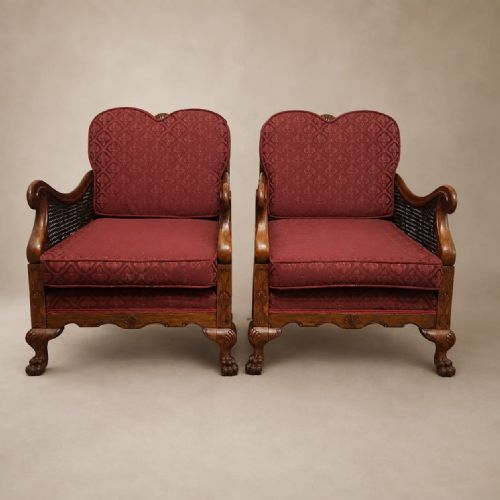
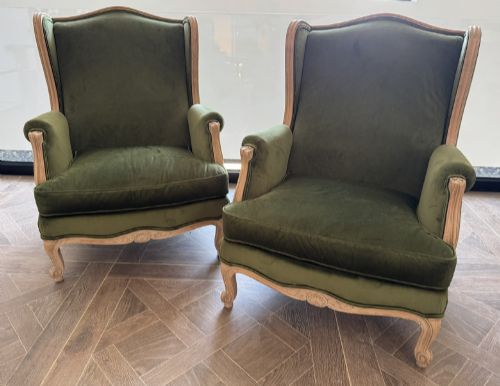
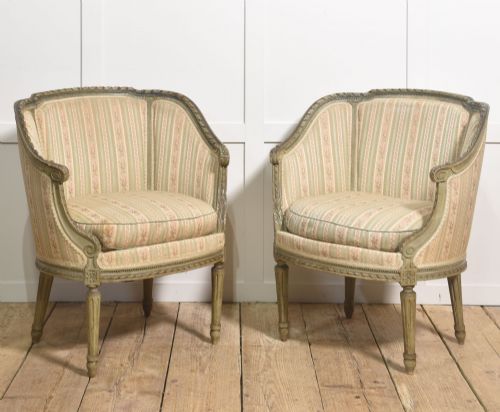
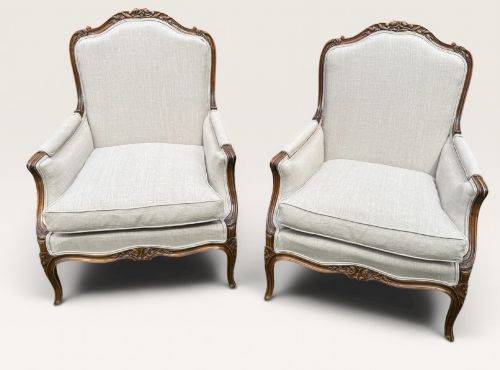
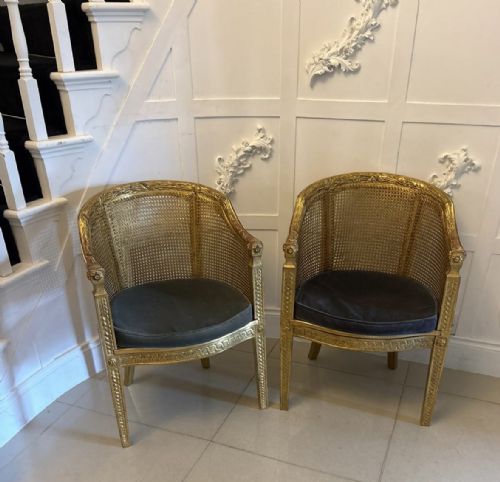
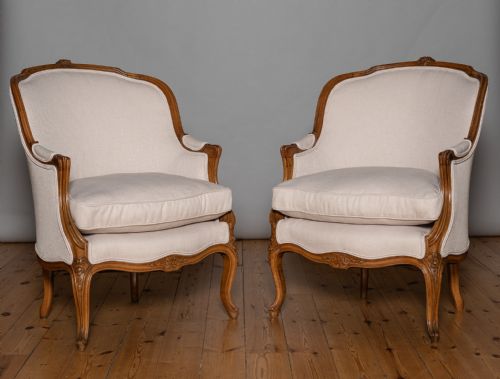


Pair French Bergere Armchairs
Pair french bergere armchairs bring deep recessed seating and classic woodwork into a room, shaped by centuries of French design.
Pair French Bergere Armchairs
These seating pairs span periods from the nineteenth century through the 1920s, drawing heavily on Louis XV and Louis XVI styles. The forms include tub chairs, wing backs, and library armchairs framed in carved wood with distinct low seats. Buyers most frequently encounter painted, gilt, or walnut frames paired with traditional upholstery.
Originating in French salons and chateaux, these matched pairs function as principal seating arrangements in drawing rooms and libraries. The designs integrate cane panels on the back and sides with upholstered seat cushions for sustained comfort. Many examples reflect revivalist movements that reinterpreted eighteenth-century aesthetics for twentieth-century interiors.
How they were made
Frame construction relies on solid hardwoods such as beech, walnut, and fruitwood, often shaped with hand-carved details and curved cabriole legs. Artisans incorporated split cane panels tightly woven into the wooden frames for the backrests and sides. Giltwood and painted finishes were applied to the timber surfaces, sometimes incorporating parcel-gilt highlights.
Upholstery techniques combined webbed bases with loose or fixed cushions filled with traditional stuffings. Materials selected for covering included velvet, silk, linen, and needlepoint, secured with rows of decorative tacks. Original paint and surface patination are preserved on many surviving examples from the nineteenth and early twentieth centuries.
Several armchairs arrive accompanied by matching footstools, ready for extended lounging.
What varies in quality
The sophistication of the timber carving dictates much of the visual distinction across these seating pairs. Crisp, deep hand-carving on walnut or beech frames demonstrates greater artisan skill than shallow or mechanical shaping. Gilt and painted surfaces show variation in longevity, with original patination holding distinct appeal over later refinishing.
The integrity of the woven cane panels significantly influences the standard of an individual piece. Intact, tightly tensioned cane work requires meticulous craftsmanship to sustain structural support over decades. Furthermore, the proportion of the frame and the balance of the curves determine the overall harmony of the design.
The Pair French Bergere Armchairs Glossary
- Bergere
- An enclosed upholstered armchair with wooden framing and cane or upholstered sides. This form developed in France during the eighteenth century.
- Cane
- Material woven from stripped rattan used to form breathable panels on chair backs and sides. It requires careful tensioning during manufacture.
- Giltwood
- Timber treated with a thin layer of gold leaf or gilt finish. This surface treatment was common in formal French salon furniture.
- Fauteuil
- An open-armed upholstered chair with exposed wooden framing. Unlike the bergere, the sides are typically open beneath the armrests.
- Louis XV Style
- A design movement characterised by asymmetrical curves, scrollwork, and naturalistic floral motifs. It heavily influenced nineteenth-century revival pieces.
Pair French Bergere Armchairs: Frequently Asked Questions
What is a bergere armchair?
A bergere is a French upholstered armchair featuring enclosed sides and a low seat designed for relaxation.
These chairs typically incorporate cane panels on the back and arms alongside a soft seat cushion.
How do I clean cane panels?
Cane panels require gentle dusting with a soft brush and occasional wiping with a damp cloth.
Avoiding excessive moisture keeps the natural rattan fibres from becoming brittle over time.
Are these chairs comfortable for daily use?
The deep seats and supportive upholstered cushions make these chairs suited for everyday seating.
Many period examples were built with generous proportions specifically for lounging in libraries and drawing rooms.
How can I tell Louis XV and Louis XVI styles apart?
Louis XV pieces feature flowing asymmetrical curves, cabriole legs, and ornate scroll carvings.
Louis XVI furniture introduces neoclassical restraint with straight tapered legs, fluted columns, and geometric symmetry.