


French Parlour Furniture
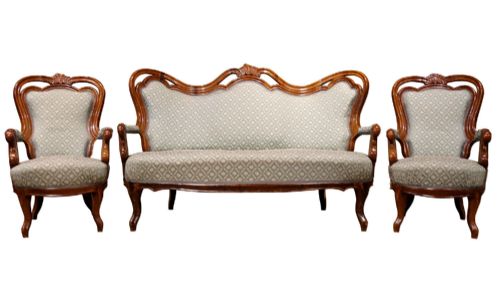
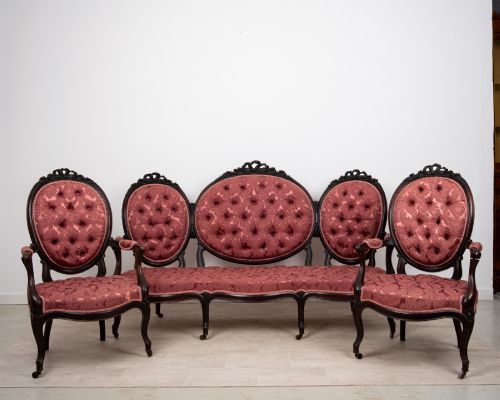
French parlour furniture brings formal nineteenth-century elegance into a modern room through carved walnut frames, giltwood details, and deep buttoned upholstery.
French Parlour Furniture
French parlour furniture encompasses matching salon suites, settees, centre tables, and credenzas designed for formal reception rooms. When buyers search for French parlour furniture, they encounter pieces originating from the nineteenth century alongside revival interpretations spanning from the Regency era into the early twentieth century.
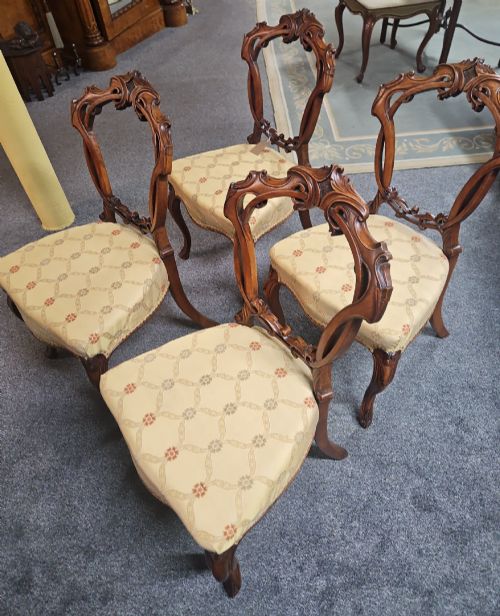
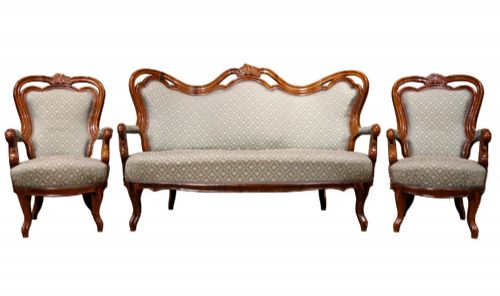
The selections on this page are dominated by three-piece and seven-piece walnut salon suites featuring carved details. Alongside these suites, individual armchairs, bergères, canapés, and mahogany centre tables appear with upholstery in damask and patterned fabric.
How they were made
Frames rely upon dense hardwoods such as walnut and mahogany, chosen for their stability when carved with intricate Rococo Revival scrolls and Neoclassical motifs. Marquetry inlay integrates contrasting timbers to decorate surface panels on tables and credenzas.
Gilt bronze, ormolu mounts, and giltwood provide reflective metallic contrast against the dark timber bases. Upholstered elements utilise traditional textiles, damask, and caning supported by deep buttoning techniques.
A robust bentwood suite sits among the walnut and giltwood, proving that even a nineteenth-century parlour occasionally desired a modern twist.
What varies in quality
The crispness of the hand-carving defines the distinction between standard production and exceptional craftsmanship. Crisp, deep relief work on walnut and giltwood reveals the hand of a skilled carver rather than mechanical replication.
The integrity of the structural joinery and the selection of figured veneers determine the enduring value of a suite or table. Matching grain patterns across multiple chairs in a salon suite indicate a higher standard of original manufacture.
François Linke·Morison and Co·Baumann
The French Parlour Furniture Glossary
- Ormolu
- Gilt bronze mounts applied to furniture for decorative effect. This technique was frequently utilised on nineteenth-century centre tables and cabinetwork.
- Bergère
- An enclosed upholstered armchair with wooden framing around the sides and back. These chairs often feature caned panels or deep buttoned upholstery.
- Credenza
- A decorative cabinet or sideboard used for display and storage. Nineteenth-century examples often incorporate figured walnut and marquetry inlay.
- Marquetry
- The art of applying pieces of veneer to a structure to form decorative patterns. Craftsmen utilised contrasting timbers to create geometric or floral designs on tabletops.
- Canapé
- An upholstered sofa designed in the French style. These pieces match the armchairs in a salon suite.
French Parlour Furniture: Frequently Asked Questions
What pieces make up a salon suite?
A standard salon suite consists of a matching set of seating furniture, typically including a settee or sofa paired with multiple armchairs or side chairs. These matched groupings were designed to furnish a formal nineteenth-century reception room in a unified style.
Larger suites on this page expand to seven pieces, incorporating additional chairs and occasionally matching tables. The unifying elements across the group include timber selection, upholstery fabric, and carved decorative motifs.
How do I identify French Empire style?
French Empire style furniture is characterised by classical proportions, dark mahogany timbers, and restrained ornamentation. The aesthetic draws inspiration from ancient Roman and Greek design.
Ormolu mounts depicting classical emblems often accent the mahogany surfaces. The overall silhouette remains architectural and grand rather than curved.
Where were these pieces used?
These furnishings were placed in the formal parlours and drawing rooms of nineteenth-century homes to receive guests and host social gatherings. The centre table often stood beneath a chandelier as the focal point of the room.
Seating arrangements were designed to facilitate conversation, with settees and armchairs grouped around the perimeter or centred in the space. The materials reflected the social standing of the household.
How do I care for antique upholstery?
Antique upholstery requires gentle maintenance to preserve delicate textiles such as damask and fabric. Regular vacuuming with a low suction attachment prevents dust accumulation within the fibres.
Exposure to direct sunlight should be avoided to prevent the fading of coloured textiles. Professional cleaning is recommended for antique fabrics to maintain their structural integrity.