


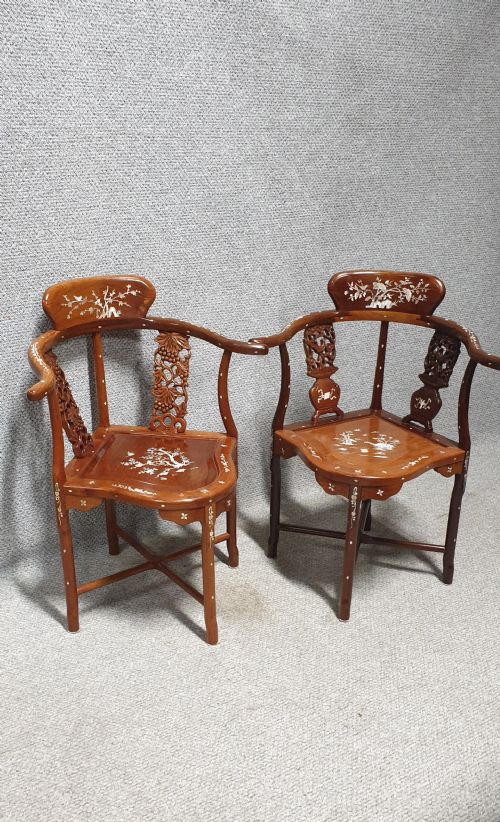
Pair Corner Armchairs
These pair corner armchairs combine clever space-saving geometry with commanding presence, offering a practical seating solution that transforms an awkward angle into a focal point.
Pair Corner Armchairs
When you search for pair corner armchairs, you encounter inventive seating designed to fit precisely into room angles while providing comfortable support. These pieces utilise diagonal footprints that maximise floor space without sacrificing the presence of traditional armchairs.
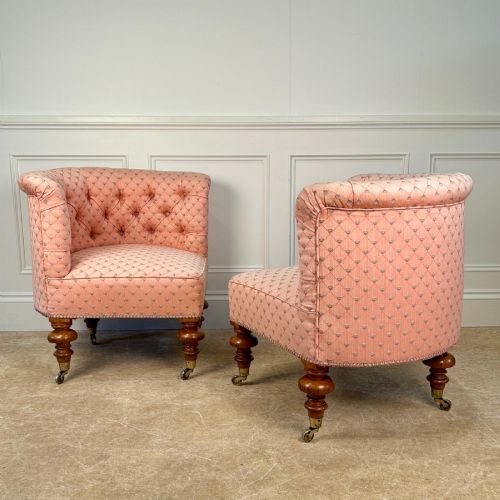
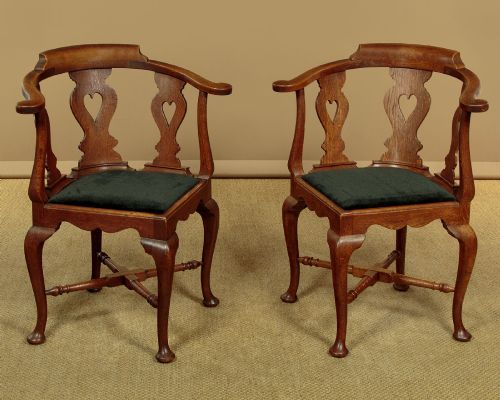
The selections on this page span the late nineteenth century through the early twentieth century, taking in Victorian, Edwardian, and Arts and Crafts movements alongside Moorish and Levantine revival styles. Oak and mahogany form the structural backbone of these duos, often enriched with intricate inlays and turned members.
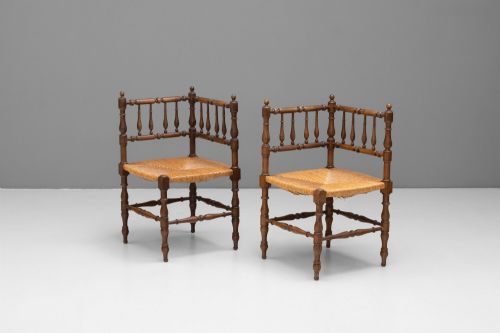
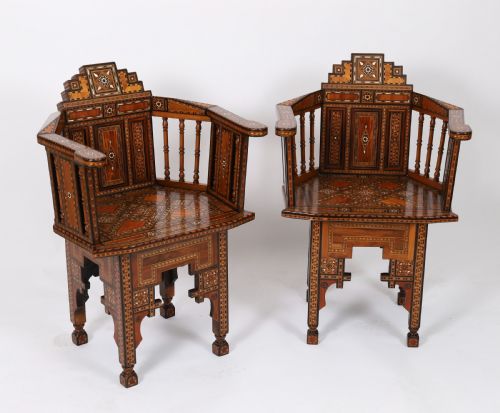
You meet various configurations ranging from compact structural frames with bobbin turnings to more expansive upholstered tub chairs and Syrian inlaid designs. The pairing ensures symmetrical placement options for drawing rooms, libraries, and studies.
How they were made
Carpenters constructed these frames primarily from dense hardwoods like oak, walnut, and mahogany, selecting timber for strength along stress points. Joinery methods relied on traditional dowels and mortise-and-tenon joints to secure the angled corner posts under daily weight.
Decorative surface work involved intricate parquetry and mother-of-pearl or bone inlays set flush into the wooden frames of Levantine and Moorish pieces. Other examples relied on extensive hand-carving, bobbin turning, and steam-bent elements to shape the distinctive curved backs.
Some nineteenth-century examples incorporate turned bobbin spindles that resemble strings of oversized wooden beads.
What varies in quality
The distinction between standard workshop output and superior production lies in the crispness of the carved details and the precision of the inlaid geometric motifs. Master makers ensured that parquetry tiles aligned seamlessly across the complex angles of the corner structure.
Structural integrity also separates the grades, where heavier gauge hardwoods and robust internal bracing prevent the looseness common in lesser framed seating. Upholstery execution, from the spring placement to the tension of the outer fabric, dictates the comfort and longevity of the piece.
The Pair Corner Armchairs Glossary
- Parquetry
- Geometric mosaic woodwork arranged in repeating patterns across flat surfaces. This technique adds ornamental complexity to the wooden frames.
- Bobbin turning
- A method of woodturning that produces a series of spherical or spool-shaped shapes along the spindle. It creates a distinctive textured silhouette on chair legs and stretchers.
- Tub chair
- An armchair featuring a continuous curved back and armrest rail forming a circular enclosure. This form provides wrap-around support for the sitter.
- Gothic Revival
- A nineteenth-century design movement drawing inspiration from medieval architecture and ecclesiastical furnishings. Pieces often incorporate pointed arches, heavy tracery, and dark woods.
- Moorish Revival
- An architectural and decorative style incorporating elements of Islamic design, including intricate star patterns and horseshoe arches. It gained significant popularity during the Victorian and Edwardian eras.
Pair Corner Armchairs: Frequently Asked Questions
Where do pair corner armchairs work best?
These chairs fit naturally into neglected room corners, turning dead space into functional seating areas without blocking walkways.
They also serve well flanking a fireplace or framing a desk where traditional rectangular seating proves too cumbersome.
How do I distinguish Edwardian from Victorian examples?
Victorian pieces generally display heavier proportions, darker finishes, and denser carved ornamentation reflecting earlier revival movements.
Edwardian counterparts tend towards lighter mahogany frames, delicate string inlays, and a more restrained aesthetic.
Are these chairs comfortable for daily use?
Many feature supportive high backs and padded arms designed for extended sitting in libraries and drawing rooms.
Those with wooden seats rely on ergonomic angles rather than cushions, making them better suited for occasional use.
How should I care for inlaid wooden surfaces?
Keep these pieces away from direct sunlight and dramatic humidity shifts to protect delicate bone and mother-of-pearl inlays.
Apply occasional microcrystalline wax to nourish the wood and maintain a protective barrier against moisture.