

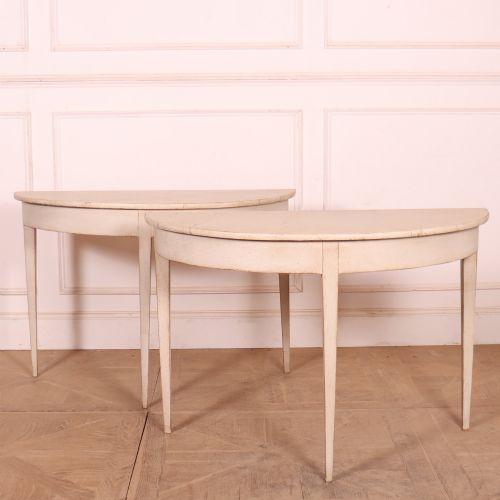
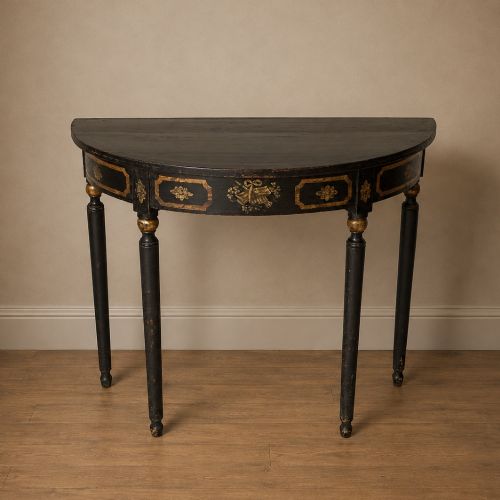
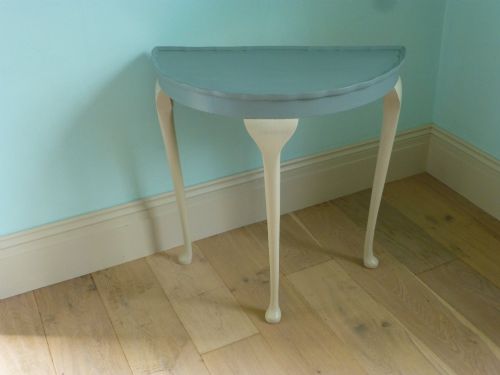


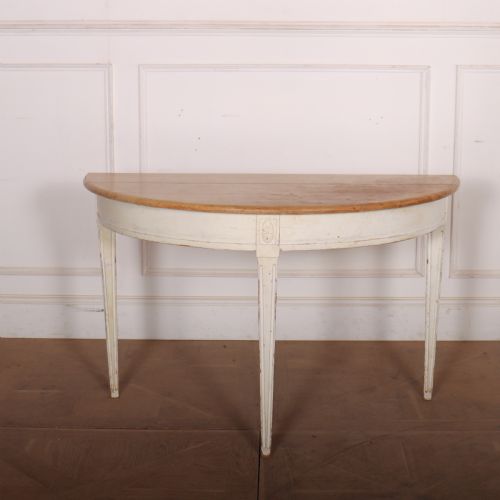


Painted Demi Lune Side Table
These painted demi lune side table pieces bring half-round elegance to a hallway, resting flat against a wall with gentle curves.
Painted Demi Lune Side Table
A painted demi lune side table takes the shape of a half-moon, designed to stand flush against a wall in hallways or principal rooms. You will frequently encounter examples from the eighteenth and nineteenth centuries, often showing Swedish, French, or English regional origins.
Many of these items function as console tables or serving tables, while others serve as compact bedside tables or games surfaces. The form accommodates limited floor space whilst offering a decorative surface for lamps or ornaments.
Makers utilised pine, timber, and satinwood as foundations for decorative schemes, applying painted finishes that range from simple monochrome to elaborate hand-painted enamel designs. Pairs appear alongside single items, reflecting their original placement in symmetrical interior schemes.
How they were made
Cabinet makers built the curved framework using timber such as pine and satinwood, often employing intricate inlay alongside the wooden structure. The half-round top required precise joinery to ensure the curved edge remained stable over centuries of use.
Surfaces received layers of paint, sometimes incorporating parcel gilding, red lacquer, or hand-painted enamel details directly onto the wood. Certain examples incorporated contrasting materials, mounting rouge marble tops onto the wooden frames.
Painted Demi Lune Side Table Retail Price Guide 2026
Typical asking prices for painted demi lune side table among the pieces listed under this phrase on Sellingantiques today, from the lower quarter to the upper quarter. They describe what is for sale here now, not the wider market.
Some tables served double duty as games surfaces, meaning your antique half-moon might once have hosted serious card games centuries ago.
What varies in quality
The refinement of the painted decoration dictates the distinction between standard and superior pieces, particularly where hand-painted enamel or delicate satinwood inlay is concerned. Finer examples display meticulous brushwork and thoughtful composition across the half-round top.
Structural integrity of the curved apron and the condition of the underlying timber influence overall execution. Tables retaining their original decorative surfaces without excessive later repainting hold greater interest.
The Painted Demi Lune Side Table Glossary
- Demi-lune
- A half-moon shape used for tables designed to stand flat against a wall. This profile became popular during the eighteenth century for serving and console tables.
- Console table
- A table supported by wall brackets or legs, historically placed against a wall in formal rooms. The evidence shows many examples taking the demi-lune form.
- Satinwood
- A hard, yellow timber imported from tropical regions, valued for its smooth grain and pale colour. It served as a favoured surface for fine painted furniture.
- Parcel gilt
- Wood decorated with partial applications of gold leaf to highlight carved details or mouldings. This technique often accompanies black painted finishes.
- Gustavian
- The Swedish interpretation of French neoclassical style, characterised by pale painted finishes and restrained classical ornamentation. Pieces from Sweden frequently feature this aesthetic.
Painted Demi Lune Side Table: Frequently Asked Questions
Where should I place a demi lune table?
These tables suit narrow hallways, entrance passages, and reception rooms where floor space is limited. Their flat back allows them to sit securely against a wall.
Pairs often work well flanking a doorway or placed beneath a mirror to create a balanced interior arrangement.
How do I identify a Swedish painted console?
Swedish examples often display characteristic pale painted surfaces reflecting the Gustavian style. They frequently appear in pairs and date predominantly from the nineteenth century.
Constructed from timber, these tables maintain simple neoclassical lines without heavy ornamentation.
What is the difference between a console and a side table?
Console tables historically stood against walls, sometimes supported by brackets, whilst side tables stood independently on four legs. Over time, the terms became interchangeable in descriptions of antique furniture.
Both forms appear with the half-moon demi-lune shape across eighteenth and nineteenth century listings.
Are marble top tables original?
Certain pieces incorporate inset marble, such as rouge marble tops, resting within the wooden framework. This combination appeared in neoclassical and later nineteenth century designs to provide a durable surface.
Inspect how the stone integrates with the painted wooden moulding to understand its construction.