

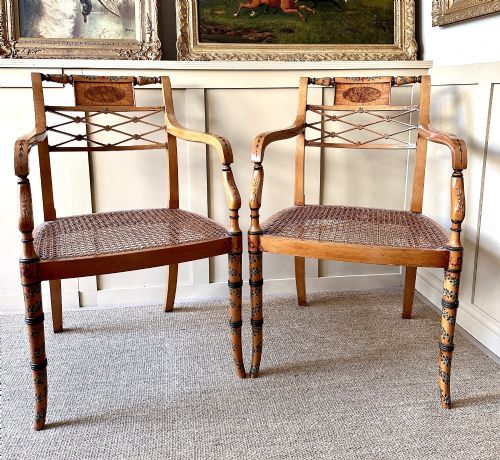
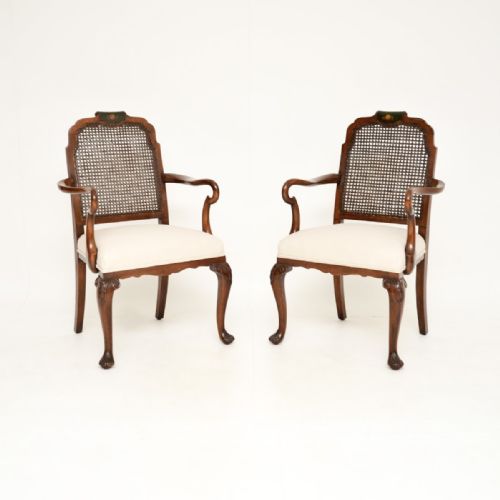
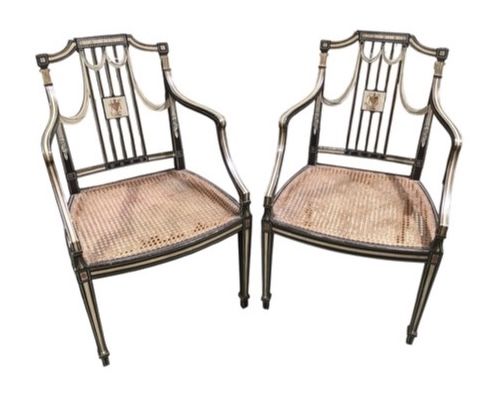

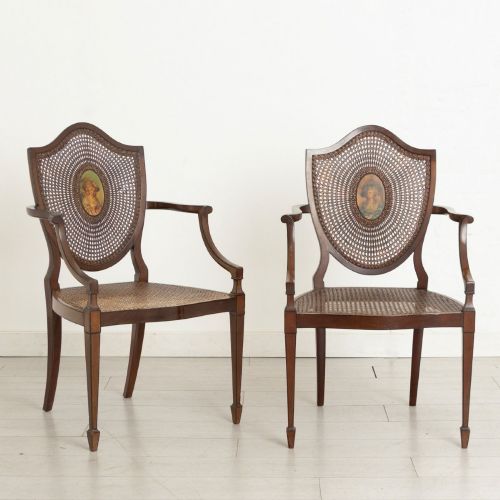


Painted Cane Armchair Pair
A painted cane armchair pair brings lightness and classic seating to a room, offering matching proportions and woven texture.
Painted Cane Armchair Pair
A painted cane armchair pair comprises matching seats designed with woven cane panels and finished surfaces, uniting seating comfort with decorative impact. These pairs emerge across several eras, ranging from the Regency period through to Edwardian and early twentieth century revivals.
Buyers meet various regional interpretations on this page, including French Louis XV style, Louis XVI style, and English Regency or Chinoiserie examples. The forms predominantly feature open armchairs and bergere designs intended for salons or living spaces.
Materials and construction
Maker workshops utilised solid timbers such as beech, walnut, and general wood frameworks, shaping them into curved or neoclassical silhouettes. These structural elements were then painted, ebonised, or lacquered to achieve distinct surface finishes.
Cane was woven tightly into the backrests and seat frames to provide flexible support, occasionally complemented by upholstered squab cushions and fabric elements.
Painted Cane Armchair Pair Retail Price Guide 2026
Typical asking prices for painted cane armchair pair among the pieces listed under this phrase on Sellingantiques today, from the lower quarter to the upper quarter. They describe what is for sale here now, not the wider market.
Current listings span the Regency era, Edwardian period, and early twentieth century, utilising beech, walnut, and painted wood.
Assessing quality and craftsmanship
The sophistication of the carved woodwork and the crispness of the painted or lacquered finish dictate the standing of a pair. Finer examples display detailed hand carving and harmonious proportions that reflect their specific stylistic period, whether Regency or French revival.
The tightness and regularity of the woven cane panels, alongside the preservation of the original paintwork, separate standard production from superior pieces.
The Painted Cane Armchair Pair Glossary
- Bergere
- An enclosed upholstered armchair with wooden frames and cane sides, originating in France. These seats often include loose matching cushions for added comfort.
- Cane
- Woven material made from the outer portion of rattan palms, utilised for flexible and breathable seat and back panels. It adds lightness to heavy timber frames.
- Regency
- A British design period spanning the early nineteenth century, characterised by classical revival motifs and elegant lines. Pieces from this era often feature painted or ebonised surfaces.
- Japanned
- A European imitation of East Asian lacquerwork, applied to furniture surfaces to create a glossy dark finish with decorative motifs. It appears on Chinoiserie items.
- Medallion
- A circular or oval padded backrest set within a carved wooden frame, typical of Louis XVI style seating. This detail provides a distinct geometric focal point.
Painted Cane Armchair Pair: Frequently Asked Questions
Where should I place these armchairs?
A pair of painted armchairs suits drawing rooms, large bedrooms, or reception spaces where matching symmetry is desired. Their open cane panels keep rooms feeling light rather than heavy.
Position them flanking a fireplace or beneath a window to make the most of their decorative frames and painted finishes.
How do I care for cane seats?
Cane requires moderate humidity to prevent the natural fibres from becoming brittle and snapping. Avoid placing the armchairs directly beside heat sources.
Dust the woven panels regularly with a soft brush and clean gently with a damp cloth when necessary.
Are these chairs comfortable for daily use?
Many examples are designed as salon or occasional chairs, offering firm support through their woven cane backs and seats. Some variants include upholstered squab cushions for softer seating.
Consider adding fitted cushions if you plan to use the armchairs for extended periods of reading or relaxing.
How do I distinguish French styles?
French Louis XV style seating is marked by flowing asymmetrical curves and cabriole legs. Louis XVI style introduces stricter symmetry, straight fluted legs, and circular medallion backs.
Edwardian and Regency revival pieces blend these classical continental motifs with British craftsmanship of the early twentieth century.