
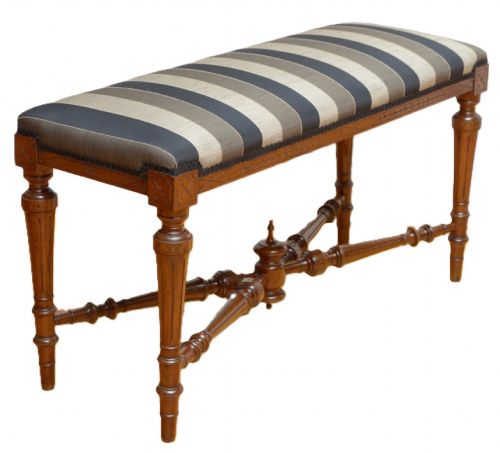
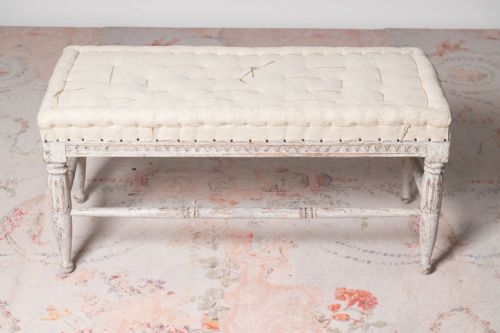


Padded Hallway Bench
A padded hallway bench brings a welcoming seat to an entryway, combining structural wood frames with soft upholstered textiles.
Padded Hallway Bench
A padded hallway bench offers a practical seating option near an entrance, often taking the form of a window seat, hall seat, or duet stool. These items appear across periods including the Victorian and Edwardian eras, as well as the nineteenth century.
Makers constructed these forms in styles such as Georgian Revival, Arts and Crafts, Gustavian, and English Country House. Walnut and mahogany frame designs frequently recur alongside textile upholstery in linen, velvet, and cotton.
The selection ranges from carved wooden frames with fluted legs to gilded and open-framed seating. Buyers encounter pieces intended for hallways, entryways, and end-of-bed placements.
How they were made
Craftsmen shaped structural frames primarily from hardwoods like walnut, mahogany, and oak, occasionally applying gilt finishes or detailed carving. These wooden skeletons provide the durable foundation required for daily seating.
Upholstery techniques involve securing textiles such as linen, velvet, and patterned fabrics over padded interiors, sometimes finished with brass detailing. The combination of dense wood and soft textile provides both support and tactile comfort.
Some benches double as impromptu stages for sleeping cats who appreciate the morning sun streaming through the hallway.
What varies in quality
The refinement of the woodwork distinguishes finer examples, visible in the depth of hand-carved details and the structural integrity of joints. Superior pieces demonstrate careful joinery that supports the frame without excess bulk.
Quality also resides in the selection of upholstery textiles and the precision of the padding application. Original or sympathetic recovering using recognised designer fabrics alters the overall character and finish of the seat.
The Padded Hallway Bench Glossary
- Duet stool
- A wider stool or bench designed to accommodate more than one person at a time, often paired with keyboard instruments or placed in bedrooms and hallways.
- Window seat
- A long, narrow seating form traditionally fitted to the recess of a window, featuring upholstered top surfaces and exposed wooden frames.
- Fluted leg
- A column support carved with parallel vertical grooves, commonly seen on furniture from the Victorian and Georgian Revival periods.
- Arts and Crafts
- A design movement emphasising handcraftsmanship, simple forms, and local materials, prevalent in the late nineteenth and early twentieth centuries.
- Gustavian
- A Swedish interpretation of French neoclassical style, characterised by pale painted finishes, restrained carving, and functional elegance.
Padded Hallway Bench: Frequently Asked Questions
Where should I place a hallway bench?
These seats suit entryways, narrow passages, and the foot of a bedroom bed. Their compact depth allows them to fit flush against walls without blocking movement.
They offer a convenient spot for putting on shoes or dropping bags upon entering the home.
How do I identify a Victorian bench?
Victorian examples typically feature dark hardwoods such as walnut or mahogany, often with substantial turned or carved supports. The upholstery framework reflects mid to late nineteenth-century proportions and decorative tastes.
Details like heavy framing and rich wood grains distinguish these pieces from lighter Edwardian designs.
Are these benches comfortable for daily sitting?
The padded top surfaces provide a soft cushion, while the solid wood frames ensure structural stability. Many pieces have been reupholstered to restore their supportive qualities.
Their primary function is short-term seating rather than lounging.
What maintenance do the fabrics require?
Upholstery in velvet, linen, or patterned textiles benefits from gentle vacuuming and prompt attention to spills. Keeping the wooden frames dusted preserves the finish.
Professional cleaning helps maintain the condition of antique and vintage textiles over time.