

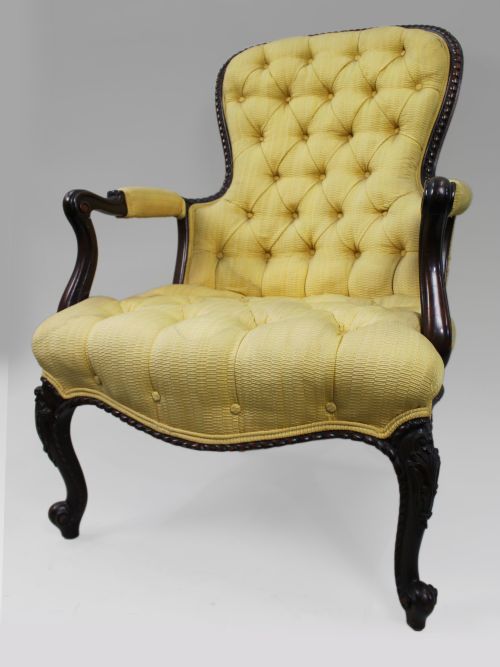
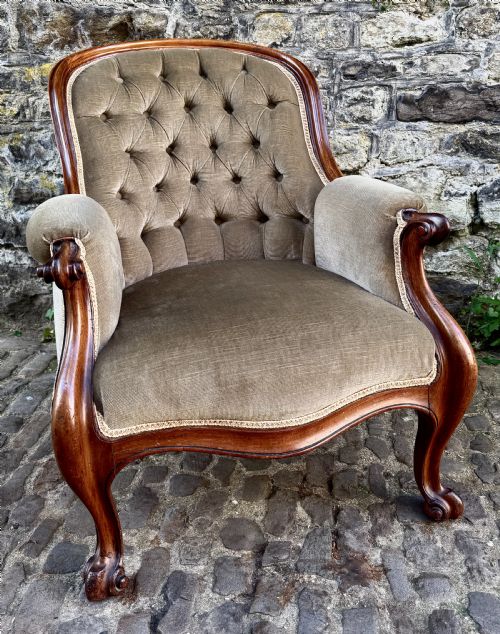
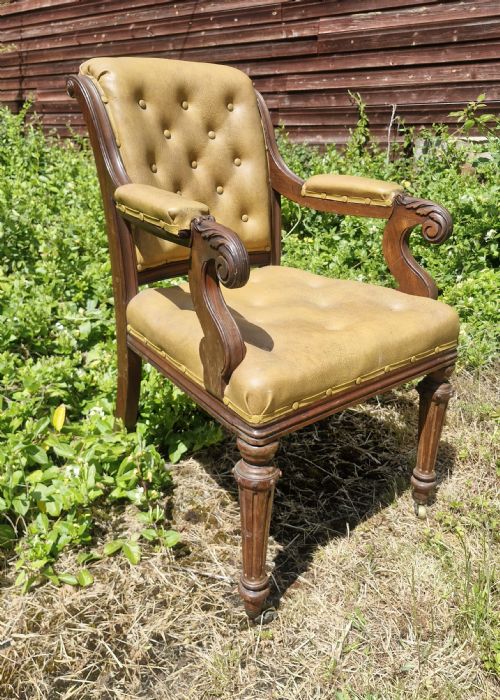


Padded Button Back Armchair
A padded button back armchair offers deep sprung comfort alongside period presence, anchoring a study or drawing room with tailored upholstery.
Padded Button Back Armchair
A padded button back armchair brings together deep upholstery and architectural timber frames, creating a seating form designed for formal libraries, gentleman's studies and drawing rooms. When exploring padded button back armchair choices, buyers encounter nineteenth-century walnut and mahogany frames, alongside early twentieth-century Edwardian boudoir and tub chairs.
The selection ranges from compact nursing chairs and fireside seats to substantial library chairs featuring cabriole legs and traditional American rocking chair formats. Walnut and mahogany predominate among the timber frames, supporting various fabrics, velvet and leather upholstery.
Victorian examples form the core of the available selection, often exhibiting carved wooden details, open arms or enclosed square backs. Each piece reflects the domestic comfort and craftsmanship of its specific decade, spanning the mid-nineteenth century through to the early twentieth century.
Materials and construction
Makers utilised dense hardwoods such as walnut and mahogany to construct sturdy structural frames capable of supporting heavy internal springing and buttoned upholstery. Brass castors frequently fitted to the feet allowed these substantial chairs to move smoothly across heavy carpets.
Upholstery involved securing horsehair or similar stuffing beneath durable layers of fabric, velvet or leather, anchored tightly by the characteristic deep buttoning technique. Painted and silver gilt finishes also appear on select frames, adding decorative flair to the woodwork.
Padded Button Back Armchair Retail Price Guide 2026
Typical asking prices for padded button back armchair among the pieces listed under this phrase on Sellingantiques today, from the lower quarter to the upper quarter. They describe what is for sale here now, not the wider market.
Listings for this phrase feature walnut, mahogany and wood frames paired with velvet, leather and fabric upholstery across Victorian and Edwardian eras.
Evaluating craftsmanship and condition
Quality reveals itself in the crispness of the timber carving, the tightness of the frame joints and the depth of the buttoning work across the backrest. Superior examples retain robust structural integrity within the internal wooden webbing and springs.
The choice of primary timber and secondary framing woods distinguishes standard workshop production from finer cabinet-maker output. Selection of high-grade leather, velvet or traditional fabric further elevates the standing of individual seating pieces.
Howard and Sons
The Padded Button Back Armchair Glossary
- Cabriole leg
- A furniture leg that bends outward and tapers downward to a pad or scroll foot, imitating an animal's limb. This style appears frequently on eighteenth and nineteenth-century revival seating.
- Button back
- An upholstery style where buttons are pulled deep into the padding to create a grid of diamond shapes. This method secures internal stuffing while providing firm lower back support.
- Gentleman's chair
- A large, padded armchair with a low seat and upholstered arms designed for relaxation in a study or library. These chairs often feature rich walnut or mahogany frames.
- Tub chair
- An armchair featuring a rounded, enclosed back and arms forming a single continuous curved rail. This compact form provides a secure, enveloping seat.
- Fireside armchair
- A domestic seating form designed to sit near a hearth, typically featuring high sides or wings to block drafts. They utilise plush padding for prolonged comfort.
Padded Button Back Armchair: Frequently Asked Questions
How do I date a padded button back armchair?
Dating relies heavily on identifying the timber species, framing style and upholstery methods characteristic of specific periods like the Victorian era or Edwardian times. Comparing leg shapes, such as cabriole designs or turned supports, offers further clues to the decade of manufacture.
Cabinet-making techniques and secondary woods found beneath the upholstery also help narrow down the production window. Examining structural fasteners and general wear patterns provides additional chronological context.
Where were these armchairs originally used?
These seats found homes in formal drawing rooms, private libraries, gentleman's studies and boudoirs as primary relaxation furniture. Specific variations like nursing chairs served specialised domestic roles near firesides or bedrooms.
Their robust construction made them suitable for daily household use by family members and guests alike. Over time, many transitioned into prominent accent pieces within eclectic modern interiors.
How should I care for leather and velvet upholstery?
Leather requires periodic conditioning with appropriate balms to prevent drying and cracking across the buttoned surface. Velvet needs gentle brushing with the nap to maintain its texture and remove surface dust without crushing the pile.
Keeping antique upholstery away from direct sunlight and excessive heat sources preserves both colour and fabric strength. Professional cleaning is advisable for deep maintenance of delicate historic textiles.
Can I use an antique armchair in a modern room?
These armchairs introduce rich textures, traditional timber warmth and distinct historical character into contemporary living spaces. Pairing a nineteenth-century silhouette with modern minimalist furniture creates a striking visual contrast.
Their comfortable proportions and practical seating heights make them as functional today as they were in the Victorian era. Selecting pieces with complementary fabric tones helps integrate them seamlessly into current interior schemes.