


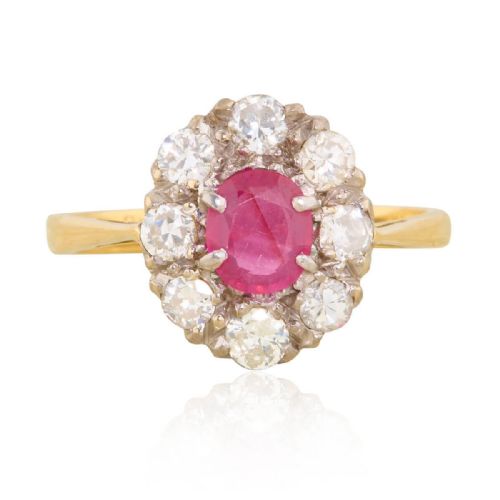


Oval Ruby Diamond Halo
These oval ruby diamond halo pieces combine rich red stones with bright borders of diamonds, offering timeless elegance on the hand or around the neck.
Oval Ruby Diamond Halo
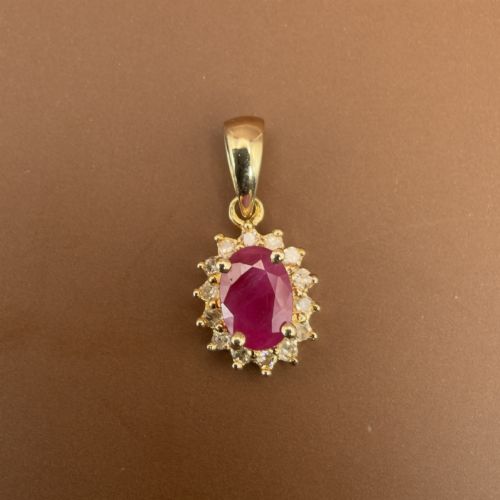
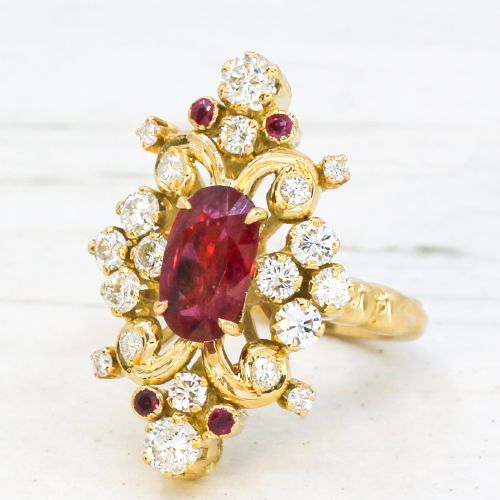
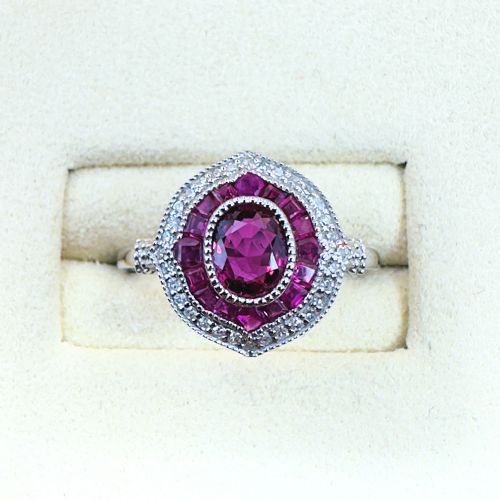
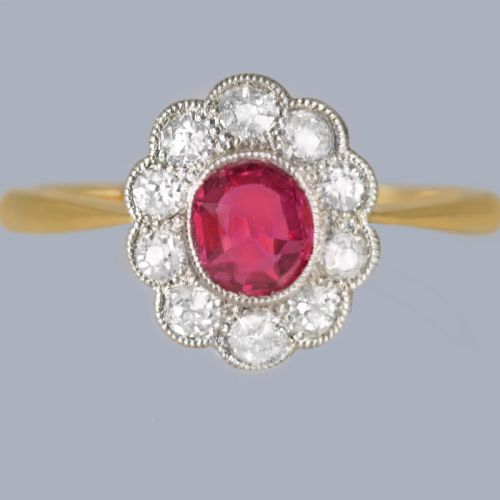
An oval ruby diamond halo centres on a vivid red corundum surrounded by a sparkling border of smaller diamonds, creating a striking contrast of colour and brilliance. These items appear primarily as finger rings and pendants, designed to showcase the central gem to maximum effect.
You will most frequently meet pieces originating from the 1930s, 1940s, 1950s, and 1960s, reflecting mid-century design sensibilities alongside earlier Art Deco influences. The cluster format remains a enduring choice for those seeking classic fine jewellery with notable visual presence.
How they were made
Goldsmiths utilised precious metals such as platinum, 18ct yellow gold, 18ct white gold, and occasionally 14ct gold to form the settings and bands that secure the gemstones. Platinum offered exceptional strength for delicate claw work, whilst gold provided a warm contrast or a bright silvery finish through white gold plating.
The central rubies, often oval or cushion cut, are framed by precision-set diamonds using traditional techniques of the period to maximise light entry and reflection. Gemmological reports sometimes accompany these items to verify the origin and natural state of the stones.
Some vintage rings carry hidden under-bezels shaped like tiny floral baskets just beneath the ruby.
What varies in quality
The distinction between tiers rests upon the saturation and origin of the ruby, alongside the cut and clarity of the surrounding diamonds. Burmese stones and unheated examples command greater attention due to their natural depth of colour.
Metalwork execution also dictates standard, where heavier gauge platinum and well-balanced claw settings ensure long-term durability. The symmetry of the halo and the precision of the stone alignment separate standard production from finer workshop output.
The Oval Ruby Diamond Halo Glossary
- Halo
- A concentric border of smaller pavé or prong-set diamonds encircling a larger central gemstone. This arrangement enhances the perceived size and brilliance of the primary stone.
- Cluster
- A jewellery arrangement where multiple stones are grouped tightly together around a focal point. In these pieces, the diamond cluster surrounds the central oval ruby.
- Corundum
- The mineral species encompassing both rubies and sapphires, valued for its extreme hardness second only to diamond. The red variety derives its colour from trace chromium.
- Platinum
- A dense, ductile precious metal prized for its silvery-white lustre and immense tensile strength. It securely holds fine diamond settings without wearing away quickly.
- Art Deco
- A design style spanning the 1920s and 1930s characterised by geometric symmetry, clean lines, and strong architectural forms. Pieces from this era often feature precise stone calibration.
Oval Ruby Diamond Halo: Frequently Asked Questions
How do I care for my halo ring?
Protect your ring by removing it during heavy manual tasks to prevent scratching the softer ruby or loosening the claw settings. Regular gentle cleaning in warm soapy water restores the sparkle of the diamonds.
Store the item separately in a lined box to avoid contact with harder gems that might damage the polished metal or stone surfaces.
Are these rubies natural?
Many pieces incorporate natural gemstones, with specific examples noting Burmese origin and unheated characteristics in accompanying gemmological reports. Natural rubies display unique internal growth patterns.
Evaluation documents often provide detailed insights into the geological history and treatment status of the primary stone.
Which metals were commonly used?
Maker workshops utilised platinum, 18ct yellow gold, 18ct white gold, and 14ct gold depending on the decade of production. Platinum was frequently chosen for secure diamond settings.
Yellow gold provides a traditional warm contrast to the red and white stones, whilst white gold offers a unified silvery tone.
How can I tell the period?
Dating relies upon stylistic markers such as geometric Art Deco mounts from the 1930s or heavier cluster profiles typical of the 1950s and 1960s. Metal hallmarks and construction techniques further clarify the era.
Comparing the setting style and gemstone cuts against established jewellery eras helps narrow down the precise decade of manufacture.