



Oval Oak Gate Leg Table
An oval oak gate leg table provides a flexible dining surface that folds down compactly when not in use.
Oval Oak Gate Leg Table
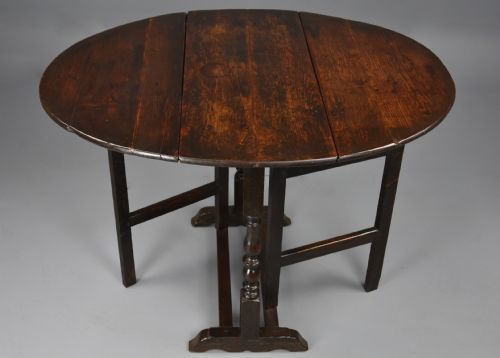
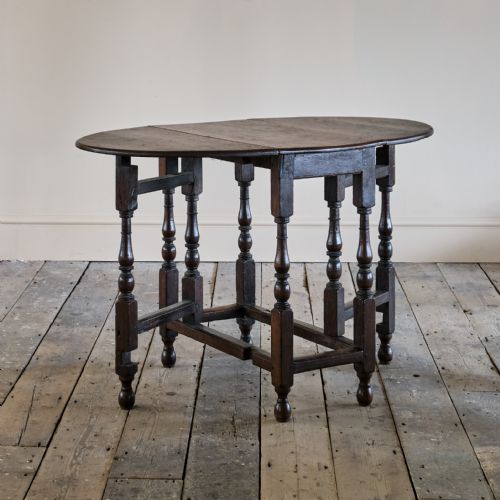
An oval oak gate leg table offers a drop-leaf surface supported by hinged legs that swing out from the centre frame. These pieces appear primarily in seventeenth-century, eighteenth-century, and nineteenth-century forms, alongside later revival examples.
The format ranges from small occasional and coffee tables to large dining tables intended to seat six, eight, or ten people. Solid oak and timber construction dominates the selection, occasionally paired with fruitwood or ash components.
Buyers encountering this search phrase find diverse styles including Jacobean, Georgian, and rustic farmhouse designs. The primary function remains a space-saving dining or side table with a folding oval top.
Materials and construction methods
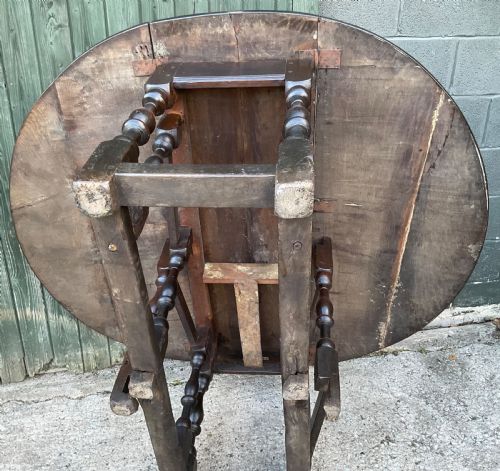
Makers utilised solid oak and regional timbers such as fruitwood and ash, shaped into thick planks for the folding top and sturdy framing components. Iron hinges and fixings provide the pivot mechanism for the swinging legs.
Turned wooden supports, including bobbin and barley twist configurations, carry the structural load while adding decorative detail beneath the drop leaves. Box stretchers often connect the lower legs to provide rigidity for the folding frame.
Listings span seventeenth-century origins through to twentieth-century revival pieces, constructed primarily in solid oak with occasional fruitwood and ash.
Distinctions in construction and character
Quality rests upon the integrity of the timber, the snugness of the drop-leaf joints when opened, and the smoothness of the gate leg swing. Substantial framing timbers and well-balanced proportions separate finer provincial examples from standard later reproductions.
Surface finish and original patination heavily influence the character of each piece. Tables retaining mellow, undisturbed timber surfaces and authentic period turnings command stronger interest than heavily restored alternatives.
Heals
The Oval Oak Gate Leg Table Glossary
- Gate leg table
- A table with hinged leaves supported by one or more swinging legs that move outward like a gate. This design allows the leaves to drop down when extra floor space is needed.
- Drop leaf
- A hinged section of a table top that can be folded down or supported horizontally. It permits the surface area to expand or contract easily.
- Bobbin turned
- A style of leg shaping where timber is turned on a lathe to create a series of rounded, spool-like shapes. This decorative turning appears frequently on seventeenth- and nineteenth-century examples.
- Barley twist
- A spiral carving resembling a twisted rope, worked into the vertical supports of the table base. It adds texture and visual weight to the underframe.
- Box stretcher
- A system of horizontal wooden bars connecting the lower legs near the floor to add stability. It braces the swinging action of the gate legs.
Oval Oak Gate Leg Table: Frequently Asked Questions
How do I seat guests comfortably around a gate leg table?
The swinging leg frames provide clearance for chairs when the leaves are fully extended into an oval shape. Positioning the legs correctly ensures diners have adequate legroom beneath the top.
Smaller versions suit compact dining areas or function as side tables until extra seating is required. Larger examples accommodate multiple guests across regular dining configurations.
How do I distinguish a seventeenth-century table from a later revival piece?
Early pieces display authentic construction markers, hand-tooled timber surfaces, and period-appropriate turnings like bobbin legs. Examining the underside and hinge fixings reveals the age of the materials and joinery methods.
Revival pieces from later centuries often utilise machine-cut elements and standardised hardware. Comparing the timber density and patination helps clarify the manufacturing era.
Where should I place an oval gate leg table in my home?
Placing the table against a wall with both leaves dropped down creates a compact console or side surface. Opening one or both leaves transforms the piece into a central dining or occasional table.
The versatile footprint suits kitchens, living rooms, and dining spaces where floor area changes frequently. Natural timber tones integrate well with both traditional and contemporary interiors.