




Oval Dial Clock
When you search for oval dial clock, you are looking at timepieces housed in distinct curved cases, prized for their elegant symmetry and refined proportions.
Oval Dial Clock
An oval dial clock brings together timepieces enclosed in rounded cases, spanning carriage clocks, mantel clocks, strut clocks, and longcase clocks. These pieces appear in periods ranging from the nineteenth century through the Edwardian era, Art Deco, and into the nineteen-thirties.
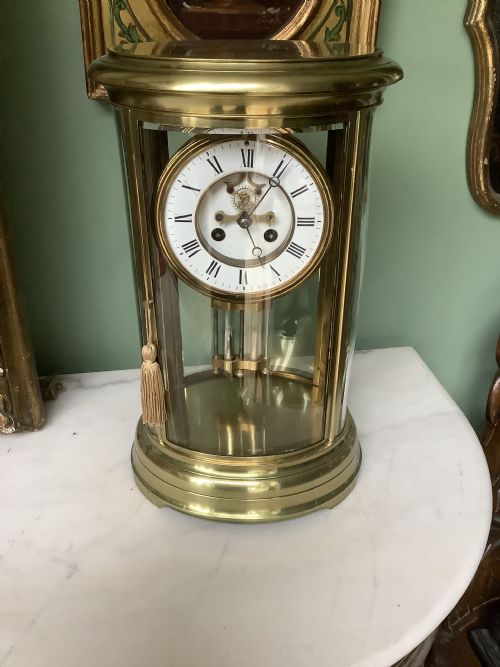
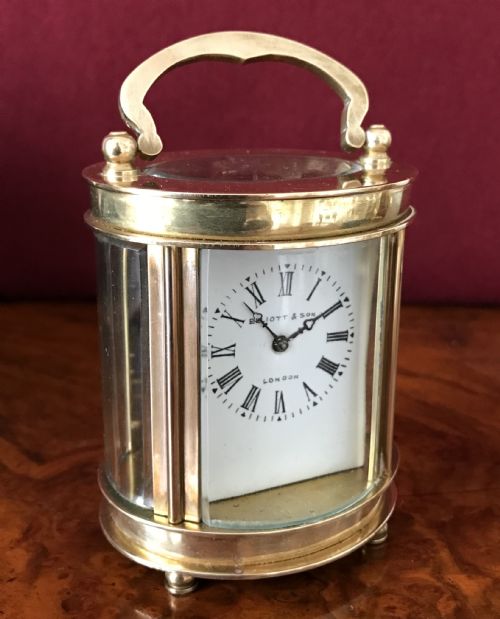
The version you are most likely to meet on this page is the French carriage clock or four glass mantel clock featuring an oval brass case and glass panels. Such pieces often incorporate striking mechanisms, repeating functions, or alarm complications housed within French frames.
Earlier examples include nineteenth century longcase clocks featuring oak crossbanded cases paired with oval moonphase dials. Miniature formats also appear alongside giant and large striking carriage clocks, demonstrating the variety of sizes produced.
How they were made
Maker workshops constructed these frames predominantly from brass and gilt brass, housing precision mechanical movements behind glass panels. Cases were shaped into curved or elliptical profiles to frame enamelled or silvered metal dials.
Clockmakers incorporated specialised mechanisms such as striking trains, repeaters, and alarms into the brass chassis. Dial faces utilised enamelled finishes and silvered metal applications to display the numerals clearly within the oval boundary.
Some miniature clocks are small enough to travel in a pocket yet loud enough to wake a household.
What varies in quality
The distinction between ordinary and superior pieces rests upon the precision of the brass casting, the crispness of the gilt finish, and the complexity of the movement. Master makers incorporated striking or repeating functions that elevate the mechanical sophistication.
Proportion and scale also define the hierarchy, ranging from delicate miniature strut clocks to substantial four glass mantel clocks. The integration of signed dial work and documented maker provenance further separates standard production from exceptional examples.
Howell & James London·AD Mougin·Richard & Co Paris
The Oval Dial Clock Glossary
- Carriage clock
- A portable timekeeper designed for travel, typically fitted with a brass case, glass panels, and a swing handle. These pieces often feature platform escapements visible through the top glass.
- Strut clock
- A timepiece supported by a hinged prop or stand attached to the rear of the case, intended for desk or mantel display. They frequently employ decorative metal frames.
- Four glass clock
- A mantel clock enclosed by glass panels on the front, back, and sides, allowing the movement to be viewed from multiple angles. This style gained popularity during the Victorian period.
- Moonphase dial
- A mechanism displaying the lunar phases through an aperture on the clock face. Early longcase clocks occasionally incorporated this feature alongside oval framing.
- Repeater
- A mechanism that chimes the hours and quarters upon demand when a button or lever is pressed. This complication appears in higher grade carriage clocks.
Oval Dial Clock: Frequently Asked Questions
What is an oval dial clock?
An oval dial clock is a timepiece featuring a curved or elliptical dial and housing, spanning carriage clocks, mantel clocks, and longcase formats.
These pieces showcase mechanical movements enclosed in brass, gilt brass, and glass structures originating from nineteenth and twentieth-century workshops.
How do I date an oval clock?
Dating relies upon stylistic markers, materials such as gilt brass or silvered metal, and mechanical indicators like platform escapements.
Victorian, Edwardian, and Art Deco periods each imparted distinct proportions and decorative treatments to the brass and glass cases.
Were these clocks used for travel?
Certain forms, particularly carriage clocks fitted with swing handles, were originally designed for portability among travellers.
Others, such as four glass mantel clocks and longcase clocks, remained stationary decorative fixtures within domestic interiors.
What materials make up the cases?
Makers constructed the housings primarily from brass, gilt brass, and glass panels, occasionally incorporating timber framing like oak.
Dials were finished in white enamel or silvered metal to contrast against the metallic frames.
Do these clocks include striking mechanisms?
Many examples incorporate striking trains that sound the hours, while advanced models feature repeating functions or alarms.
Miniature versions and simple strut clocks often focus solely on timekeeping without additional auditory complications.