




Oval Cabochon Diamond Ring
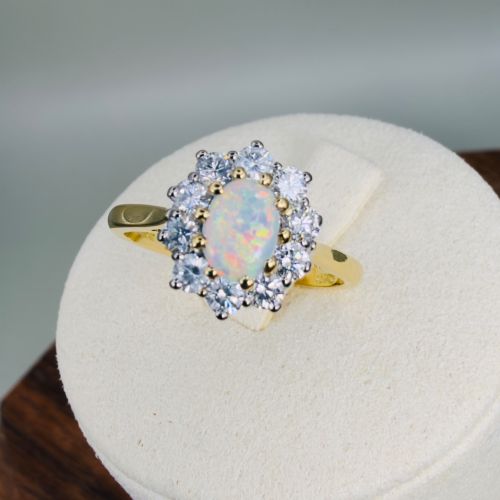
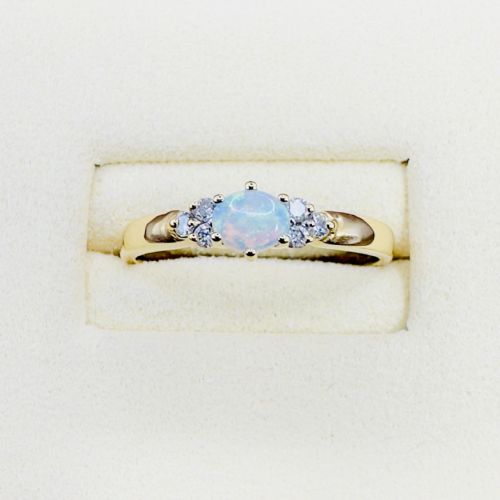
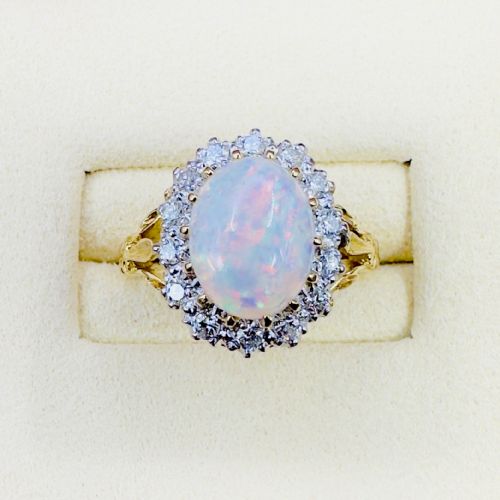
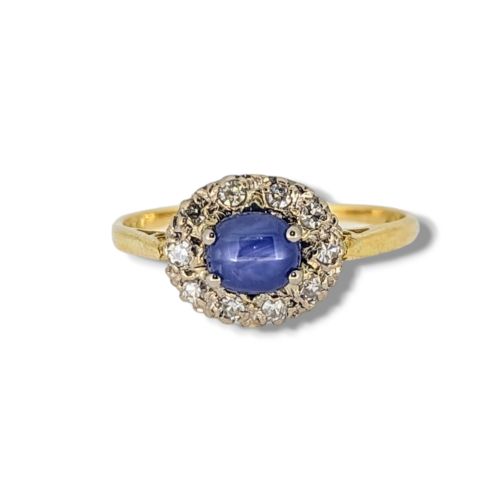
An oval cabochon diamond ring pairs a smooth, rounded central gemstone with sparkling diamonds, offering a tactile alternative to standard faceted stones.
Oval Cabochon Diamond Ring
The selection spans several distinct historical eras, ranging from Victorian and Edwardian pieces to Art Deco designs and mid-century examples from the 1950s and 1960s. Cluster configurations dominate the available forms, often utilising yellow gold, white gold, platinum, or combinations of metals to support the central cabochon.
Materials and construction
Master jewellers constructed these rings using durable precious metals such as 18ct gold, 9ct gold, 14ct gold, and platinum to securely hold the central stones and surrounding diamond melee. Settings frequently employ delicate claws or solid bezels that hug the curved contours of the polished cabochon gemstones.
Diamonds are integrated either as brilliant-cut sparkles or rose-cut accents, set tightly around the central focal stone to enhance contrast and light reflection. The combination of high-carat gold and platinum settings reflects the changing metallurgical preferences across the Victorian, Edwardian, and Art Deco periods.
The listings span materials including platinum, 18ct gold, 9ct gold, alongside gemstones such as star sapphire, white opal, jadeite, and amethyst.
Factors that separate the grades
Quality in these rings rests heavily on the natural optical properties and internal depth of the central cabochon stone, whether it displays a strong play of colour in an opal or a rich saturation in a sapphire. Expert polishing that maintains a smooth, symmetrical dome without surface scratching distinguishes superior specimens from more routine examples.
The precision of the surrounding diamond setting and the structural integrity of the metalwork also define the upper tier. Heavier gauge gold or platinum mounts that show minimal wear and secure claw work indicate careful historical craftsmanship.
The Oval Cabochon Diamond Ring Glossary
- Cabochon
- A gemstone shaped and polished with a smooth, rounded surface rather than faceted edges. This ancient cutting style emphasises the internal lustre and colour of the material rather than brilliance.
- Cluster ring
- A ring design featuring a prominent central stone surrounded by a cluster of smaller gems, usually diamonds. This arrangement maximises visual impact and was favoured across the Victorian and Art Deco eras.
- Rose-cut
- An antique diamond cut featuring a flat base and a domed crown composed of triangular facets that resemble an unopened rosebud. It yields a softer, more transparent sparkle than modern brilliant cuts.
- East to West set
- An orientation where a horizontally elongated stone is mounted across the finger rather than vertically up and down the hand. This layout creates a distinctive profile often seen in mid-century cocktail rings.
Oval Cabochon Diamond Ring: Frequently Asked Questions
How do I care for an opal cabochon ring?
Opals contain natural water content and require gentle cleaning with a soft cloth, avoiding harsh chemical dips or ultrasonic cleaners.
Store the ring away from extreme temperature shifts to protect the structural integrity of the stone.
What does a cluster setting mean?
A cluster setting groups a large central gemstone with a tight halo of smaller diamonds or accent stones.
This configuration was designed to catch the light from multiple angles and create a larger visual presence on the hand.
How can I tell an Art Deco ring from a Victorian one?
Art Deco pieces from the 1920s and 1930s typically feature geometric symmetry, sharp lines, and white metals like platinum.
Victorian rings often display warmer yellow gold, heavier organic ornamentation, and softer, romantic cluster outlines.
Are star sapphires natural?
Star sapphires display an optical phenomenon called asterism, showing a star-shaped pattern across the domed surface caused by light reflecting off microscopic needle-like inclusions.
These natural inclusions are characteristic of genuine unheated sapphire varieties.