

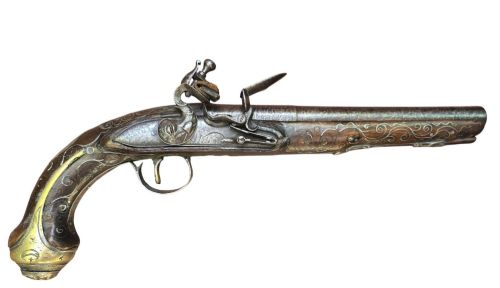


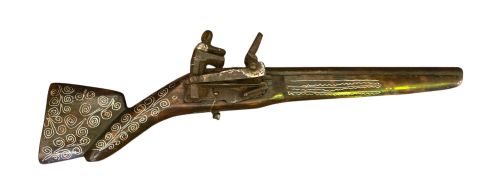
Ottoman Flintlock
These ottoman flintlock firearms are historic weapons from the Ottoman Empire, combining practical military utility with decorative metalwork and inlay.
Ottoman Flintlock
An ottoman flintlock typically takes the form of a holster pistol, belt pistol, carbine, or long musket originating from regions such as the Balkans, Turkey, Algeria, and Afghanistan.
The pieces appearing on this page span the eighteenth century and the nineteenth century, including specific regional subtypes like Bosnian Sarajevo region pieces and North African toe-lock long guns.
Buyers encounter martial arms decorated for frontier service, cavalry use, and personal defence, featuring distinct regional styling from the Adriatic to North Africa.
Materials and Construction
Makers constructed these weapons using steel, iron, and brass for barrels and locks, paired with wooden stocks of walnut and other timbers.
Decoration relied heavily on silver wire inlay, silver parc, engraved brass mounts, and inlaid mother-of-pearl secured into the stock.
Mechanisms range from standard flintlock systems and French Dumarest locks to Miquelet and rat-tail snaphaunce configurations.
Ottoman Flintlock Retail Price Guide 2026
Typical asking prices for ottoman flintlock among the pieces listed under this phrase on Sellingantiques today, from the lower quarter to the upper quarter. They describe what is for sale here now, not the wider market.
Listings feature materials such as steel, brass, wood, walnut, silver, iron, bone, and mother-of-pearl across the 18th and 19th centuries.
Assessing Quality
Quality rests in the precision and complexity of the metalwork, particularly the depth of cast barrel decoration and the intricacy of silver inlay on the stock.
The standard of regional craftsmanship dictates value, with superior examples displaying harmonious integration of brass mounts, bone details, and functional lock mechanisms.
The Ottoman Flintlock Glossary
- Flintlock
- A firearm ignition mechanism that uses a flint held in a cock to strike a steel frizzen, creating sparks to ignite the priming powder.
- Miquelet
- A distinct Mediterranean lock type featuring an external mainspring and a combined steel and frizzen, common on firearms from the Ottoman sphere.
- Snaphaunce
- An early precursor to the flintlock with a separately sliding frizzen cover and a spring-retained steel, appearing on several Balkan pieces.
- Holster Pistol
- A large handgun designed to be carried in a saddle holster during travel or military service on the cavalry frontier.
- Frizzen
- The vertical steel plate struck by the cock and flint to produce sparks, sometimes grooved on specific regional variants.
Ottoman Flintlock: Frequently Asked Questions
What is an ottoman flintlock?
An ottoman flintlock is a historic firearm produced within the Ottoman Empire or its borderlands during the eighteenth and nineteenth centuries.
These weapons include holster pistols, belt pistols, and muskets characterised by regional mounting styles and decorative metal inlays.
How do I identify a Balkan piece?
Balkan pieces often feature embossed brass clad stocks, rat-tail lock mechanisms, and intricate brass mounts associated with the Adriatic and frontier regions.
Makers in these areas utilised distinctive stock shapes and metalwork that separate them from central Turkish or North African examples.
Were these used in combat?
Many of these pieces served practical military and personal defence roles on the cavalry frontier and across Ottoman territories.
While heavily decorated with silver wire and mother-of-pearl, they were functional weapons designed for active service.