

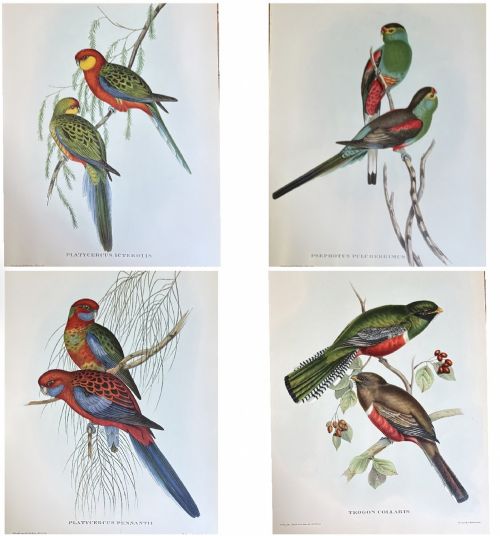


Ornithology Illustration Set
These ornithology illustration set pieces are framed or unframed plates capturing avian life, prized by collectors for historic scientific study and decorative appeal.
Ornithology Illustration Set
An ornithology illustration set brings together grouped plates of avian subjects, most frequently encountered here as nineteenth-century framed bird engravings or mid-century tropical bird prints. These collections range from bound reference books on British birds and their nests to suites of hand-coloured water fowl and tropical species.
The material forms vary between loose unframed prints on paper and securely framed wall art, often assembled in sets of four, six, eight, or ten plates. Originating across the eighteenth, nineteenth, and mid-twentieth centuries, these works document scientific observation through historic artistic output.
Materials and construction
These works rely fundamentally upon paper supports carrying ink, watercolour, or lithographic colour, frequently paired with wood and glass for framing. Many nineteenth-century examples incorporate hand-applied pigment over engraved lines to render plumage with naturalistic precision.
Some multi-volume reference books utilise cloth or fabric bindings to protect the printed pages inside, while individual plates occasionally feature gold leaf detailing within the accompanying mount or frame.
Ornithology Illustration Set Retail Price Guide 2026
Typical asking prices for ornithology illustration set among the pieces listed under this phrase on Sellingantiques today, from the lower quarter to the upper quarter. They describe what is for sale here now, not the wider market.
Edward Lear is remembered for nonsense verse, yet he began his career illustrating parrots.
Factors that influence quality
Quality rests upon the crispness of the original impression and the precision of any hand-applied watercolour, which separates dynamic natural history plates from flat mechanical reproductions. The involvement of notable illustrators or publishers elevates a suite significantly above anonymous reference materials.
The preservation of the paper support and the integrity of early framing elements, such as period wood and glass, contribute substantially to the desirability of the set.
William Swainson·Edward Lear·Eleazor Albin
The Ornithology Illustration Set Glossary
- Engraving
- A printmaking technique where an image is incised into a metal plate with a cutting tool to hold ink. This method produces fine, precise lines characteristic of early scientific works.
- Lithography
- A planographic printing process based on the repulsion of oil and water on a limestone or metal surface. It allowed for rapid and accurate reproduction of multi-coloured natural history illustrations.
- Hand-coloured
- A print finished with applied watercolour by brush after the initial black and white impression is struck. This technique adds realistic tones to avian plumage.
- Plate
- An individual printed page or sheet within a bound volume or a series of loose illustrations. Plates often feature captions detailing the species.
- Waterfowl
- Birds that live in or near water, frequently chosen as a specific thematic subject by nineteenth-century natural history illustrators.
Ornithology Illustration Set: Frequently Asked Questions
What periods do these illustration sets cover?
The listings span from the eighteenth century through the Victorian era up to nineteen fifty. They encompass Georgian scientific output as well as mid-twentieth-century decorative publishing.
Earlier items often appear as bound reference volumes or copperplate engravings, whereas later items typically present as loose tropical bird prints.
How are these bird prints usually displayed?
Many sets come already presented in period wooden frames behind glass, ready for hanging as cohesive wall art. Unframed plates offer the option of custom mounting to suit specific interior schemes.
Matching sets of four or six look particularly effective arranged in a grid or a straight line across a wall.
What is the difference between engravings and water fowl prints?
Engravings rely on incised metal lines to define the bird's form and plumage with scientific precision. Water fowl prints often highlight applied watercolour pigment to capture naturalistic feather patterns and colours.
Both formats serve as historical records of avian species from different periods of natural history illustration.
Are these sets complete books or loose plates?
The inventory includes both multi-volume reference books, such as works detailing British birds and their nests, and dispersed sets of individual prints. Loose plates are commonly found grouped in numbers ranging from two up to ten.
Book formats retain their original cloth or fabric bindings for library preservation.