

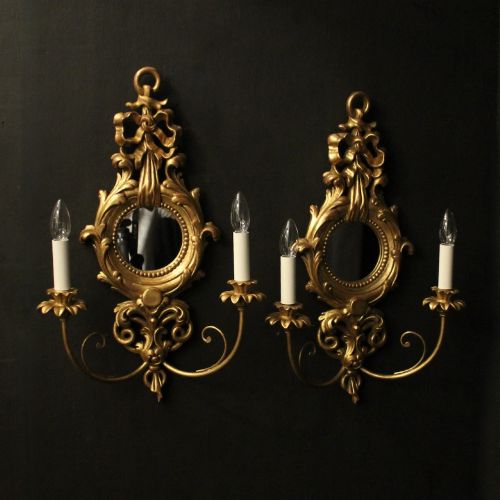
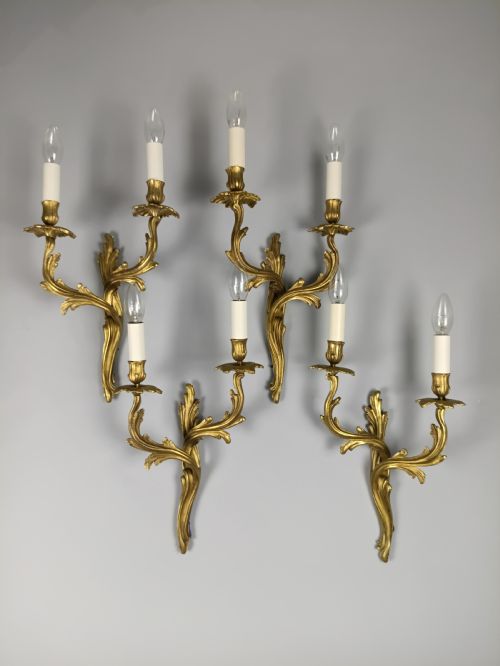
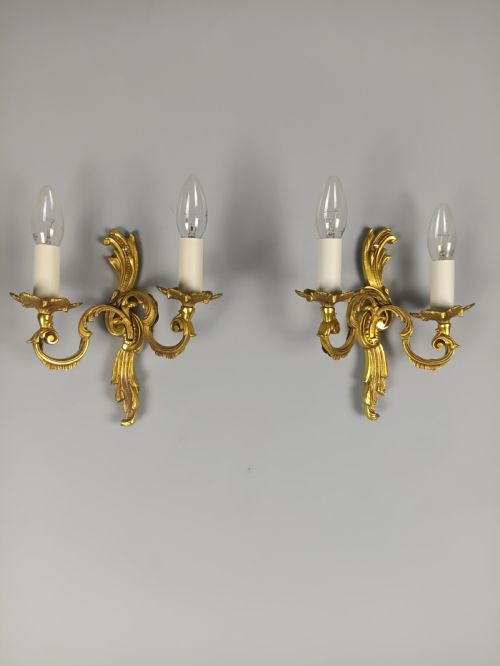
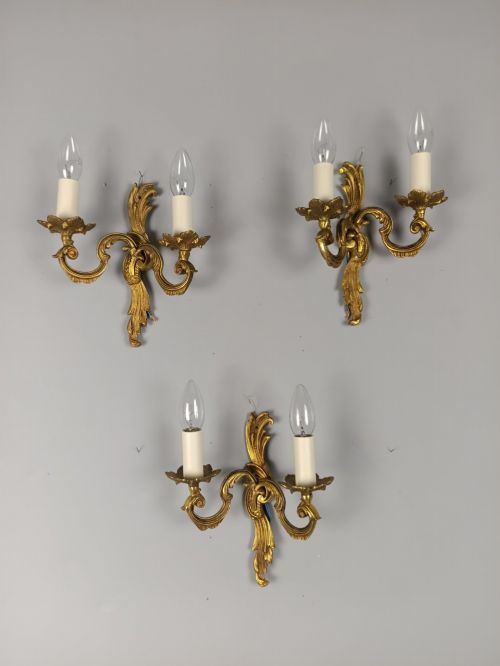


Ornate Twin Light Sconces
Ornate twin light sconces bring double-branch illumination and sculptural metalwork to a wall, driven by French revival tastes.
Ornate Twin Light Sconces
Ornate twin light sconces are double-branch wall lights designed to hold two candles or electric bulbs whilst adding decorative presence to a room. When you examine this selection, you encounter pairs, sets of three, sets of four, and larger groupings configured for domestic illumination.
The objects span periods from eighteen hundred through the nineteenth century, nineteen-twenty, and nineteen-thirty. Most pieces originate from French workshops, though English and Italian examples also appear.
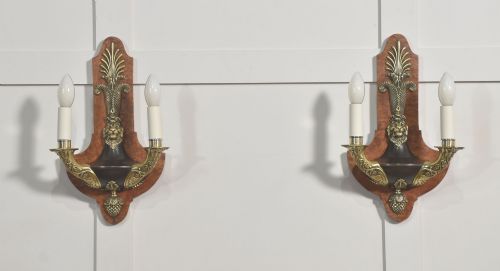
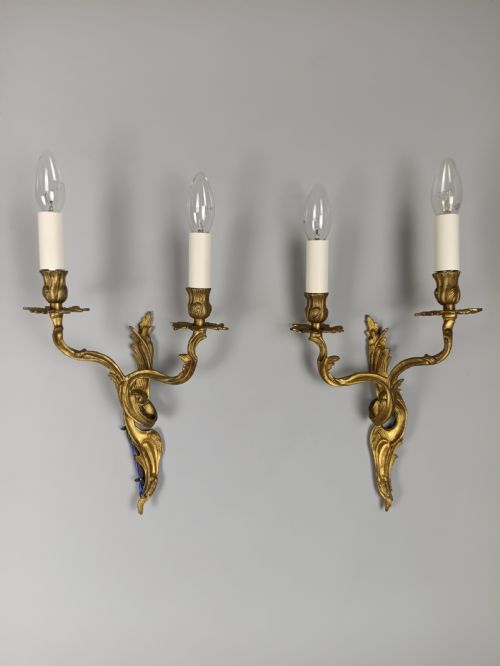
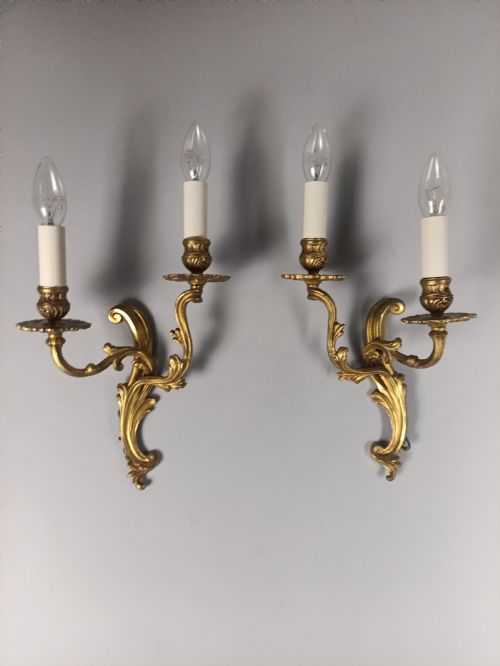
The dominant aesthetic draws heavily on French Rococo, Rococo Revival, Louis XIV and Louis XV styles, alongside Neoclassical, Empire, and French Chateau designs.
How ornate twin light sconces were made
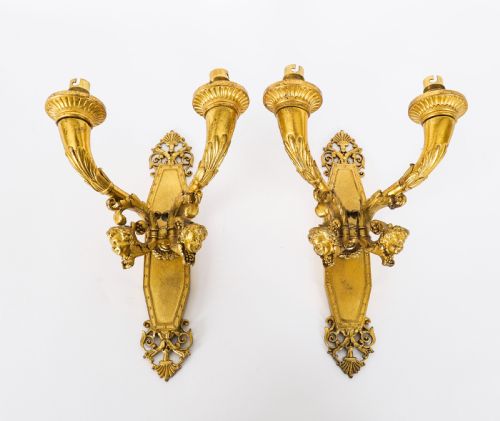
Makers utilised cast metals including brass, bronze, ormolu, gilt bronze, and gilt metal, often applying layers of gilding to create a lustrous surface finish. Some specialised pieces incorporate timber elements such as burr walnut alongside metal branches.
Casting and chasing techniques allowed artisans to shape complex scrolls, cherubs, ribbons, and asymmetric foliage characteristic of Rococo and revival styles. Individual arms were joined to backplates designed for secure wall mounting.
Cherubs peer out from several nineteenth-century brass backplates, keeping a watchful eye on whoever passes beneath the twin-branch illumination.
What varies in quality
The choice of base material also marks the grade of the piece, with heavy gilt bronze and ormolu sitting above standard brass castings. Furthermore, the integrity of the original gilding and the weight of the metal arms influence the overall substance of the sconce.
The Ornate Twin Light Sconces Glossary
- Ormolu
- Gilded bronze produced by applying a mercury and gold amalgam to a bronze casting and firing it in a kiln. This historic technique yields a rich, deep golden finish found on fine French pieces.
- Girandole
- A branched wall light or sconce fitted with mirrored glass or polished metal backs to reflect and amplify the light. They appear frequently in eighteenth and nineteenth-century domestic interiors.
- Rococo Revival
- A nineteenth-century design movement that revived the ornate, asymmetrical scrolls, shells, and naturalistic motifs of the mid-eighteenth-century French court. It dominates the decorative vocabulary of these wall lights.
- Empire Style
- The decorative arts movement spanning the early nineteenth century characterised by classical Roman and Greek motifs, symmetry, and formal dignity. Pieces in this style offer a structured contrast to curved Rococo forms.
- Twin-branch
- A configuration featuring two arms extending from a central backplate to hold a pair of light sources. This layout provides balanced illumination across a wall surface.
Ornate Twin Light Sconces: Frequently Asked Questions
How do I install antique wall sconces?
Many sconces arrive rewired and ready for professional mounting onto standard electrical wall junctions.
Ensure a qualified electrician secures the backplate directly to wall studs or appropriate anchors given the weight of cast metal branches.
What periods do these wall lights come from?
The pieces span from the early nineteenth century through nineteen-twenty and nineteen-thirty.
Revival movements meant earlier styles like Louis XIV and Rococo were frequently replicated across later decades with traditional manufacturing methods.
Are these sconces sold as pairs or sets?
Listings feature individual pairs as well as larger sets of three or four matching wall lights.
Larger sets allow for uniform illumination across extensive reception rooms or grand hallways.
What materials were used to make them?
Common materials include cast brass, gilt bronze, ormolu, and gilded metal.
Select examples also incorporate wooden elements like burr walnut combined with metal arms.