



Ornate Salon Chairs
Ornate salon chairs bring architectural drama and French revival character into a room.
Ornate Salon Chairs
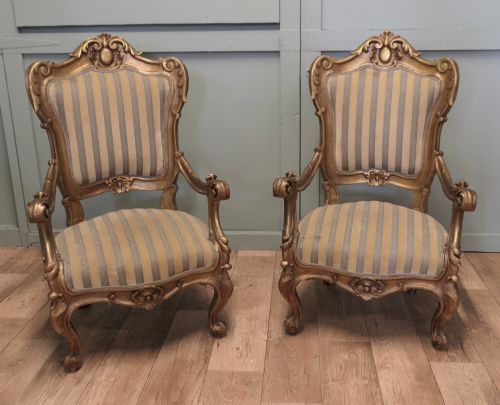
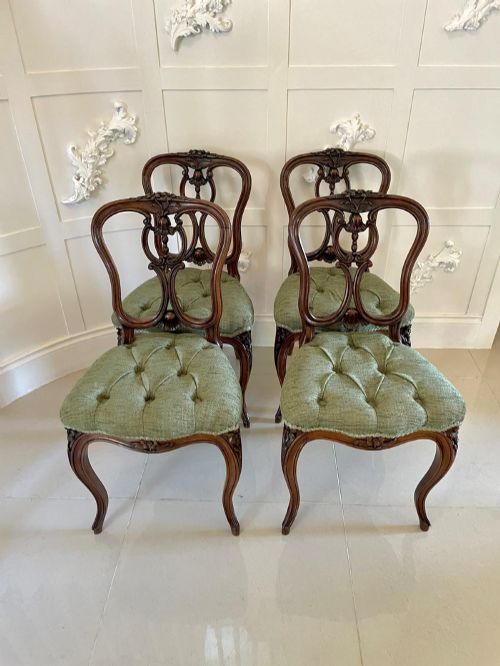
Ornate salon chairs span the nineteenth century through the early twentieth century, taking the form of side chairs, armchairs, hall chairs, and boudoir chairs. These pieces emerge in styles such as French Chateau, Rococo Revival, Hollywood Regency, Louis XVI, and French Louis XV Revival.
The version most commonly met on this page is the nineteenth-century Continental side chair or armchair, often formed as a pair and finished with gilt or carved walnut. Makers drew directly upon classical French court design to supply these decorative seating options for formal rooms.
How they were made
Makers shaped these frames from solid timber, predominantly utilising walnut and giltwood, alongside polished brass for later twentieth-century examples. Carving was executed by hand to achieve the elaborate scrollwork and decorative motifs characteristic of revivalist furniture.
Upholstery completed the work, employing fabric, silk with parrot designs, and woven tapestry fabric secured to the frames. Brass components and structural fixings were integrated to support the decorative metalwork and brass salon chairs.
Ornate Salon Chairs Retail Price Guide 2026
Typical asking prices for ornate salon chairs among the pieces listed under this phrase on Sellingantiques today, from the lower quarter to the upper quarter. They describe what is for sale here now, not the wider market.
Several nineteenth-century salon chairs abandon floral upholstery entirely in favour of silk featuring exotic parrots.
What varies in quality
The refinement of the carved detail separates a standard production piece from superior work, particularly in the depth and crispness of the foliage and scrollwork on walnut and giltwood frames. Hand-carved elements display a fluidity that mechanical shaping fails to replicate.
The choice and execution of the upholstery fabric define the secondary tier of difference, where original woven tapestry or specialised silk designs indicate a higher commissioning standard than plain replacement textiles.
The Ornate Salon Chairs Glossary
- Giltwood
- Timber treated with gold leaf or gilt finish. This technique creates the bright metallic sheen seen on nineteenth-century Continental frames.
- Side chair
- An upright chair without arms designed for dining or occasional use. These pieces form the majority of matched sets in period salons.
- Rococo Revival
- A nineteenth-century design movement mimicking the asymmetrical curves of the eighteenth-century French court. It dominates the ornamentation of these seats.
- Louis XVI Style
- A neoclassical aesthetic characterised by straight tapered legs and classical symmetry. Pieces in this style offer a structured alternative to curvilinear revival forms.
Ornate Salon Chairs: Frequently Asked Questions
What are ornate salon chairs?
Ornate salon chairs are decorative nineteenth- and early twentieth-century seating pieces designed for formal reception rooms. They draw heavily on French revival styles.
These chairs typically feature carved wooden frames, gilt finishes, and decorative upholstery fabrics suited to prominent placement within a home.
How were ornate salon chairs used?
These chairs served as movable seating in formal parlours, drawing rooms, and boudoirs during the nineteenth and early twentieth centuries. They were arranged to facilitate conversation rather than long periods of relaxation.
Because they were intended for display in public spaces within the home, their decoration prioritised visual impact and adherence to fashionable revival aesthetics.
How do you live with ornate salon chairs?
Placing these chairs in a modern interior adds a distinct layer of historical texture and metallic warmth through giltwood and polished brass. They function effectively as occasional seating in living rooms or as striking single pieces in hallways.
Protection from direct sunlight preserves fragile textiles such as silk and woven tapestry, while careful placement prevents heavy physical wear on antique carved joints.
How do you identify nineteenth-century Continental chairs?
Nineteenth-century Continental chairs are recognised through specific construction traits, such as hand-carved walnut frames and traditional gilt finishes reflecting French Chateau and Louis XV or XVI revival tastes. Makers in this tradition adhered closely to historical proportions.
Comparing the joinery methods and the style of the carved ornamentation against documented period examples helps confirm the nineteenth-century origin.