
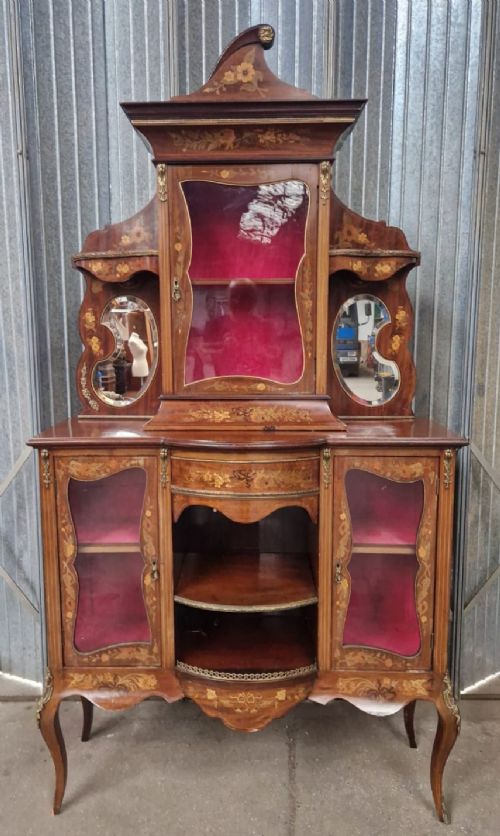
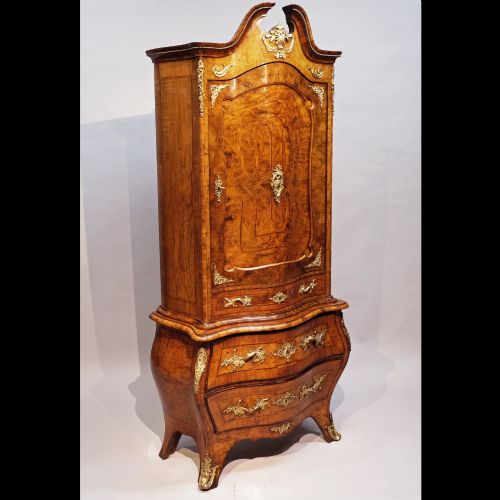
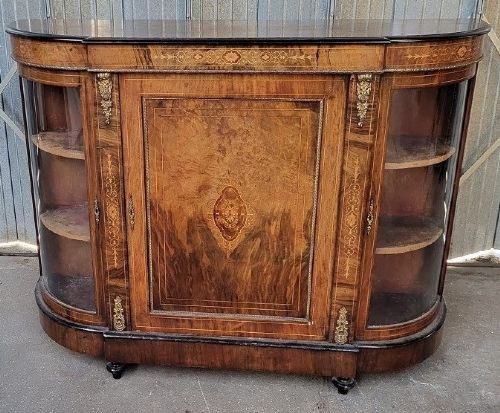


Ornate Marquetry Cabinet
An ornate marquetry cabinet brings patterned wood veneers and decorative mounts into a room, offering both display space and storage.
Ornate Marquetry Cabinet
The selection extends from mid-nineteenth-century credenzas with glass doors and ormolu mounts to later cocktail cabinets and commodes. Pieces typically feature floral or geometric wood inlay set into rich timber surfaces, often topped with marble or fitted with internal mirrors.
Origins span English Victorian workshops and French revival pieces, reflecting a shared nineteenth- and early twentieth-century taste for elaborate surface decoration. Forms range from serpentine shapes and kidney-bound bed-side units to tall bookcase vitrines.
How they were made
Cabinet makers utilised contrasting timbers such as satinwood, rosewood, kingwood, and walnut to construct intricate marquetry patterns. Veneers were carefully sliced and arranged on solid carcases to create detailed pictorial or geometric designs.
Metalwork played a defining structural and decorative role, with cast ormolu and brass mounts edge-trimming doors, corners, and aprons. Glass panels were incorporated into doors for vitrines and credenzas, while marble was fitted to the upper surfaces of commodes.
Materials appearing across the current selection include ormolu, glass, brass, burr walnut, walnut, kingwood, marble, and rosewood.
What varies in quality
The precision and complexity of the marquetry dictate the upper tier of the range, where individual wood species are shaded and fitted with exactness. Simpler panels with repetitive or sparse inlay sit at the more modest end.
The calibre of the metal mounts and the selection of timber figure also separate standard examples from finer ones. Burr walnut with rich natural graining and heavy, finely chased ormolu mounts command greater attention than plainer veneers and stamped brass.
The Ornate Marquetry Cabinet Glossary
- Marquetry
- Decorative veneer work forming pictures or patterns by assembling thin pieces of wood. Craftsmen select contrasting timbers to achieve tonal variation across the surface.
- Ormolu
- Gilded bronze applied as mounts, feet, and decorative trim on furniture. The technique was widely utilised during the nineteenth century on revival pieces.
- Credenza
- A low cabinet, frequently enclosed by glass or panelled doors and flanked by curved ends. These pieces often feature extensive inlay and mirror backs.
- Vitrine
- A glass-fronted cabinet designed for the display of porcelain and small objects. They frequently sit atop credenzas or form standalone tall display units.
- Boulle inlay
- Decoration employing tortoiseshell and brass cut together in a counter-change pattern. It appears on French revival pieces from the nineteenth century.
Ornate Marquetry Cabinet: Frequently Asked Questions
What is an ornate marquetry cabinet used for?
These cabinets served historically as principal reception room furniture for displaying prized possessions and storing household goods behind lockable doors.
Today, they function well in living spaces and dining rooms to display glassware or ceramics while providing enclosed storage beneath.
How do I identify a Victorian piece?
Victorian examples frequently utilise burr walnut timber combined with ormolu mounts, glass doors, and internal mirror panels.
Look for construction traits typical of the period, such as mahogany secondary timbers and traditional hand-cut dovetails in the drawer construction.
Where were these cabinets made?
Production was divided between English cabinet makers working in London and provincial centres, and French workshops producing revival styles.
French pieces often display specific continental traits such as kingwood veneers, marble tops, and Louis XV or Napoleon III revival silhouettes.
How do I care for marquetry surfaces?
Keep wooden cabinets away from direct sunlight and steady heat sources to prevent the veneers from drying out or lifting over time.
Apply a microcrystalline wax sparingly to maintain the sheen on the timber without building up heavy layers of residue.