




Ornate Gold Clock
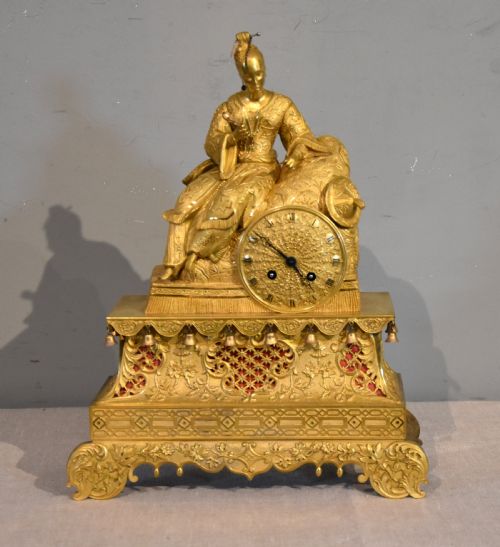
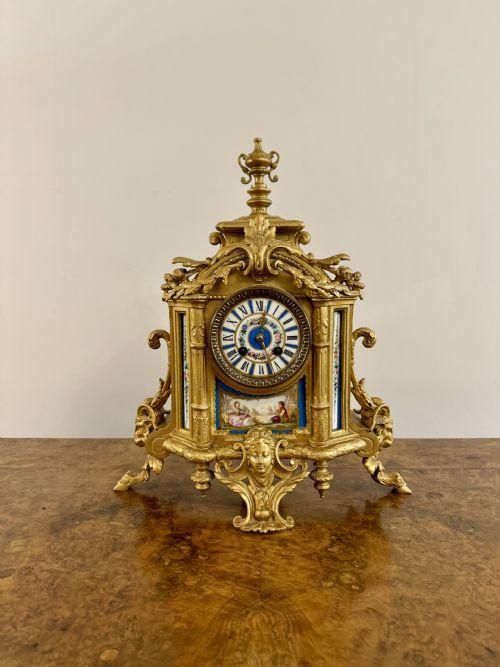
An ornate gold clock brings heavy gilt metal, glass and porcelain into a room, anchoring a mantelpiece with nineteenth-century French and Victorian weight.
Ornate Gold Clock
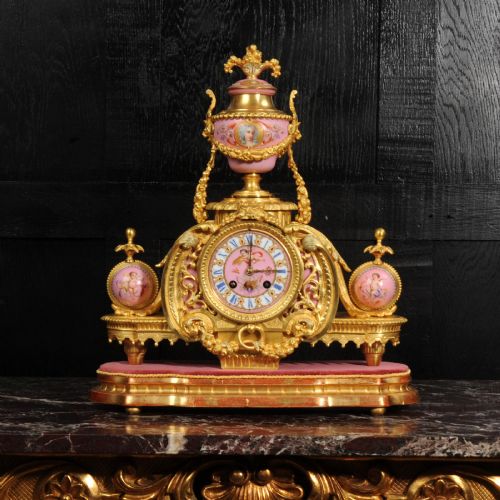
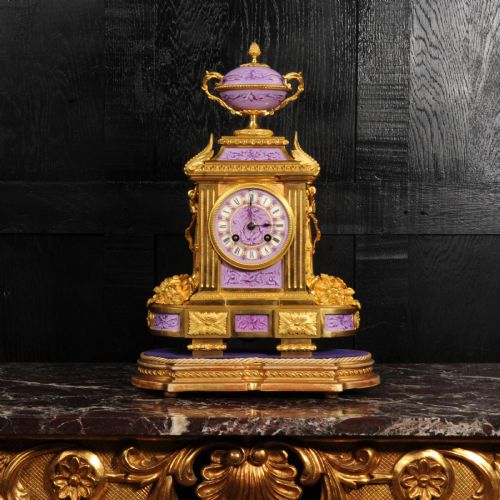
An ornate gold clock sits on a mantelpiece, desk or bracket, taking the form of mantel clocks, carriage clocks, desk clocks, wall clocks and clock sets. These objects originate largely from nineteenth-century France and Victorian England, spanning decades from eighteen fifty to nineteen hundred.
The version most commonly met on this page is the French mantel clock or carriage clock, heavily styled in French Rococo, Louis XV, Louis XVI or general Victorian revivalism. They combine gilt brass, ormolu, gilt bronze and enamel dials, sometimes paired with side garnitures.
Makers such as Achille Brocot, Samuel Marti, Japy Freres, Howell & James, and John Barwise signed movements and cases, marking the shift from functional timekeeping to elaborate interior decoration.
How they were made
Casework relies heavily on cast brass, gilt bronze and ormolu, shaped into elaborate Rococo scrolls and architectural revival styles. Gilt finishes are applied to base metals, catching light across floral and figural reliefs.
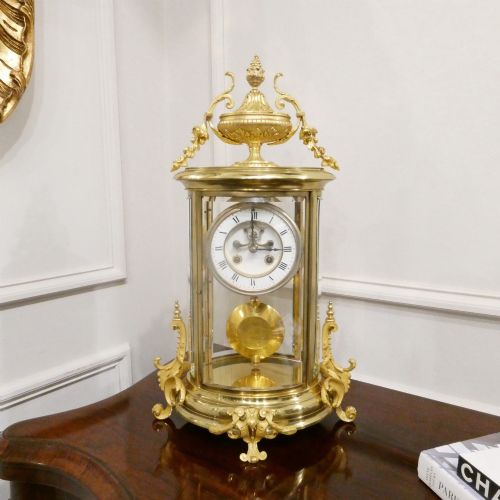
Glazing takes the form of heavy bevelled glass panels, particularly in four-glass mantel clocks and brass carriage clocks where the inner movement remains visible from multiple angles. Porcelain plaques, often painted with scenes, are set directly into the brass or gilt metal housing.
Champlevé enamel work decorates dials and bezels, fusing coloured glass into recessed metal cells. Movements are mechanical, requiring eight-day striking mechanisms, repeater complications or grand sonnerie functions housed within solid brass plates.
Listings feature nineteenth-century French and Victorian pieces made from gilt bronze, ormolu, brass, marble, porcelain and glass.
What varies in quality
The depth and crispness of the gilt bronze or ormolu casting separate standard production pieces from finer works. Sharp relief work and heavy metal gauge indicate substantial workshop labour, whereas lighter brass cases lack the same physical presence.
The integration of decorative elements dictates overall harmony. Finer examples combine hand-painted Sèvres porcelain or intricate champlevé enamel with balanced gilt mounts, whereas lesser pieces rely on repetitive stamping without hand-chasing.
Maker attribution elevates an object, with movements signed by established houses like Samuel Marti or Achille Brocot demonstrating mechanical precision alongside decorative merit.
Achille Brocot·Samuel Marti·Howell & James London·Japy Freres·John Barwise of London
The Ornate Gold Clock Glossary
- Ormolu
- Gilt bronze created by applying a mercury and gold amalgam to a bronze object before heating. This technique produces a deep, durable golden finish found on nineteenth-century French cases.
- Carriage clock
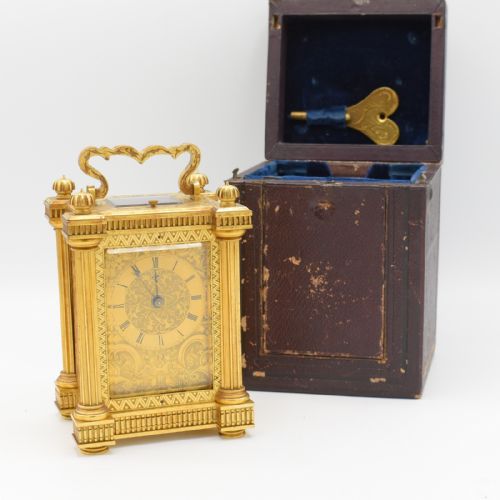
- A small, portable spring-driven timepiece designed for travel, typically fitted with a carrying handle and glass panels. They emerged in nineteenth-century France and England.
- Clock garniture
- A set comprising a central mantel clock accompanied by matching side ornaments, such as urns or candelabra. These sets were designed to sit symmetrically on a mantelpiece.
- Champlevé
- An enamelling technique where troughs are dug into a metal surface and filled with vitreous enamel powder before firing. It frequently appears on Victorian and late nineteenth-century clock bezels.
- Four glass clock
- A mantel clock housed in a brass or gilt bronze frame with bevelled glass panes on the front, back and sides. This construction allows light to pass through and exposes the escapement and gear train.
- Fusee
- A conical pulley used in clock movements to maintain even tension on the gear train as the mainspring unwinds. It ensures consistent timekeeping accuracy across the power reserve.
Ornate Gold Clock: Frequently Asked Questions
What is a carriage clock?
A carriage clock is a portable mechanical timepiece fitted with a folding handle and glass viewing panels. Nineteenth-century travellers used them on journeys.
They sit in heavy brass or gilt cases, often featuring lever escapements and striking or repeating complications housed securely within.
How do I identify French revival styles?
French revival styles borrow heavily from Louis Quatorze, Louis Quinze and Louis Seize periods, showing up in nineteenth-century ormolu and gilt bronze cases. Look for asymmetrical Rococo scrolls or symmetrical neoclassical urn motifs.
Maker signatures on the movement backplate often confirm the French origin and narrow down the production decade.
Where should I place a heavy mantel clock?
Place the clock on a stable, level surface such as a wooden mantelpiece or shelf away from direct sunlight and dampness. A level base ensures the pendulum beats evenly.
Heavy gilt bronze and marble cases require solid support to bear their substantial weight safely over long periods.