


Ornate Carved Chest
An ornate carved chest brings tactile history into a room, offering both practical storage and deep regional carving.
Ornate Carved Chest
When you search for an ornate carved chest, you enter a diverse field spanning centuries and continents, from seventeenth-century Italian walnut to twentieth-century Indian teak. These pieces serve as storage cabinets, blanket coffers, and commodes, each shaped by distinct regional aesthetics.
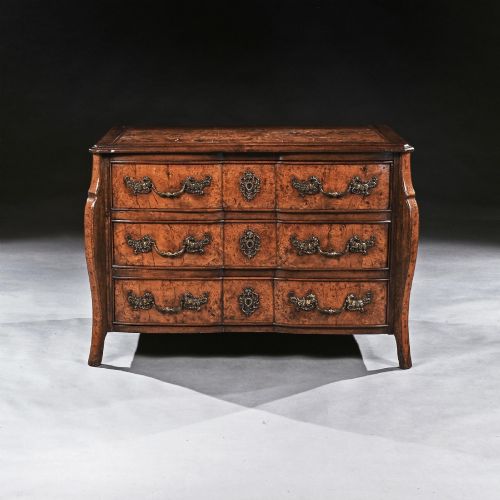
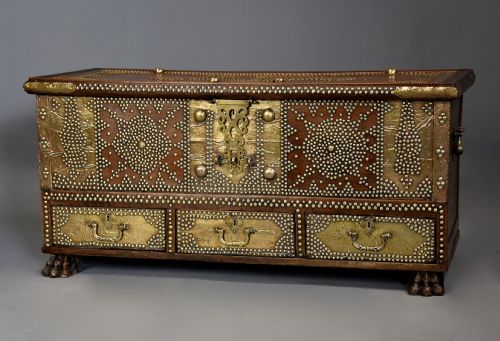
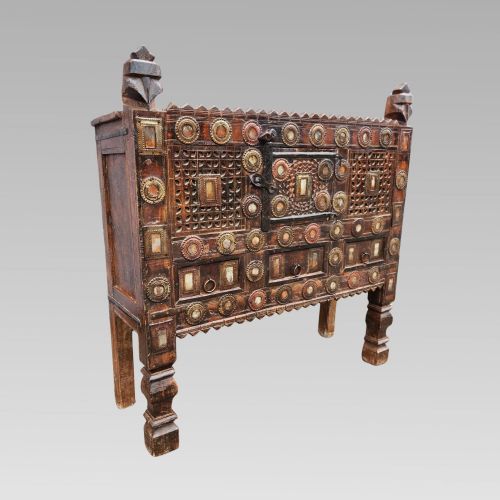
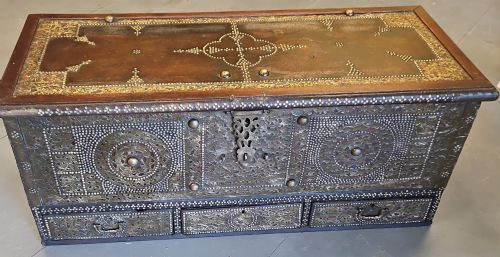
The versions most frequently met on this page include nineteenth-century Zanzibar traders chests adorned with brass studs and Indian dowry chests. French commodes and Italian cassones also appear, bringing varied forms such as desks, boxes, and multi-drawer chests of drawers.
Makers ranged from European cabinetmakers working in Louis XV or Gothic styles to traditional artisans across India, the Middle East, and Burma. The function shifts from grand domestic storage to intimate jewellery boxes, yet the common thread remains heavy, intentional surface decoration.
How they were made
Construction relies on solid timbers such as teak, walnut, burr elm, oak, and various hardwoods, chosen for their structural stability and response to chisel work. Artisans joined panels using traditional methods to support the weight of dense surface carving and metal mounts.
Decoration is applied through deep relief carving, often paired with brass stud work, iron fittings, silvering, and giltwood. Lacquer and paint finishes appear on specific regional pieces, adding colour and texture to the timber grain.
Listings feature timbers including teak, walnut, burr elm, and hardwood, alongside brass, bronze, and giltwood elements.
What varies in quality
The depth and clarity of the carving separate standard workshop pieces from exceptional examples, as sharp chisel work retains crisp edges over time. The integration of decorative elements, such as brass stud placement on Zanzibar chests or the proportion of giltwood mounts on European commodes, dictates the visual balance.
The choice of primary timber influences the piece, with figured woods like burr elm or select walnut offering rich natural patterns beneath the carved surfaces. Original hardware, including drop handles and hinges, preserves the integrity of the object more effectively than later replacements.
The Ornate Carved Chest Glossary
- Cassone
- An Italian chest, typically made of walnut and heavily decorated, historically used for wedding dowries. These form the grand precursors to later storage cabinets and commodes.
- Commode
- A decorative chest of drawers or cabinet, often originating from French or Italian traditions. They sit on legs or a plinth and frequently feature shaped fronts.
- Zanzibar chest
- A distinct form of traders chest originating from East Africa and India, characterised by heavy brass stud decoration and geometric strapwork. They were built for maritime transport and domestic display.
- Damchiya
- An Indian dowry chest or storage cabinet featuring intricate carved panels and recesses. These pieces are traditionally used to store household valuables and textiles.
- Giltwood
- Wood that has been treated with a thin layer of gold leaf or gilt preparation to create a metallic sheen. It appears frequently on European frames and carved furniture details.
Ornate Carved Chest: Frequently Asked Questions
How do I clean an ornate carved chest?
Dust the deep recesses regularly using a soft-bristled brush to prevent dirt accumulation in the carved details.
Apply a microcrystalline wax sparingly every year to feed the wood without leaving a sticky residue on the carved surfaces.
Can I use a carved chest as a coffee table?
Lower coffers and trunks function well as coffee tables if the top surface is flat and stable enough to support objects.
Place a glass top over delicate carvings to protect the timber from spills and daily wear while keeping the texture visible.
How do I tell an Italian cassone apart from a French commode?
Italian cassones are traditionally long, rectangular coffers with heavy walnut construction and architectural or Gothic relief panels.
French commodes are typically chests of drawers raised on legs, often showing Louis XV curves and refined marquetry or giltwood.
What is the difference between a Zanzibar chest and an Indian dowry chest?
Zanzibar chests are defined by brass studwork, strap hinges, and a rectangular trunk form built for maritime trade.
Indian dowry chests, or damchiyas, feature deep architectural carving, enclosed compartments, and are constructed as stationary cabinets for household textiles.