



Ornate Bronze Panel
An ornate bronze panel brings heavy cast detail and golden gilding to French nineteenth century mantel clocks, vitrines, and firescreens.
Ornate Bronze Panel
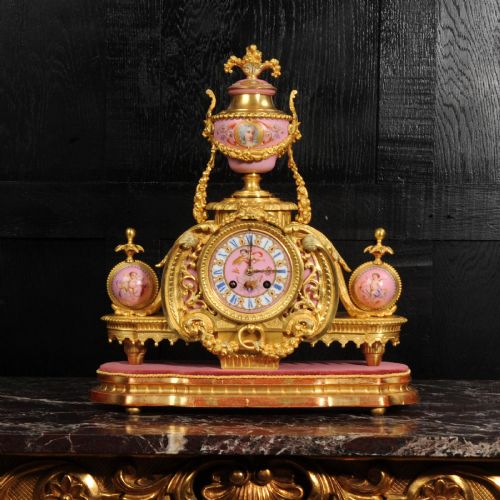
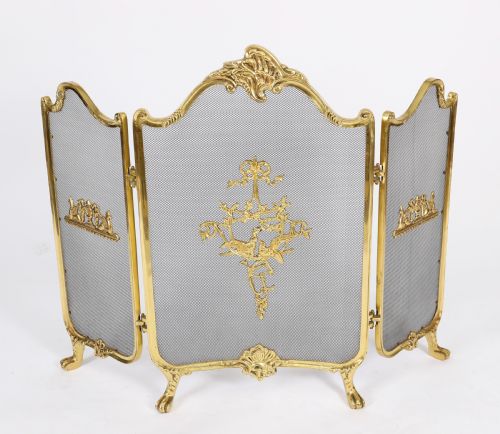
An ornate bronze panel forms part of elaborate French furniture, clocks, and firescreens dating from the nineteenth century. These decorative elements appear across diverse objects including mantel clocks, display cabinets, jewellery boxes, and triple fire screens.
The versions most commonly met on this page belong to the French Rococo, Napoleon III, and Louis XVI revival styles. Makers integrated gilt bronze and ormolu mounts alongside porcelain, glass, and velvet to enrich the decorative surface.
Pieces from this period frequently combine bronze work with Sèvres style porcelain panels, kingwood veneers, and marble tops. The resulting items range from complete clock sets under glass domes to large bombe vitrines.
How they were made
Gilt bronze and ormolu provide the primary metallic structure for these panels and mounts, shaped through detailed casting techniques. Craftsmen applied gold plating or mercury gilding to bronze bases to achieve a brilliant, lasting lustre.
Makers combined the metalwork with contrasting materials such as Sèvres style porcelain panels, painted ceramic inserts, and enamel dials. Wooden carcases utilise kingwood veneers, while display cabinets incorporate glass panels and marble tops.
Ornate Bronze Panel Retail Price Guide 2026
Typical asking prices for ornate bronze panel among the pieces listed under this phrase on Sellingantiques today, from the lower quarter to the upper quarter. They describe what is for sale here now, not the wider market.
Listings feature nineteenth-century French pieces combining gilt bronze, ormolu, and Sèvres style porcelain across mantel clocks and vitrines.
What varies in quality
The sharpness of the cast detail in the bronze or ormolu separates finer pieces from simpler work, showing crisp chasing and deep relief. Lesser examples exhibit softer edges where the finishing smoothing has removed the definition.
The integration of supplementary materials alters the character of each piece, distinguishing standard production items from ambitious workshop commissions. Hand-painted porcelain panels and rich gilt finishes indicate higher status creation.
Achille Brocot·Henri Jacot
The Ornate Bronze Panel Glossary
- Ormolu
- Gilded bronze, produced by applying a finely ground high-carat gold-mercury amalgam to a bronze object before heating. This technique creates a rich golden surface characteristic of fine French decorative arts.
- Vitrine
- A glass-fronted display cabinet designed for showing porcelain, silver, and small curiosities. These cabinets often feature elaborate gilt bronze mounts and kingwood or vernis martin decoration.
- Sevres style
- Ceramic decoration produced in imitation of the famous French Sèvres factory, featuring hand-painted scenes or floral motifs against coloured grounds. These panels frequently decorate nineteenth-century mantel clocks and cabinets.
- Fire screen
- A decorative standing screen placed in front of a fireplace when not in use. Triple fire screens from the nineteenth century often incorporate ornate gilt bronze frames and fabric panels.
- Bombe
- A bulging or convex furniture shape curved outward on the front and sides. This form requires skilled cabinetmaking to fit marble tops and bronze mounts precisely.
Ornate Bronze Panel: Frequently Asked Questions
What periods do these pieces date from?
The objects featuring these decorative elements predominantly date from the nineteenth century, with specific examples recorded across the 1850s, 1870s, 1880s, and 1890s.
Stylistic influences draw heavily from earlier French eras such as Rococo and Louis XVI, reinterpreted during the Second Empire and Napoleon III periods.
How were mantel clocks and cabinets used?
Mantel clocks served as functional timekeepers and centrepieces on drawing room fireplaces, often accompanied by matching side urns or candelabra in three-piece sets.
Display cabinets and vitrines housed valuable porcelain, miniatures, and collection pieces, protecting them behind glass while showcasing them in formal reception rooms.
What materials accompany the bronze panels?
Gilt bronze and ormolu form the primary metal framing, frequently paired with Sèvres style porcelain panels and hand-painted ceramic plaques.
Additional elements include kingwood veneers, marble top surfaces, velvet linings, and glass panels found on vitrines and clock domes.
How do I identify different French revival styles?
French Rococo revival pieces display asymmetrical scrollwork, flowing organic forms, and naturalistic motifs like flames and foliage. Louis XVI revival items favour greater symmetry, classical architectural proportions, and restrained geometric detailing.
Napoleon III design encompasses eclectic revivals utilising rich mounts, Boulle marquetry, and vibrant porcelain inserts.