




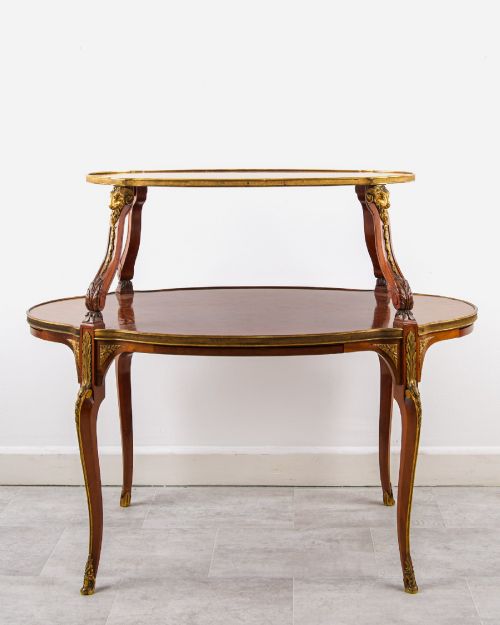


Ormolu Mounted Tier Table
An ormolu mounted tier table brings tiered elegance and gilt bronze highlights to a room, offering practical display space with a distinct French revival character.
Ormolu Mounted Tier Table
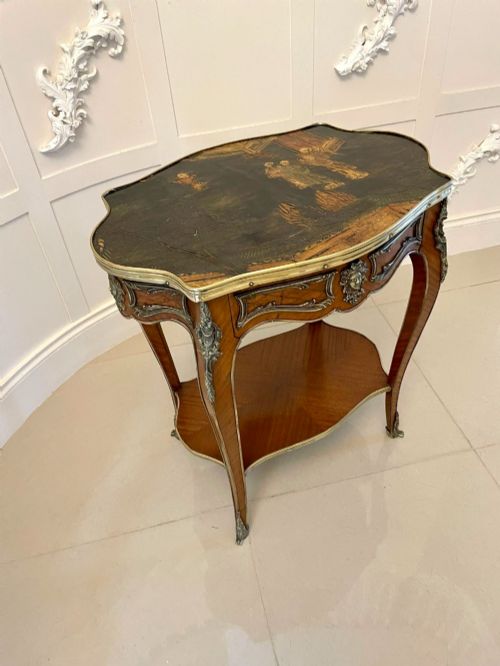
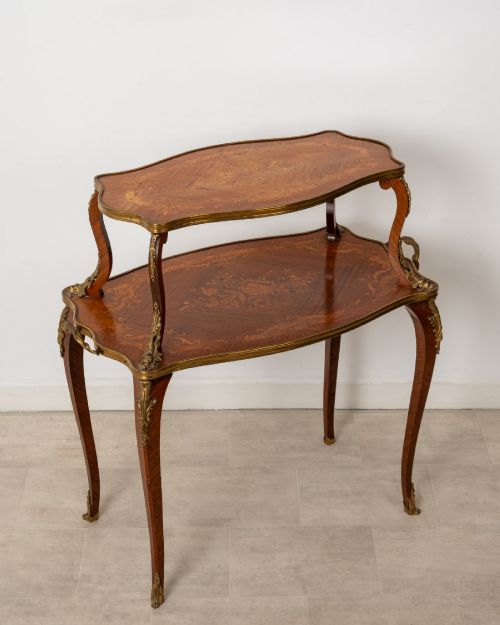
An ormolu mounted tier table is a multi-level piece designed for display or service, combining stacked surfaces with decorative metal mounts. These tables emerge predominantly from the nineteenth century, reflecting Victorian and Edwardian interpretations of French design.
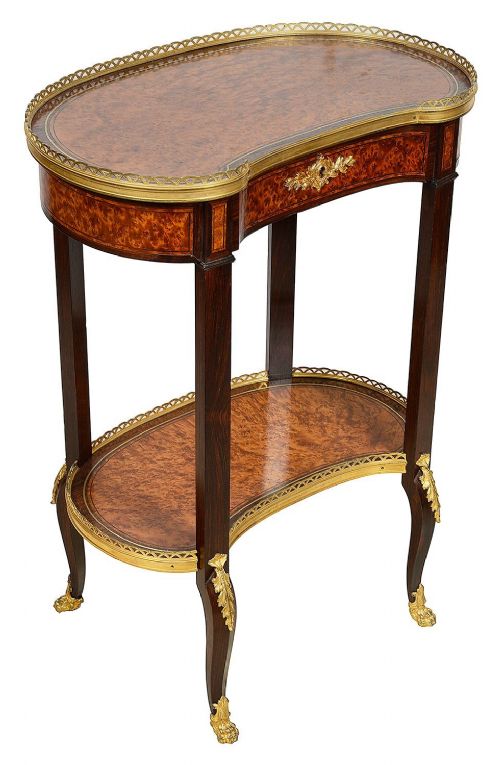
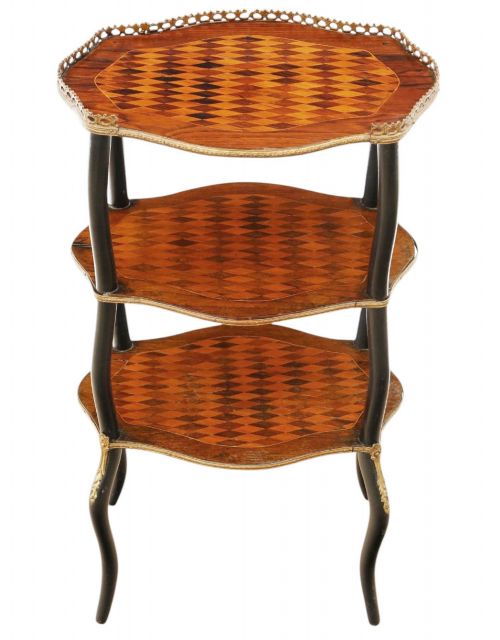
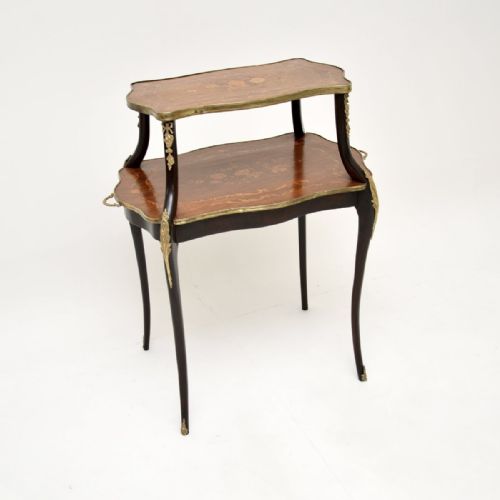
The form encompasses two-tier and three-tier etagere structures, alongside side tables and occasional pieces. Makers utilised walnut, mahogany, and kingwood timbers, often incorporating marquetry and parquetry patterns across the stacked platforms.
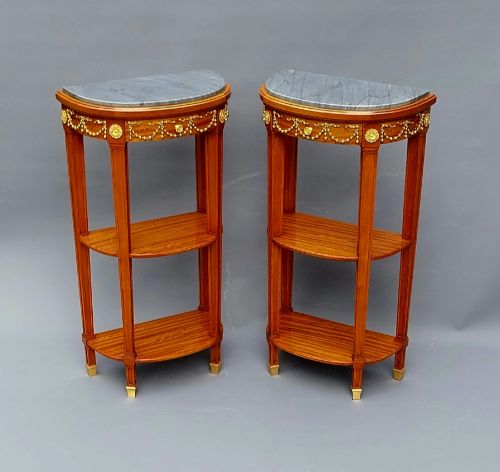
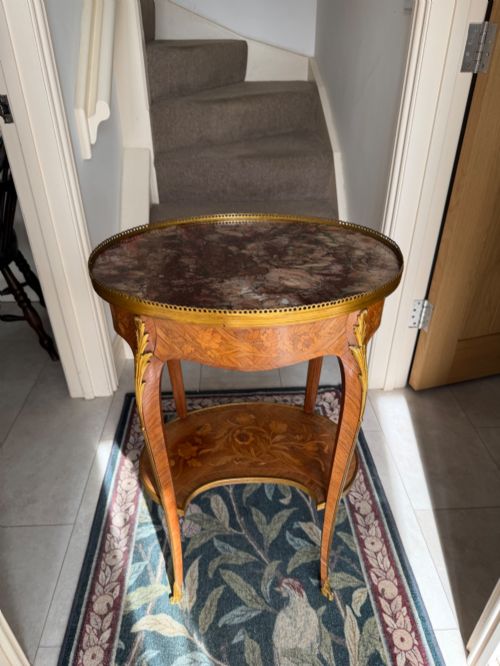
Most examples trace their origins to French workshops adopting Louis XV and Louis XVI styles, or the later Napoleon III aesthetic. Buyers frequently encounter pieces featuring galleried edges, marble tops, and shaped surfaces designed to catch the eye.
How they were made
Cabinetmakers constructed the foundational frames using dense hardwoods like mahogany, walnut, and kingwood, frequently applying intricate floral marquetry or geometric parquetry veneers to the surfaces. Selected pieces incorporate amboyna, rosewood, and ebonised elements to enhance the visual depth of the tiers.
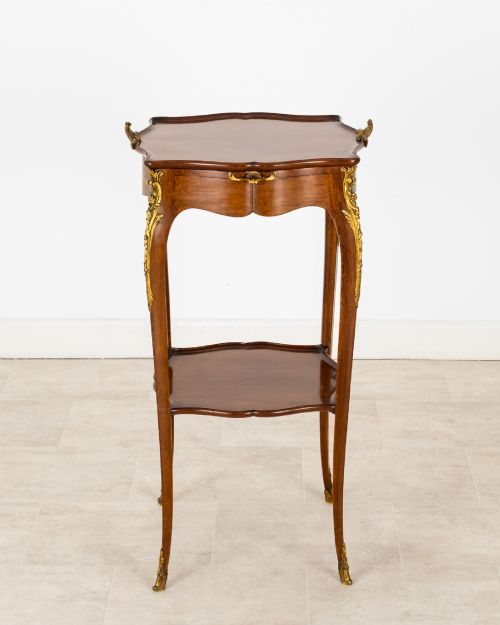
Gilt bronze and brass mounts, cast and chased into Rococo scrolls, floral motifs, or classical friezes, were secured to the angles and legs of the table. Marble inserts and pierced brass galleries were integrated into the upper and lower platforms to complete the structure.
Ormolu Mounted Tier Table Retail Price Guide 2026
Typical asking prices for ormolu mounted tier table among the pieces listed under this phrase on Sellingantiques today, from the lower quarter to the upper quarter. They describe what is for sale here now, not the wider market.
The documented pieces span the Victorian, Edwardian, and Napoleon III periods, leaning heavily into French Louis XV and XVI styles.
What varies in quality
The fineness of an ormolu mounted tier table rests heavily on the crispness of the bronze casting and the precision of the hand-chasing on the mounts. Superior examples display sharp relief and careful finishing, whereas lesser pieces show soft edges and simpler assembly.
Marquetry execution similarly divides the range, with master workshops producing detailed, shaded wood inlays against simpler geometric parquetry. The choice of underlying timber, from figured mahogany to exotic kingwood and amboyna, dictates the structural ambition of the piece.
François Linke·Edwards and Roberts
The Ormolu Mounted Tier Table Glossary
- Ormolu
- Gilded bronze used for decorative mounts on furniture. It provides a bright metallic contrast to dark wood veneers.
- Étagère
- A piece of furniture consisting of open shelves for displaying small objects. These tables frequently feature multiple tiers for this purpose.
- Marquetry
- Decorative veneer work formed by small pieces of wood fitted together to form pictures or patterns. Craftsmen applied these across the tabletops.
- Parquetry
- Geometric mosaic woodwork used for floors or furniture surfaces. It appears on numerous occasional tables in diamond or cube patterns.
- Galleried
- Fitted with a raised miniature railing around the edge of a shelf or tabletop. This prevents items from sliding off the tier.
Ormolu Mounted Tier Table: Frequently Asked Questions
How were tier tables used?
These tables served as versatile furniture for holding lamps, small decorative objects, or tea services across grand nineteenth-century reception rooms. The multiple tiers allowed owners to display collections without overcrowding a single surface.
In domestic settings, they functioned flexibly as occasional pieces beside seating or as freestanding display stands in a corner or centre of a room.
How do I identify French revival styles?
French revival pieces incorporate curved cabriole legs, asymmetrical floral mounts, and elaborate marquetry inspired by Louis XV and Rococo design. Louis XVI revival pieces shift towards straight tapered legs and neoclassical symmetry.
Examining the underlying timber and the crispness of the gilt bronze mounts helps pinpoint the nineteenth-century period of manufacture.
Are marble tops original?
Many nineteenth-century occasional and tier tables incorporated inset marble slabs to provide a durable and cool surface for drinks or plants. These marble inserts were typically fitted precisely into the wooden frame during initial construction.
Matching the stone type and edge profiling to the era helps confirm whether the top remains as the maker intended.
Where should I place a tier table?
A tier table suits placement beside a sofa or as an accent piece in a drawing room where its multiple levels can be appreciated. Freestanding centre variations work well in open spaces to showcase inlay work from all angles.
Keeping the table away from direct heat sources protects the delicate wood veneers and prevents movement in the joints.