
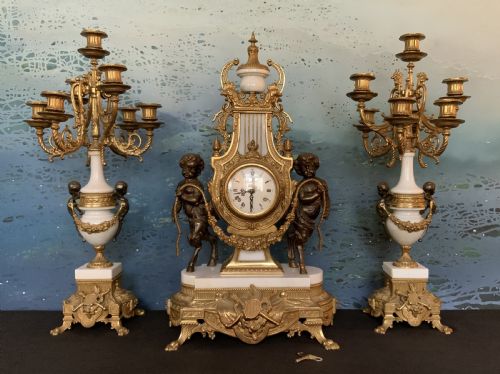


Ormolu Lyre Mantel Clock
An ormolu lyre mantel clock brings neoclassical symmetry and gilt brilliance to a mantelpiece, shaped just like the ancient stringed instrument.
Ormolu Lyre Mantel Clock
When you search for an ormolu lyre mantel clock, you are looking at upright timepieces modeled on the classical musical instrument, flanked by gilt mounts and supported on architectural bases. These decorative objects emerge from periods such as the Regency era, the nineteenth century, and later revivals spanning 1860, 1890, 1900, and 1960. The version you are most likely to meet on this page is a French timepiece featuring neoclassical design influences, often paired with matching garnitures.
The architectural form borrows heavily from Louis XVI and Louis XV revival aesthetics, integrating the central dial within the body of the lyre frame. Materials vary from white, pink, and bleu de roi marble to burr walnut and maple, all enhanced by metallic mounts. Whether standing alone or accompanied by candelabra, these sculptural clocks dominate a room through their distinct silhouette.
Materials and construction
The physical structure relies on heavy natural stones like marble alongside timber frames in walnut or maple, housing mechanical movements driven by chains or standard springs. Gilt bronze and ormolu form the decorative mounts that trace the sweeping curves of the lyre shape and adorn the base.
Enamel dials provide the face for timekeeping, whilst porcelain panels in Sevres styles frequently decorate the central body. Workshops combined metal casting, gilding, stone carving, and cabinetmaking to achieve the finished object.
Listings feature pieces spanning the Regency period through to 1960, utilising marble, porcelain, gilt bronze, and various woods.
What separates the fine examples
The distinction between standard and superior pieces lies in the crispness of the gilt bronze chasing and the selection of the base materials. Richer clocks utilise finely figured marble or burr walnut alongside deep, clean mercury gilding that retains its sharp relief across the mount details.
Makers' marks and the complexity of the internal movement, such as chain fusee systems or specialised mystery clock mechanisms, elevate the standing of a piece. The integration of hand-painted porcelain and balanced proportions across the garniture sets further defines the upper tier of the range.
Lenzkirch·FB Adams London·Maple and Co Paris
The Ormolu Lyre Mantel Clock Glossary
- Ormolu
- Gilt bronze created by applying a finely ground high-carat gold-mercury amalgam to a bronze base. This technique produces a distinctive golden surface finish.
- Lyre
- A stringed musical instrument of ancient Greece, shaped like a U with a crossbar. Clockmakers adopted this symmetrical outline for decorative mantel timepieces.
- Garniture
- A set of matching ornamental objects for a mantelpiece, usually comprising a central clock flanked by two matching candelabra or vases.
- Fusee
- A conical pulley used in clock movements to equalize the declining power of the mainspring as it unwinds. This mechanism improves timekeeping accuracy.
- Neoclassical
- A Western cultural movement drawing inspiration from the classical art and culture of ancient Greece or Rome. It emphasises clean lines, symmetry, and classical motifs.
Ormolu Lyre Mantel Clock: Frequently Asked Questions
What is an ormolu lyre mantel clock?
An ormolu lyre mantel clock is a decorative timepiece designed in the shape of a musical lyre, decorated with gilt bronze mounts and supported on a marble or wooden base.
These clocks draw heavily from neoclassical and Louis XVI design traditions, utilising the symmetrical curves of the instrument to frame the clock dial.
Where do these clocks come from?
The pieces recorded here originate primarily from French and English workshops, reflecting stylistic periods from the Regency era through the late nineteenth and mid-twentieth centuries.
Maker signatures and style indicators point to notable centres of horology and decorative arts in Paris and London.
How do you display them on a mantel?
These clocks are placed centrally on a mantelpiece or console table, where their vertical silhouette and reflective gilt surfaces catch the light.
Many examples include matching side pieces like candelabra, forming a complete garniture set that requires adequate surface width for balanced arrangement.
What materials are used?
The primary structural materials include various types of marble, such as white, pink, and bleu de roi, alongside timbers like burr walnut and maple.
Surface decoration relies on ormolu and gilt bronze mounts, enamel clock faces, and hand-painted porcelain panels.