

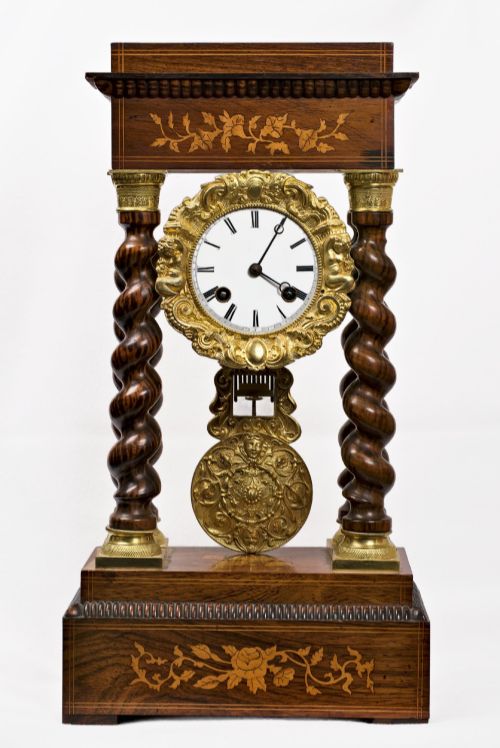
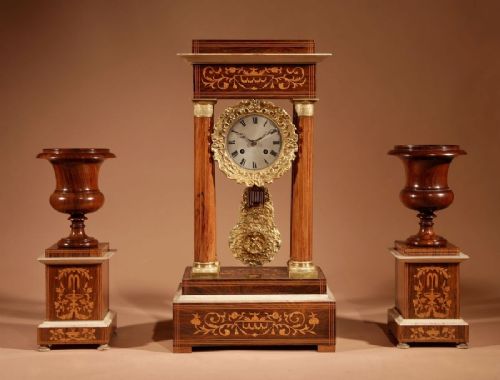
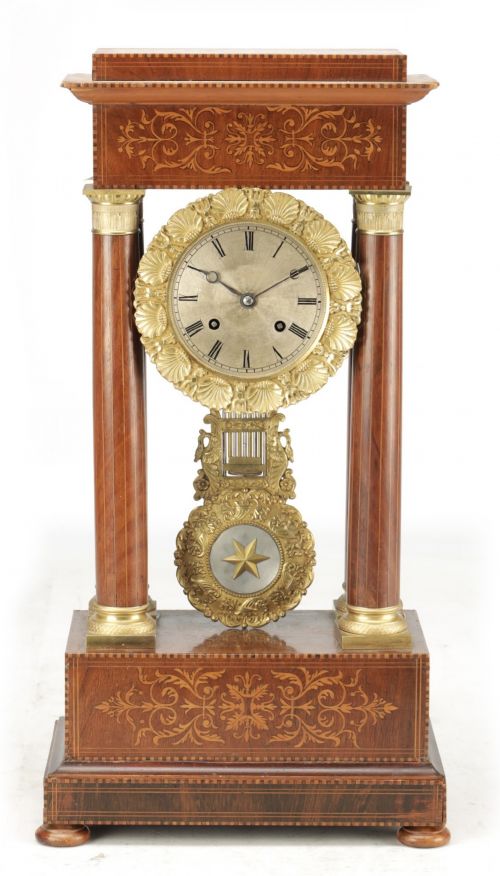
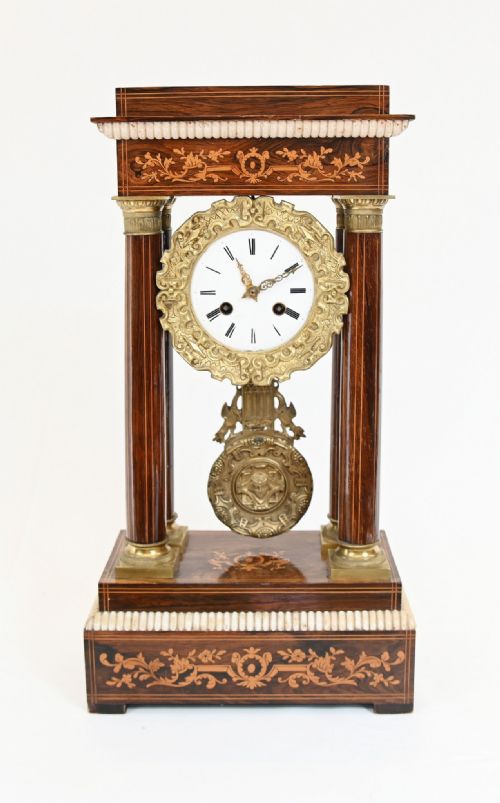


Ormolu Column Clock
An ormolu column clock brings neoclassical French architecture onto the mantelpiece, combining gilded bronze columns with precise mechanical movements.
Ormolu Column Clock
When searching for an ormolu column clock, buyers encounter distinct architectural forms often described as portico clocks, featuring upright supporting pillars framing a central pendulum dial. These timepieces stem predominantly from French workshops active across the eighteenth and nineteenth centuries, including the Charles X, Louis Philippe, and Victorian periods.
The architectural format draws heavily from neoclassical design principles, utilising twin columns of marble, rosewood, mahogany, or crystal to elevate the central clock housing. Surviving examples frequently appear alongside matching side garnitures or as standalone mantel pieces displaying white enamel dials and delicate hands.
How they were made
The construction relies on fire-gilded bronze, commonly known as ormolu, combined with structural carcases of white marble, alabaster, or exotic woods such as rosewood and mahogany. Metal mounts were cast, chased by hand to sharpen details, and coated in gold amalgam to achieve a lasting metallic lustre.
Ormolu Column Clock Retail Price Guide 2026
Typical asking prices for ormolu column clock among the pieces listed under this phrase on Sellingantiques today, from the lower quarter to the upper quarter. They describe what is for sale here now, not the wider market.
Listings feature periods spanning the late eighteenth century through the Victorian era, utilising white marble, rosewood, ormolu, and cut crystal.
What varies in quality
The standard of an ormolu column clock rests on the crispness of the bronze chasing and the depth of the original gilding, where hand-finished detailing separates finer pieces from simpler castings. The architectural proportioning of the columns relative to the central dial and pediment dictates the visual balance of the whole structure.
Material selection further defines the hierarchy, with dense marbles, flawless cut crystal columns, and intricate rosewood marquetry marking out superior productions. The incorporation of signed mechanical movements or complex garniture sets adds significant substance to an individual piece.
Benson 67 Ludgate Hill·Breguet
The Ormolu Column Clock Glossary
- Ormolu
- A technique of applying finely ground gold-mercury amalgam to a bronze object, which is then fired to drive off the mercury and leave a rich gold coating. This process creates the distinctive warm metallic finish seen on nineteenth-century French mounts.
- Portico clock
- A mantel clock designed with architectural columns supporting a lintel and housing a suspended pendulum in the open central space. These pieces reflect neoclassical tastes popular during the Charles X and French Empire periods.
- Garniture
- A set consisting of a central clock flanked by matching decorative objects such as urns or vases designed to sit together on a mantelpiece. They became particularly widespread in French domestic interiors during the Victorian era.
- Fusee
- A conical pulley used inside certain clock movements to equalize the declining power of the mainspring as it unwinds. This mechanism helps maintain consistent timekeeping throughout the duration of the winding cycle.
- Enamel dial
- A fused glass surface fired onto a copper or brass disk to provide a smooth, durable background for painted clock numerals. White enamel dials are standard on the majority of nineteenth-century French mantel clocks.
Ormolu Column Clock: Frequently Asked Questions
How do I wind an ormolu column clock?
Use the designated winding key inserted into the dial holes to gently turn the springs until resistance is felt, taking care not to overwind the movement.
Most traditional French movements require winding once a week to maintain accurate timekeeping and keep the pendulum swinging freely.
Where should I place a portico clock?
Position the clock on a stable, level mantelpiece or sideboard away from direct sunlight, draughts, and damp walls to protect the delicate wood and gilt surfaces.
Because many examples feature tall columns and hanging pendulums, a vibration-free surface ensures the mechanical movement operates without interruption.
How do I distinguish Charles X from Victorian examples?
Charles X pieces, dating from the early nineteenth century, typically exhibit clean neoclassical architectural lines with light wood veneers or polished marble and crisp ormolu mounts.
Victorian pieces often display heavier proportions, darker woods, or decorative pink marble elements reflecting mid-nineteenth-century revival styles.
What is a mystery clock?
A mystery clock is an uncommon horological piece where the mechanism driving the hands appears concealed or operates through unusual invisible connections.
These clever designs showcase the advanced mechanical ingenuity of period French clockmakers working within decorative architectural cases.