

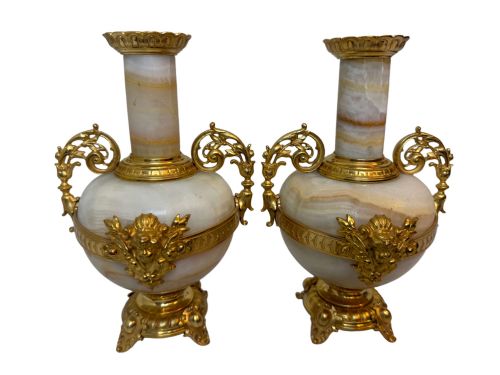


Ormolu and Onyx Urns
Ormolu and onyx urns combine gilded metal and translucent stone to create decorative focal points that bring French elegance to any mantel or table.
Ormolu and Onyx Urns
When you search for ormolu and onyx urns, you are looking at ornamental vessels that merge carved stone bodies with gilded mounts, predominantly originating from French workshops during the nineteenth and early twentieth centuries. These decorative objects frequently appear as pairs or as part of garniture sets alongside matching clocks.
The forms span from classical amphora shapes and cassolettes with reversible lids to dedicated table lamps and mantel clocks. Stylistically, they draw heavily on French Neoclassical, Louis XVI Revival, and Empire designs, reflecting a sustained nineteenth-century fascination with classical antiquity.
You will most commonly encounter pieces dating from the Victorian era through the early nineteen-twenties. The stone body ranges from standard banded onyx to white onyx and marble, paired with gilt bronze, brass, and occasional enamel details.
How they were made
The production of these pieces required close collaboration between stonemasons and metalworkers. Solid onyx or marble was turned on a lathe and hand-polished to a smooth finish, creating the core body of the vase or urn.
Mounts and decorative elements were cast in bronze or brass before undergoing gilding to produce the characteristic ormolu finish. These metal components, including handles, collars, and cherub figures, were then meticulously fitted to the stone body.
Ormolu and Onyx Urns Retail Price Guide 2026
Typical asking prices for ormolu and onyx urns among the pieces listed under this phrase on Sellingantiques today, from the lower quarter to the upper quarter. They describe what is for sale here now, not the wider market.
Listings for this phrase feature pieces spanning from the eighteen-eighties to nineteen-twenty, predominantly utilising onyx, marble, gilt bronze, and brass.
What varies in quality
Quality in these decorative pieces rests largely on the crispness of the metal casting and the richness of the stone. Finer examples display sharply chased ormolu details with deep relief, whereas simpler pieces rely on smoother, unadorned gilt surfaces.
The selection of the stone body also dictates the tier of the piece. Uniformity of grain, subtle natural veining in the onyx or marble, and substantial weight signal superior material selection by the maker.
The Ormolu and Onyx Urns Glossary
- Ormolu
- Gilt bronze produced by applying a mercury and gold amalgam to cast bronze and heating it to drive off the mercury. This technique creates a durable, golden surface finish characteristic of fine French decorative objects.
- Onyx
- A banded variety of chalcedony quartz prized for its smooth texture and translucency. It forms the primary stone body in many nineteenth-century French decorative urns and clock sets.
- Cassolette
- A dual-purpose decorative vessel featuring a reversible lid with a solid side and a burner or bobeche side. They function as both decorative urns and candle holders.
- Garniture
- A set of matching decorative objects, typically comprising a central clock flanked by two urns or cassolettes designed for display on a mantelpiece. These matched suites represent the height of period interior arrangement.
Ormolu and Onyx Urns: Frequently Asked Questions
What is an ormolu and onyx urn?
These decorative objects are nineteenth-century French ornamental vessels that combine carved stone bodies with gilded metal mounts. They were designed primarily for visual display on mantelpieces and tables.
The materials typically include banded onyx or white onyx paired with gilt bronze or brass. Many examples take the form of cassolettes, amphorae, or table lamps.
How were garniture sets used?
Garniture sets served as symmetrical decorative arrangements on nineteenth-century mantelpieces, usually placing a central clock between two matching urns or cassolettes.
This arrangement created a balanced focal point in formal reception rooms. The pieces were selected to complement the architectural style of the interior.
How do I identify French Revival styles?
French Revival styles draw inspiration from earlier periods such as Louis XVI and the Empire era, featuring classical motifs like acanthus leaves, cherubs, and urn shapes.
Craftsmen in the nineteenth century reinterpreted these historical designs using contemporary manufacturing techniques. The resulting pieces balance classical symmetry with ornate nineteenth-century execution.
Can these urns be used as lamps?
Many nineteenth-century urns and cassolettes were later converted into table lamps to suit modern lighting needs. This adaptation allows period stone and gilt bronze to function in contemporary interiors.
Original lamp configurations also exist from the early twentieth century, integrating electrical wiring directly into the classical form.