

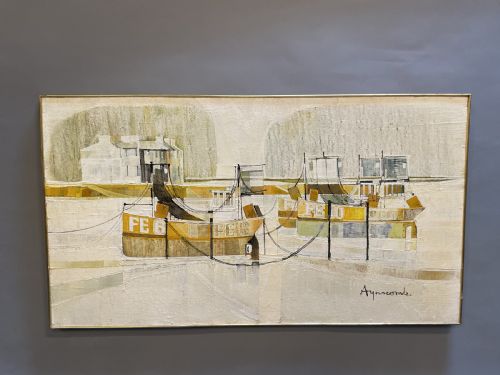


Original Post War Artwork
Original post war artwork captures the creative energy of the mid-century decades, offering buyers authentic paintings that bring period character to any interior.
Original Post War Artwork
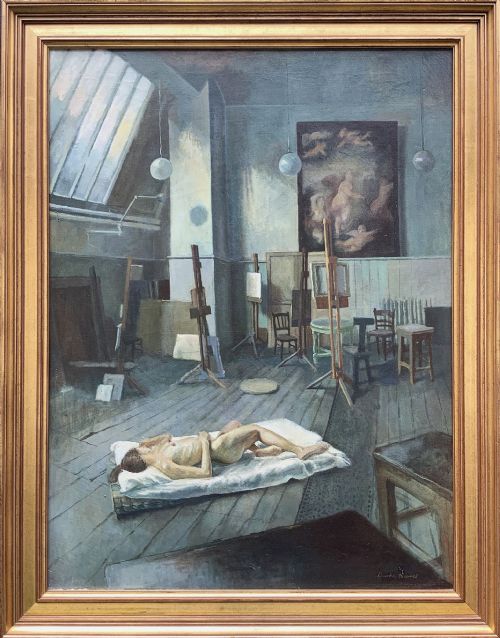
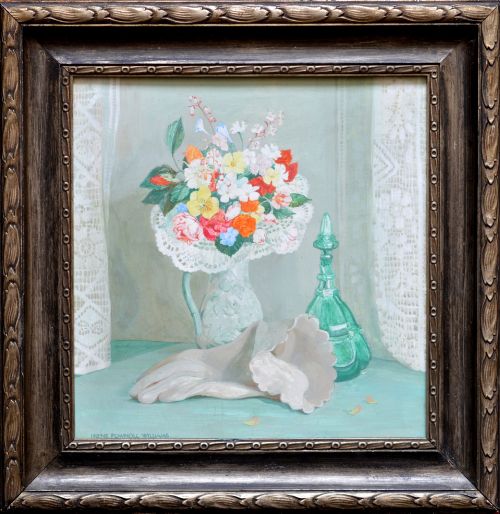
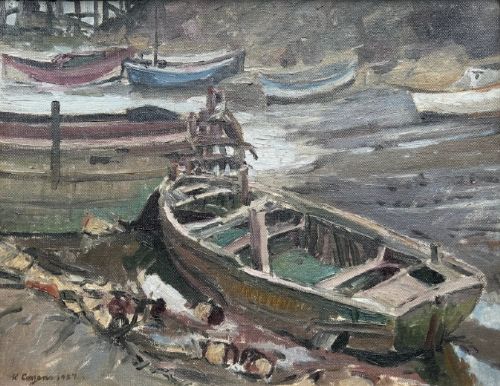
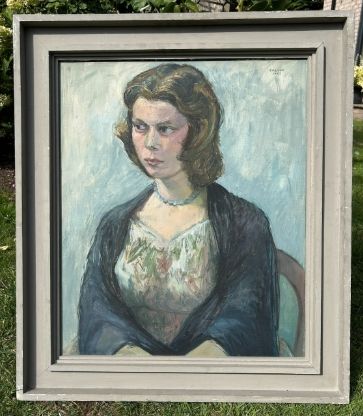
Original post war artwork encompasses paintings created across the 1940s, 1950s, and 1960s, reflecting mid-century modernism, post-impressionism, and constructivism. Buyers seeking original post war artwork will encounter subjects ranging from industrial scenes and maritime landscapes to portraits and still life studies.
The selections span British and European contexts, including St Ives school associations and regional landscapes such as the Norfolk Broads and the River Tees. Works frequently present mid-century portraiture, abstract compositions, and English country house aesthetics.
Most examples date firmly within the 1940s to 1960s timeframe, capturing wartime moments and post-war renewal through distinct stylistic movements.
How these pieces were made
Artists painted primarily using oil paint and watercolour on traditional supports such as canvas, board, wood panels, and paper. These materials interact to produce textured surfaces, particularly when applied in thick layers for maritime landscapes and still life studies.
The application of paint ranges from dynamic abstract strokes to precise tempera techniques on panel and detailed watercolour washes. Framing often involves wood and glass to protect paper and canvas components.
Original Post War Artwork Retail Price Guide 2026
Typical asking prices for original post war artwork among the pieces listed under this phrase on Sellingantiques today, from the lower quarter to the upper quarter. They describe what is for sale here now, not the wider market.
Several paintings capture the exact moment chestnut leaves unfurled in spring.
What varies in quality
Quality rests on the strength of the artist's composition, the clarity of provenance, and the skillful handling of medium and support. Works linked to notable schools or documented makers display more resolved handling of abstract and figurative subjects.
The integrity of the canvas, panel, or board together with the preservation of the original paint surface determines the visual impact of each painting. Stronger pieces combine deliberate brushwork with balanced spatial organisation within mid-century frameworks.
Irene Christobelle Pownoll Williams·Kenneth Cozens·Mark Ingram·Paul-Jean Anderbouhr·Denis Mitchell·James Tower·William McCance·Richards Rubin·John Osborn·John Gilroy
The Original Post War Artwork Glossary
- Board
- A rigid flat support made from wood pulp or compressed material used instead of canvas. It provides a stable surface for oil paint applications.
- Tempera
- A permanent, fast-drying painting medium consisting of coloured pigments mixed with a water-soluble binder. It produces a matte finish well suited to detailed panel works.
- Constructivism
- An artistic and architectural movement that originated in Russia and influenced mid-century industrial and abstract compositions. It prioritises geometric forms and spatial construction.
- Provenance
- The chronological documentation showing the origin, history, and previous ownership of a painting. It establishes authenticity and context for signed works.
- Mid-Century Modern
- A design and art style spanning roughly the middle decades of the twentieth century. It emphasises clean lines, abstracted forms, and progressive palettes.
Original Post War Artwork: Frequently Asked Questions
What periods do these paintings cover?
The works originate predominantly from the 1940s, 1950s, and 1960s, capturing the aesthetic shifts of the mid-century era.
Pieces also reflect earlier twentieth-century moments including wartime reflections and post-war reconstruction.
Which materials were commonly used by artists?
Artists utilised oil paint and watercolour applied to canvas, wood panels, board, and paper supports.
Glass and wood framing frequently accompany the paintings to protect delicate surfaces.
How do I identify a mid-century style?
Styles include mid-century modernism, post-impressionism, abstract landscapes, and constructivist industrial factory scenes.
Compositions often favour simplified forms, expressive brushwork, and structured colour arrangements.