

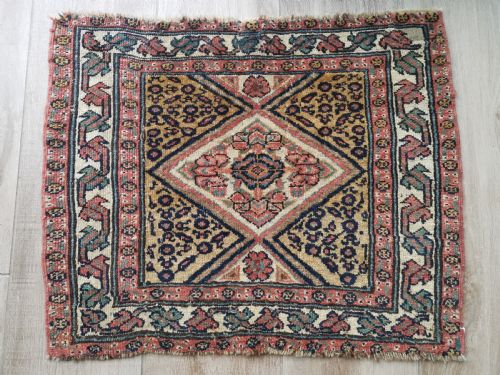


Oriental Tribal Bagface
An oriental tribal bagface brings the woven art of nomadic and village weavers into the home as a striking wall hanging or cushion.
Oriental Tribal Bagface
An oriental tribal bagface is a surviving fragment or panel from a larger nomadic container, such as a torba, storage bag, or saddlebag used by tribes across Central Asia, Persia, and the Caucasus.
Buyers searching for an oriental tribal bagface will most frequently encounter pieces originating from Turkmen groups like the Ersari, Tekke, and Saryk, as well as Shahsevan, Jaf Kurd, Qashqai, and NW Persian weavers.
These textiles date from the nineteenth century up to the early twentieth century, spanning periods from the first half of the nineteenth century through the 1920s.
The forms vary from complete torba faces with backs and dowry weaving to saddlebag fragments and cushion conversions created by nomadic artisans.
Materials and construction
Nomadic weavers utilised hand-spun wool and cotton foundations, building dense structures designed for daily utility and endurance on animal transport or inside tents.
Colour derives from natural dyes applied to wool, producing deep tones characteristic of nineteenth-century tribal weaving traditions from Central Asia and Persia.
Oriental Tribal Bagface Retail Price Guide 2026
Typical asking prices for oriental tribal bagface among the pieces listed under this phrase on Sellingantiques today, from the lower quarter to the upper quarter. They describe what is for sale here now, not the wider market.
Listings span periods from the first half of the nineteenth century through 1920, featuring wool, cotton, and natural dyes.
Assessing quality and weave
The distinction between ordinary and exceptional pieces rests upon the density of the weave, the precision of tribal gul motifs, and the depth of the natural dye palette.
Fine dowry weaving and intact original structures command greater attention from collectors than heavy wear or later alterations.
The Oriental Tribal Bagface Glossary
- Torba
- A small storage bag produced by Turkmen tribes, often used for household storage inside a yurt. Its face is frequently preserved as a decorative textile.
- Gul
- A repeating primary medallion motif used by Turkmen and other tribal weavers to identify specific clans and lineages. Each design carries traditional geometric symbolism.
- Dowry weaving
- Finer, highly detailed textiles created by young women as part of their marriage trousseau. These pieces often exhibit superior handling of materials and technique.
- Saddlebagface
- The visible front panel of a bag designed to be slung over a horse, donkey, or camel. They were separated from their original paired halves over time.
Oriental Tribal Bagface: Frequently Asked Questions
How were these bags used originally?
Nomadic tribes utilised these woven containers for storing household goods, bedding, and personal possessions inside tents or portable dwellings.
Smaller formats functioned as saddlebags for travelling across Central Asian and Persian landscapes during seasonal migrations.
How do I display a bagface at home?
Many collectors mount these textile fragments securely on a wall to display the tribal patterns and natural dyes as flat art. nAlternatively, some pieces are finished as cushions or pillows for placement on seating or beds.
How can I tell different tribal groups apart?
Distinctions rely on the specific gul motifs, colour palettes, and structural characteristics associated with weavers such as the Tekke, Ersari, Shahsevan, or Qashqai.
Each group utilised distinct geometric vocabularies and knotting techniques passed down through generations.