

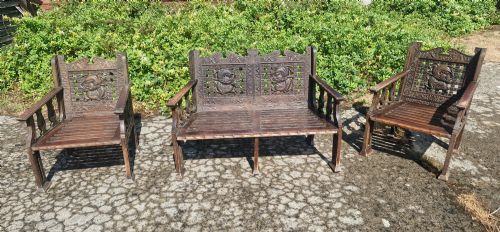


Oriental Garden Seat
These oriental garden seat pieces are sturdy drum-shaped ceramic and hardwood vessels built for both terrace and interior use, offering a distinct sculptural presence.
Oriental Garden Seat
When you search for an oriental garden seat, you encounter cylindrical drum forms that function interchangeably as low tables, accent stools, and terrace seating. The examples recorded here stem primarily from the nineteenth century and the early twentieth century, spanning Chinese Qing Dynasty pieces alongside later Anglo-Indian and Regency Chinoiserie interpretations.
Ceramic forms dominate the selection, including blue and white porcelain, famille rose, rose medallion, and clobbered ironstone variants alongside glazed earthenware. Wooden counterparts appear in denser timbers such as hongmu, teak, and other hardwoods, occasionally incorporating mother-of-pearl inlay or carved Burmese country house constructions.
How they were made
Ceramic garden seats rely on high-fired porcelain or ironstone shaped into hollow barrel silhouettes, finished with hand-painted underglaze blue, enamel palettes, or rich surface glazes. These vessels often feature pierced coin or ring motifs moulded directly into the clay body to allow for lifting and air circulation.
Hardwood examples utilise dense timbers like hongmu and teak, joined through traditional cabinetmaking techniques to form low stands, drum-shaped tables, and structural stools. Artisans embellished these wooden surfaces through deep relief carving or delicate mother-of-pearl inlay embedded into the grain.
Oriental Garden Seat Retail Price Guide 2026
Typical asking prices for oriental garden seat among the pieces listed under this phrase on Sellingantiques today, from the lower quarter to the upper quarter. They describe what is for sale here now, not the wider market.
Several nineteenth-century ironstone seats carry European clobbered overglaze paint, proving that historical decorators simply could not resist adding extra colour.
What varies in quality
The distinction between standard production and superior craftsmanship lies in the execution of the surface decoration, whether through the precision of hand-painted porcelain enamels or the depth of hardwood carving. Ceramic pieces with crisp cobalt pigments or finely layered famille rose palettes demonstrate greater artisan investment than plain glazed alternatives.
Structural integrity and material selection further define the hierarchy of these objects, particularly in wooden barrel forms where dense hongmu and intricate mother-of-pearl inlay elevate the piece beyond utilitarian function. Ironstone examples featuring secondary clobbered overglaze decoration represent distinct decorative phases that alter the visual weight of the item.
The Oriental Garden Seat Glossary
- Hongmu
- A dense, dark tropical hardwood traditionally used in fine Chinese furniture and barrel-form stands.
- Famille Rose
- A major palette of Chinese ceramic overglaze enamels featuring an opaque pink introduced during the Qing Dynasty.
- Clobbered
- Refers to older blue and white porcelain or ironstone later embellished with additional overglaze colours in European workshops.
- Rose Medallion
- A distinct Chinese porcelain decoration style divided into panels filled with figures, birds, and flowers around a central medallion.
- Barrel Form
- The characteristic cylindrical, swelling silhouette shared by traditional drum seats and low occasional tables.
Oriental Garden Seat: Frequently Asked Questions
Where should I place an oriental garden seat?
These pieces suit both covered outdoor terraces and interior reception spaces where they function as movable seating or low display surfaces.
Their compact cylindrical proportions allow them to fit easily beside larger armchairs or serve as standalone accents in hallways.
Can ceramic garden seats stay outside in winter?
Traditional ceramic and ironstone bodies absorb moisture over time, making them vulnerable to cracking during sustained freezing temperatures.
Moving glazed porcelain and ceramic stools indoors or under protected porches during winter preserves the integrity of the glaze and clay.
How do I tell wood from ceramic versions?
Ceramic and ironstone examples display glazed surfaces, painted enamel motifs, and hollow resonant bodies designed originally for damp ground.
Wooden variants utilise dense timbers like teak and hongmu, often featuring visible grain patterns, joinery, and carved relief work.
What is the purpose of the holes in ceramic seats?
The pierced openings in ceramic barrels originally served practical functions for lifting the heavy vessels and allowing air circulation.
These apertures also lighten the visual mass of the drum silhouette and prevent pressure build-up during the high-temperature firing process.