
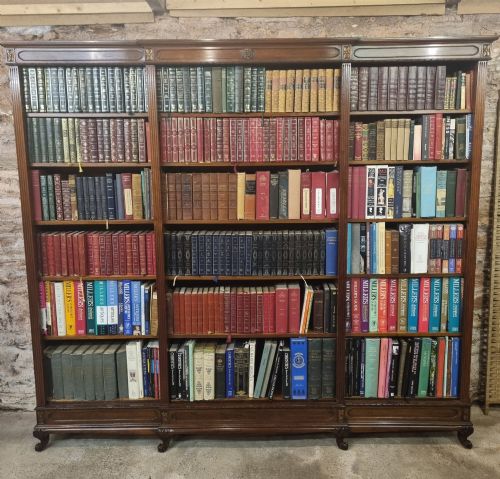
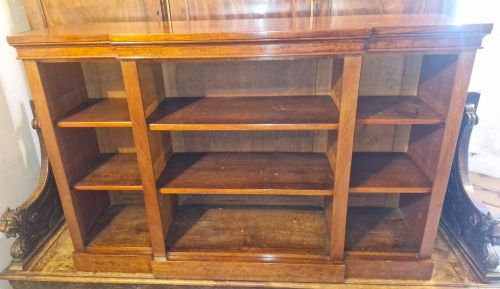
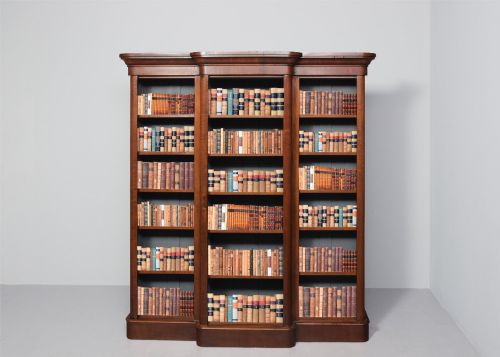
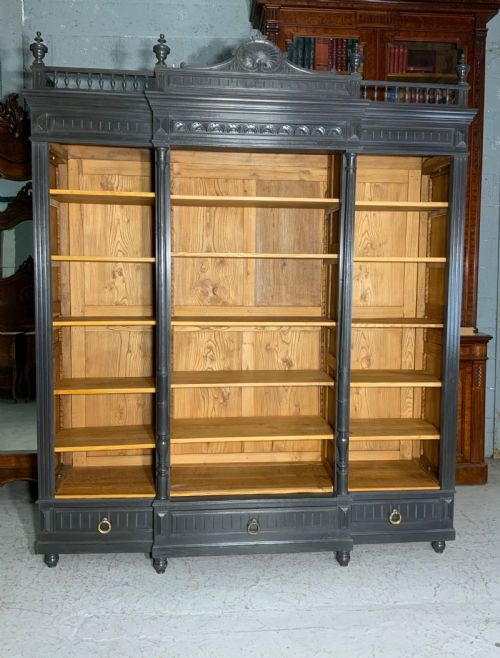
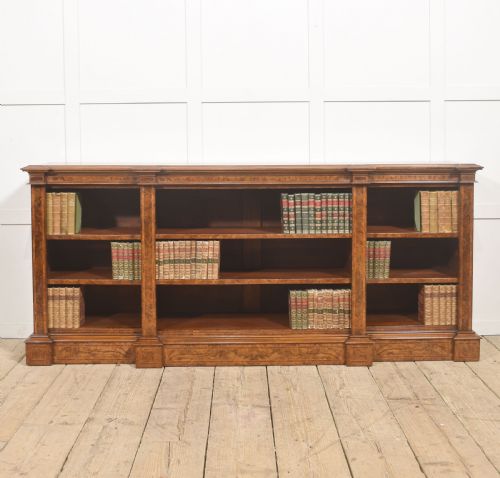
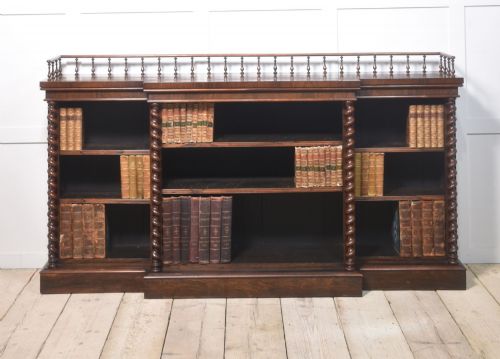


Open Breakfront Bookshelf
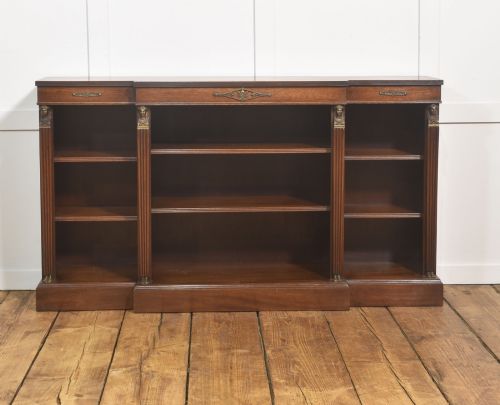
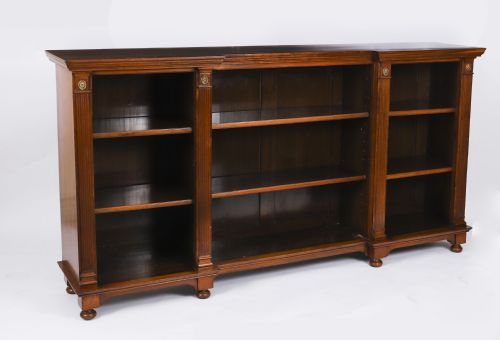
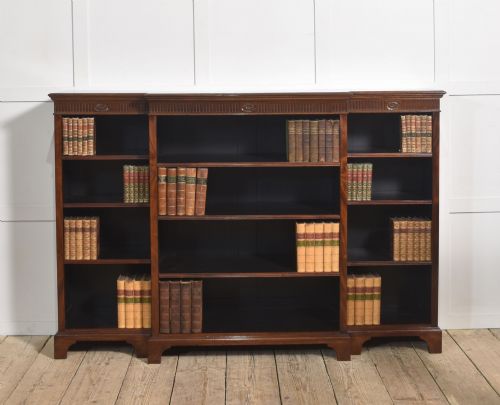
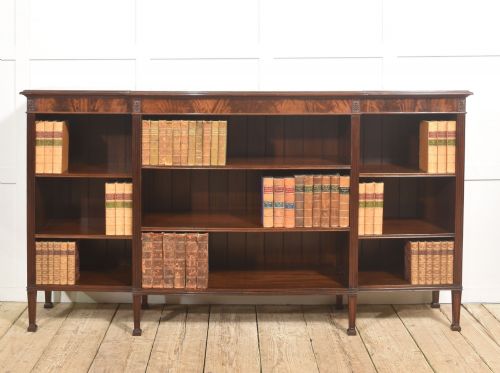
An open breakfront bookshelf organises a room with recessed central shelving flanked by projecting bays, built to hold large library collections.
Open Breakfront Bookshelf
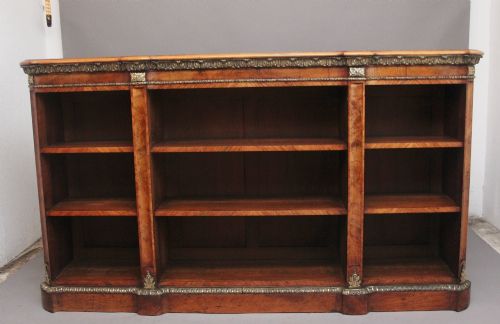
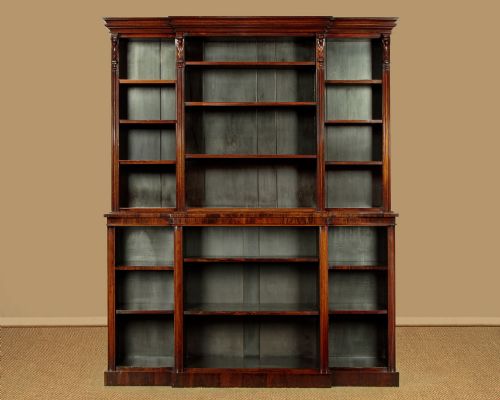
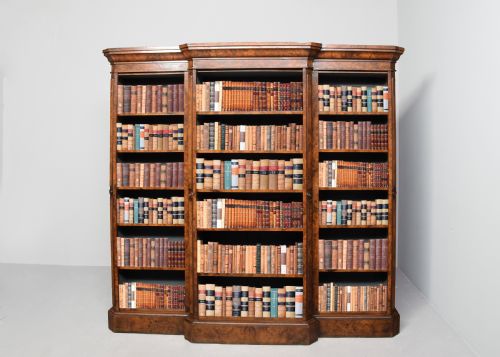
An open breakfront bookshelf provides wall storage for volumes without the barrier of glass or solid doors, keeping texts immediately accessible. These pieces project forward in distinct sections, typically showing a central bay flanked by wings that create depth along a wall.
The versions met most frequently on this page date from the nineteenth and early twentieth centuries, spanning Victorian, Regency, and Edwardian periods. Mahogany and rosewood form the main structural choices, alongside walnut and burr walnut, reflecting the preference for rich timbers in domestic libraries.
How they were made
Cabinet makers constructed these large library pieces using dense hardwoods like mahogany and rosewood, frequently incorporating burr walnut veneers to introduce varied grain patterns across the broad front panels. Satinwood crossbanding and marquetry inlay added delicate contrast to the main timber surfaces.
Ormolu mounts, brass details, and marble tops appear on selected examples, providing metallic and stone accents that elevate the formal character of the furniture. Adjustable shelving systems allowed owners to alter shelf heights for volumes of different sizes.
Listings feature mahogany, rosewood, walnut, and burr walnut, spanning the Victorian, Regency, and Edwardian periods.
What varies in quality
The standard of timber selection and veneer matching defines the upper tier of these bookcases, where grain patterns flow symmetrically across the breakfront sections. Superior workshop execution shows in the crispness of brass mounts, fine marquetry inlay, and the precision of adjustable shelf mechanisms.
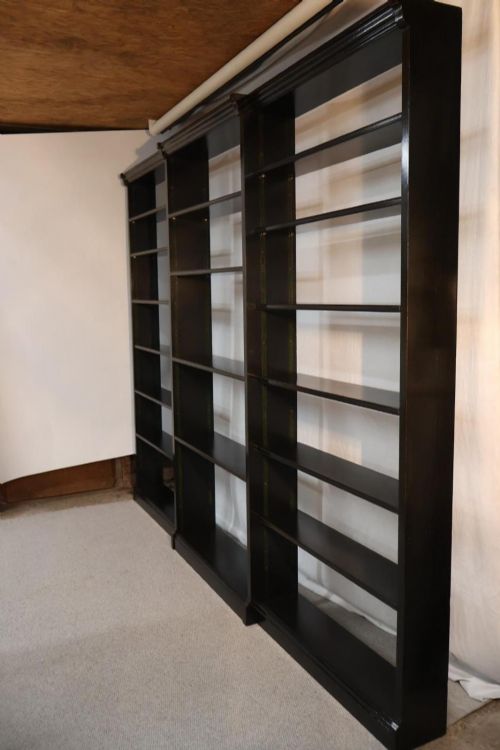
Proportion and scale distinguish finer architectural commissions from standard production pieces, particularly where column pilasters, parcel gilding, or ebonised details are integrated into the design. The handling of the breakfront projection itself determines how successfully the piece commands a room.
Johnstone and Jeanes·Edwards and Roberts
The Open Breakfront Bookshelf Glossary
- Breakfront
- A cabinet configuration where the central section projects forward from the flanking wings. This architectural arrangement creates visual depth and breaks the linear monotony of long library walls.
- Ormolu
- Gilded bronze ornamentation applied to furniture as mounts and decorative details. It provides a bright metallic contrast against dark hardwoods like mahogany and rosewood.
- Crossbanding
- A strip of veneer applied perpendicularly to the grain of the main surface around the borders of a panel. This technique frames the wood and highlights the perimeter.
- Marquetry
- Inlaid wood patterns forming decorative pictures or geometric designs on furniture surfaces. Different coloured timbers are cut and fitted together precisely into the primary ground.
- Ebonised
- Timber treated with a finish to imitate ebony, producing a dense black surface. It appears frequently on nineteenth-century pieces to lend a formal appearance.
Open Breakfront Bookshelf: Frequently Asked Questions
How do I adjust the shelves?
Most period examples use a system of vertical rack strips or wooden support pegs inside the upright partitions.
Shelves lift out entirely so the support brackets can be repositioned at different heights for various book sizes.
Where should I place one?
These large library pieces suit principal reception rooms, studies, or long hallways with adequate wall space.
Because they lack doors, they require placement away from direct sunlight and damp conditions to protect the bindings.
How do I date these pieces?
Dating relies on identifying timber choices, decorative motifs like ormolu mounts or Neoclassical styling, and construction methods.
Victorian and Edwardian versions often display rich walnut or mahogany veneers with adjustable internal shelving.