
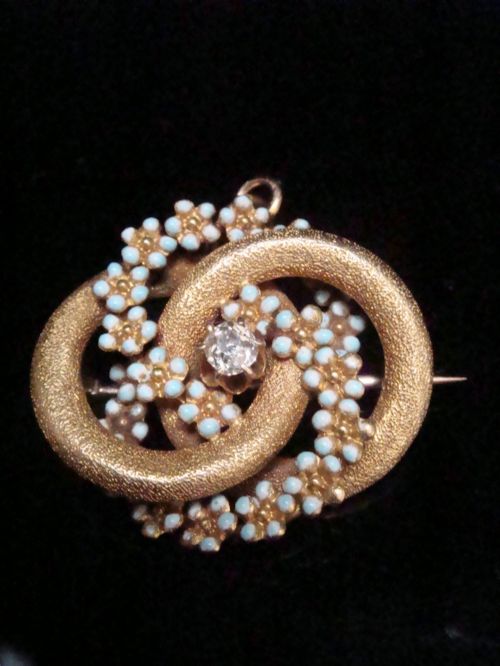


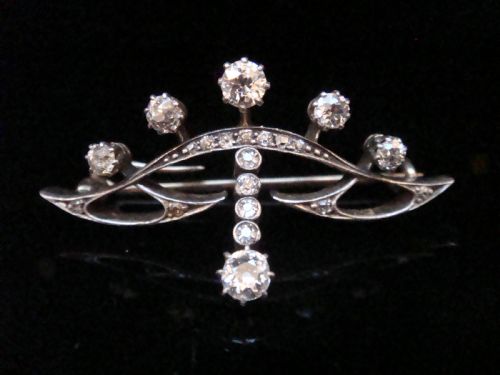


Old Cut Diamond Pin
An old cut diamond pin holds the flickering, warm candlelit sparkle of past centuries against the lapel or fabric.

Old Cut Diamond Pin
An old cut diamond pin is a piece of antique or vintage jewellery designed to fasten garments while displaying hand-faceted diamonds. These items appear primarily as brooches, stickpins, and lapel pins spanning the Victorian, Edwardian, and Art Deco periods.
Buyers will find pieces fashioned into bows, stars, hearts, bars, and floral motifs set with glittering stones. Many examples combine diamonds with natural pearls, sapphires, or coloured gemstones mounted in gold and platinum.
The selection ranges from delicate nineteenth-century stickpins to substantial geometric geometric Art Deco clips and brooches. Each piece reflects the aesthetic priorities of its era, from romantic revivalism to modernist symmetry.
How they were made
Craftsmen shaped these stones by hand using rudimentary wheels, resulting in smaller tables, higher crowns, and open culets that capture ambient light differently than modern round brilliants. Jewellers mounted these diamonds in silver-topped gold during the nineteenth century to whiten the metal appearance against the stones.
Platinum emerged in later Edwardian and Art Deco manufacturing, allowing for intricate piercing and needle-thin wirework that secured large carat weights with minimal visible metal. Cannetille and filigree wire techniques additionally decorated the gold bases of Victorian examples.
Old Cut Diamond Pin Retail Price Guide 2026
Typical asking prices for old cut diamond pin among the pieces listed under this phrase on Sellingantiques today, from the lower quarter to the upper quarter. They describe what is for sale here now, not the wider market.
Several Victorian pins cleverly double as pendants, ensuring your diamonds work overtime whether pinned to a lapel or hung from a chain.
What varies in quality
Quality rests in the harmony of stone selection and the crispness of metalwork. Superior examples display well-matched old cut diamonds with high clarity and lively light return, whereas lesser pieces utilise stones with heavy inclusions or uneven facet symmetry.
The sophistication of the mounting distinguishes the upper tier, seen in platinum work with precise piercing rather than heavy, untidy casting. Original components, secure pin stems, and pristine enamel or pearl accents elevate the desirability of a piece.
TIFFANY & CO.·MAPPIN & WEBB
The Old Cut Diamond Pin Glossary
- Old European cut
- A round diamond shape with a small table, high crown, and large facets typical of the late nineteenth and early twentieth centuries. This cut predates the mathematical precision of the modern brilliant.
- Cannetille
- A Victorian wirework technique resembling fine gold embroidery or lace. It creates voluminous, textured surfaces inspired by seventeenth-century silver thread work.
- Culet
- The small flat facet at the bottom tip of a gemstone. Old cut stones frequently feature a noticeable open culet visible through the table.
- Jabot pin
- A decorative pin originally designed to secure the ruffled jabot trim on cravats or shirts. These items often feature ornamental ends that face each other when pinned.
- Star burst
- A celestial design motif featuring radiating diamond points resembling a twinkling star. This style dominated late Victorian silver-topped cluster brooches.
Old Cut Diamond Pin: Frequently Asked Questions
How do I wear an old cut diamond pin?
These pieces fasten securely to lapels, heavy coat fabrics, scarves, and structured hats using traditional pin stems and safety catches.
For delicate silk or cotton fabrics, support the material from behind with a small backing piece to prevent the weight of larger diamond brooches from pulling the weave.
How can I tell Victorian pins from Art Deco ones?
Victorian examples rely on yellow gold, silver-topped settings, and romantic motifs like flowers, stars, and bows. Cannetille and detailed engraving often adorn the metal surfaces.
Art Deco pieces utilise platinum and white gold with geometric lines, symmetry, and stylised shapes. The metalwork on these later pieces is frequently pierced and lighter in appearance.
What is an old European cut diamond?
An old European cut is a hand-polished diamond shape characterised by a circular girdle, high crown, small table, and open culet. These stones were cut before modern proportions were standardised in the twentieth century.
They produce a distinctive chunky, patterned sparkle under low or candlelight rather than the sharp brilliance of modern stones.
Were these always worn as brooches?
Many items served dual purposes as both pendants and brooches, featuring hidden loops or detachable bails on the reverse. Smaller versions functioned as stickpins or tie pins for securing cravats and lapels.
Conversion pieces and multi-functional designs were common in the nineteenth and early twentieth centuries to maximise the utility of valuable diamond jewellery.